Heads up: some links on this page earn us a commission at no extra cost to you. It does not change what we recommend or the order. How we are funded.
The short answer
Buy a stainless steel rack sized to fit inside a half-sheet pan, with a tight grid rather than parallel bars, and check it is oven safe. That combination does both jobs a rack has: it lifts a bake off a solid surface so steam escapes and the base stays crisp, and it sits inside a sheet pan as a roasting rack so fat drains and air reaches underneath. Avoid chrome-plated racks for oven use, and avoid wide parallel bars, which let small items fall through.
Quick picks
The whole answer, on one screen. Tap a row to jump to the full write-up. Every pick below carries a stated trade-off further down — including the one at the top.
#
Product
Best for
Price
1
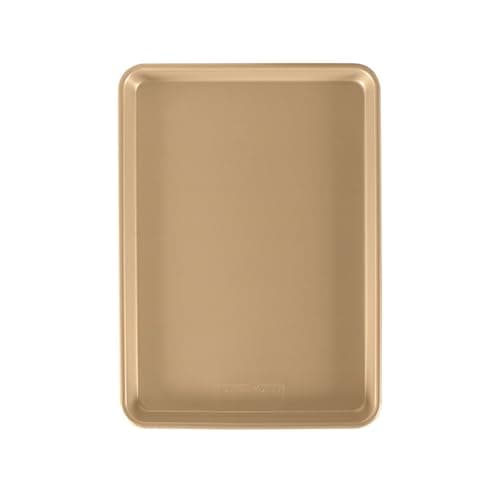
Nordic Ware Naturals Half Sheet, 18 x 13 in
18 by 13 inches with an encapsulated steel rim - the pan a rack should be sized to, and the reason half-sheet is the standard.
Prices last checked October 24, 2026. Prices move constantly — the number on Amazon when you click is the real one.
What we can tell you here
Our audited product ledger contains bakeware rather than a separately audited cooling rack, so no rack appears here as a product card — we only publish a spec table for a product whose manufacturer specifications we have read. The method is here. The pans above are the audited items a rack works with, and racks themselves are pointed at with a tagged category search.
Why a rack matters at all
A hot bake sitting on a solid surface traps its own steam underneath. That steam condenses against the base and softens it — which is how a perfectly crisp cookie ends up with a damp bottom, and why bread left in a tin goes soggy at the base.
A wire grid lets air circulate underneath so the steam leaves. It costs almost nothing and it is the difference between a good bake and a good bake ruined in the ten minutes after it left the oven.
It is also the enforcement mechanism for the timing rule that appears throughout the bakeware hub: ten minutes in the pan, then out. That rule is in how to stop baked goods sticking and it needs somewhere for the bake to go.
The grid pattern, which is the specification
Pattern
What it is
Verdict
Tight cross grid
Wires running both ways at close spacing
Buy this - nothing falls through and it supports thin items
Wide cross grid
Both directions, spaced out
Fine for cakes and loaves, poor for small cookies
Parallel bars only
Wires in one direction
Avoid - small items fall between, and it marks bakes
Perforated sheet
A solid sheet with holes
Less airflow than a grid; better than nothing
A tight cross grid is the only pattern that handles everything from a loaf to a macaron. It is also the pattern that supports food when you use the rack for roasting.
Parallel-bar racks are common because they are cheaper to make. They also let a cookie sag between wires and drop crumbs through, and they leave more pronounced marks on the base of anything soft.
Size it to your sheet pan
This is the buying decision that makes a rack useful twice. A rack sized to fit inside a half-sheet pan — roughly 16.5 by 11.5 inches, sitting inside an 18 by 13 pan — does the second job.
As a cooling rack, it sits on the counter and does the obvious thing.
As a roasting rack, it lifts meat or vegetables off the pan so fat drains away and hot air reaches underneath, which crisps skin all round — best roasting pans makes the case that this beats a dedicated roasting tin for most jobs.
As a draining rack, over a sheet pan, for anything fried — cookware for deep frying. A rack keeps fried food crisp where paper towels steam it.
As a resting rack, for meat coming out of a pan, so the underside does not sit in its own juices.
The half-sheet standard is what makes all of that work, and it is the same reason to standardize on half-sheet parchment and mats — sheet pan sizes explained.
Oven safe is not a given
Many cooling racks are chrome-plated steel, and chrome plating is not intended for sustained oven heat — it can discolor and, over time, flake. A rack you intend to roast on needs to be stainless steel rather than plated.
Stainless steel: oven safe, dishwasher tolerant, and it will not rust. Buy this.
Chrome-plated steel: cheaper, fine for cooling only, and it rusts once the plating is scratched.
Nonstick-coated racks: a coating on a grid, which is a lot of edges for a coating to fail on. Not worth it.
Silicone-coated: check the temperature rating; the coating limits the rack well below what steel tolerates — the same handle-caps-the-pan pattern as oven-safe cookware temperatures.
If a listing does not say oven safe, assume it is not. A rack that is only ever used on a counter can be anything; a rack going into a 425F oven with a chicken on it cannot.
Buy the rack to fit the pan, not the other way round. Half-sheet is the size everything else in a domestic kitchen is built around.
Feet, height and the details
Height. Around half an inch of clearance is enough for cooling. Taller racks hold more air underneath when roasting and are less stable.
Feet at the corners rather than a continuous rim, so the rack sits flat inside a pan without rocking.
Welded joints, not clipped. Clipped grids loosen and trap food in the joins.
Stackable racks are useful if you bake in volume and have counter space for one rack rather than three.
Dishwasher safe, which stainless is and which matters because a roasting rack gets genuinely greasy.
Using it well
Two habits do most of the work. First, get the bake onto the rack rather than leaving it in the pan — the whole point is airflow underneath, and a cake cooling in its tin gets none. Second, do not cover something hot on a rack, because a cloth over it traps the steam you just released.
For roasting, put the rack in the sheet pan rather than directly on the oven shelf. Fat needs somewhere to go, and a pan underneath is the difference between drained fat and a smoking oven floor.
Which to buy
One stainless half-sheet rack with a tight cross grid, oven safe. This is the whole recommendation.
A second one if you bake cookies in batches, since one rack becomes the bottleneck.
Skip nonstick-coated and chrome-plated racks if the rack will ever see an oven.
The audited bakeware a rack works with
Racks are recommended here as a category, via a tagged search, because we have not audited a specific model. Buy one sized to fit the half sheet above.
Nordic Ware Naturals Half Sheet, 18 x 13 in
Roasting vegetables, sheet-pan dinners, cookies - the pan you use most weeks
Each write-up below gives the published specs, what the pan is genuinely good at, what it costs you, and who should skip it. The trade-off line is there on the top pick too — a recommendation with no downside is an advertisement.
Top pick · Best cooling rack pairingSpecs read September 3, 2026
Nordic Ware Naturals Half Sheet, 18 x 13 in
18 by 13 inches with an encapsulated steel rim - the pan a rack should be sized to, and the reason half-sheet is the standard.
Best for: Roasting vegetables, sheet-pan dinners, cookies - the pan you use most weeks
Published specifications for the Nordic Ware Naturals Half Sheet, 18 x 13 in
Exterior dimensions
17.9 x 12.9 x 1 in
Material
Aluminum
Rim
Encapsulated steel rim
Gauge
Not published by Nordic Ware
Warranty
Lifetime
Dishwasher
Hand wash recommended. Automatic dishwasher use is not advised
Made in
America of domestic and imported materials
Good
Aluminum conducts at 237 W/m-K, which is why it browns evenly and a steel pan does not
The encapsulated steel rim is the reason it does not warp in a hot oven
Lifetime warranty on a pan this cheap
Not good
Nordic Ware does not publish a gauge figure, so thickness cannot be compared like for like
Bare aluminum stains and reacts with acid
Not dishwasher safe by the maker's own advice
The trade-off. Bare aluminum discolors and reacts with acid. It will look used within a month and Nordic Ware advises against the dishwasher.
Skip this if. You want a pan that stays looking new, or you will not hand wash. Buy an aluminized-steel coated pan instead and accept the coating as a wear item.
Stainless steel rather than chrome-plated, a tight cross grid rather than parallel bars, and a size that fits inside a half-sheet pan. That combination cools bakes, roasts with fat draining underneath, and drains fried food.
›Why do baked goods need a cooling rack?
A hot bake on a solid surface traps its own steam underneath, and that steam condenses and softens the base. A wire grid lets air circulate so the steam leaves, which is the difference between a crisp base and a damp one.
›Are cooling racks oven safe?
Only some. Stainless steel racks are; chrome-plated ones are not intended for sustained oven heat and can discolor or flake. If a listing does not say oven safe, assume it is not - it matters if you plan to roast on it.
›What size cooling rack should I buy?
One sized to fit inside a half-sheet pan - roughly 16.5 by 11.5 inches inside an 18 by 13 pan. That makes it useful twice, as a cooling rack on the counter and as a roasting or draining rack inside the pan.
›Can you use a cooling rack as a roasting rack?
Yes, if it is stainless and oven safe, and it is the main reason to buy one that fits a sheet pan. It lifts food off the base so fat drains and hot air reaches underneath, which crisps skin all the way round.
Sources
Every figure on this page came from one of these. Follow them and check our arithmetic — that is the point.