Heads up: some links on this page earn us a commission at no extra cost to you. It does not change what we recommend or the order. How we are funded.
The short answer
Name
Approximate size
Fits a domestic oven?
Full sheet
26 x 18 in
No - commercial ovens only
Half sheet
18 x 13 in
Yes - the standard to buy
Quarter sheet
13 x 9 in
Yes - useful as a second pan
Eighth sheet
9 x 6 in
Yes - toaster ovens and small tasks
Jelly roll
15 x 10 in
Yes - a shallower, older standard
Cookie sheet
Varies, usually rimless or one rim
Yes - a different tool, not a size
Where the names come from
The sizes are commercial. A full sheet, at roughly 26 by 18 inches, is built to fit a commercial oven rack and a standard bakery trolley. Every other size is a fraction of it: a half sheet is half a full sheet, a quarter sheet is a quarter, and so on.
That matters because it explains the odd dimensions and because it tells you what to ignore. A full sheet will not fit a domestic oven - most are around 30 inches wide internally at best, and a full sheet needs clearance on all sides for air to circulate.
Every size, and what it is for
Size
Dimensions
Rim
What it does
Full sheet
26 x 18 in
1 in
Commercial only. Will not fit a domestic oven
Half sheet
18 x 13 in
1 in
The domestic standard. Roasting, cookies, sheet-pan dinners
Quarter sheet
13 x 9 in
1 in
Small batches, toaster ovens, a second pan for one item
Eighth sheet
9 x 6 in
1 in
Toaster ovens, toasting nuts, reheating
Jelly roll
15 x 10 in
0.75 to 1 in
An older domestic standard; fine, and less widely stocked
Two-thirds sheet
21 x 15 in
1 in
Fits some larger domestic ovens; check yours first
Dimensions are nominal and vary slightly by maker - Nordic Ware publishes 17.9 x 12.9 x 1 in for its half sheet, which is typical.
Measure your oven before buying anything larger than a half sheet. You need at least an inch of clearance on every side for air to move, and a pan that touches the walls bakes unevenly and is difficult to remove when hot.
A cookie sheet is not a size
A cookie sheet is a different tool: flat, with a rim on only one or two edges, or none at all. The point is that hot air reaches the food from every direction and you can slide cookies off without lifting them over a wall.
It is genuinely better for cookies and useless for anything that releases liquid or fat, because there is nothing to contain it. If you own one sheet pan, own a rimmed half sheet - it does both jobs adequately and one of them very well.
How many to own
Two half sheets, and this is one of the few unequivocal recommendations on this site.
Roasting is limited by surface area, not by oven capacity. Two pans genuinely double what you can roast at once, which is the argument in cookware for batch cooking.
Cookies bake in batches, and a second pan means one is loading while one is baking.
One goes under things. Under a muffin tin, under a pie, under a loose-bottomed tart tin, under anything that might drip.
They cost very little and stack flat, so a third is not a burden.
A quarter sheet is a useful addition rather than a substitute: it suits a toaster oven, a small batch, or toasting a handful of nuts without heating a full pan.
Material, briefly
Bare aluminum with an encapsulated steel rim is the answer, and the reasoning is in sheet pan materials. Aluminum conducts at roughly 237 watts per meter-kelvin, which browns bases; the steel rim is what stops a loaded pan buckling in a hot oven.
What to avoid at any size: thin pans without a reinforced rim, which warp and bang; and dark coated pans unless you know to drop the oven by about 25F, since dark surfaces absorb more radiant heat.
Warping, and why rims matter
The bang from the oven halfway through roasting is a thin pan buckling under uneven heat and springing back. It is startling, it tips oil into a corner, and over time it leaves a pan that never sits flat.
The fix is structural: a rolled steel wire encapsulated in the rim stiffens the perimeter. Nordic Ware publishes this construction and it is the specification worth buying on, since almost nobody publishes gauge - our Nordic Ware review covers that gap.
Fitting things inside them
Accessories are sized to the pan, which is another reason the half sheet is worth standardizing on:
Wire racks sized to fit inside a half sheet, for roasting, cooling and draining.
Silicone mats cut to half-sheet dimensions, which replace parchment for repeated use - is silicone bakeware safe.
Pre-cut parchment sheets, which are sold in half-sheet size and save cutting a roll.
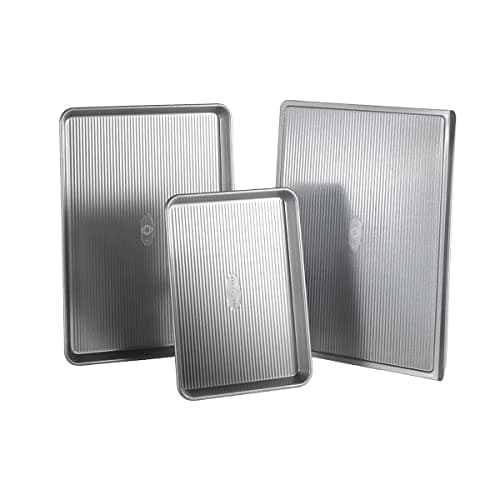
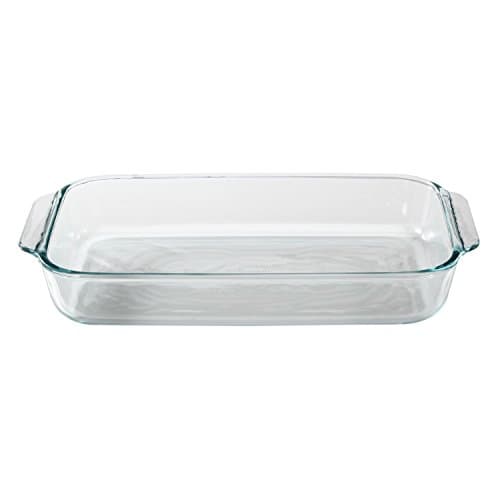
A 9 by 13 glass dish shares a footprint with a quarter sheet and does a completely different job. Depth is what separates a sheet pan from a baking dish.
Nordic Ware Naturals Half Sheet, 18 x 13 in
Roasting vegetables, sheet-pan dinners, cookies - the pan you use most weeks
These are the products this page's reasoning actually points at. Same rules as everywhere else on the site: published specs, a stated trade-off, and a live price only where one exists.
Top pick · The size to buy, twiceSpecs read September 3, 2026
Nordic Ware Naturals Half Sheet, 18 x 13 in
18 by 13 inches of bare aluminum with an encapsulated steel rim - the pan this site recommends more often than any other.
Best for: Roasting vegetables, sheet-pan dinners, cookies - the pan you use most weeks
Published specifications for the Nordic Ware Naturals Half Sheet, 18 x 13 in
Exterior dimensions
17.9 x 12.9 x 1 in
Material
Aluminum
Rim
Encapsulated steel rim
Gauge
Not published by Nordic Ware
Warranty
Lifetime
Dishwasher
Hand wash recommended. Automatic dishwasher use is not advised
Made in
America of domestic and imported materials
Good
Aluminum conducts at 237 W/m-K, which is why it browns evenly and a steel pan does not
The encapsulated steel rim is the reason it does not warp in a hot oven
Lifetime warranty on a pan this cheap
Not good
Nordic Ware does not publish a gauge figure, so thickness cannot be compared like for like
Bare aluminum stains and reacts with acid
Not dishwasher safe by the maker's own advice
The trade-off. Bare aluminum discolors and reacts with acid. It will look used within a month and Nordic Ware advises against the dishwasher.
Skip this if. You want a pan that stays looking new, or you will not hand wash. Buy an aluminized-steel coated pan instead and accept the coating as a wear item.
About 18 by 13 inches with a 1-inch rim - Nordic Ware publishes 17.9 x 12.9 x 1 in for its Naturals half sheet. It is half a commercial full sheet, and it is the size that fits a domestic oven with room for air to circulate.
›Will a full sheet pan fit in a home oven?
No. A full sheet is about 26 by 18 inches and is built for commercial ovens and bakery trolleys. Domestic ovens do not leave enough clearance around it for air to move, which is why the half sheet is the domestic standard.
›How many sheet pans do you need?
Two half sheets. Roasting is limited by surface area rather than oven capacity, so a second pan genuinely doubles what you can cook at once, and one is always going under something - a muffin tin, a pie, a loose-bottomed tart.
›What is the difference between a cookie sheet and a sheet pan?
A cookie sheet is flat with a rim on only one or two edges, or none, so air reaches food from every side and you can slide cookies off. It is better for cookies and useless for anything that releases liquid or fat.
›What is a jelly roll pan?
An older domestic standard at about 15 by 10 inches with a slightly shallower rim than a half sheet. It works perfectly well and is less widely stocked, and accessories like racks and mats are sized to half sheets rather than to it.
Sources
Every figure on this page came from one of these. Follow them and check our arithmetic — that is the point.