Heads up: some links on this page earn us a commission at no extra cost to you. It does not change what we recommend or the order. How we are funded.
The short answer
A quarter sheet pan, 13 by 9 inches, is the standard size for a full-size countertop oven. An eighth sheet suits smaller ones.
Leave at least an inch of clearance on every side, and more above - the element is close and airflow is what stops hot spots.
Metal is the safest material. Glass and ceramic are more exposed to direct radiant heat here than in a full oven.
Check the oven's own manual. Several makers publish what may and may not be used inside, and it is worth reading once.
A small oven has two constraints, not one
The obvious one is footprint: the pan has to fit. The less obvious one is proximity. In a countertop oven the heating elements sit a few inches from the food rather than a foot away, so radiant heat is far more intense and far more direct.
That second constraint is what people get wrong. A pan that behaves perfectly in a full oven can scorch on top, and a material with a thermal-shock limit is under more stress than it would be in a conventional oven.
What fits
Pan
Size
Fits a countertop oven?
Quarter sheet
13 x 9 in
Yes in most full-size countertop ovens - the standard choice
Eighth sheet
9 x 6 in
Yes in nearly all of them
Half sheet
18 x 13 in
No in almost all of them
8 in round cake pan
8 in
Usually yes
9 in round cake pan
9 in
Often too tight - measure first
1 lb loaf pan
About 8.5 x 4.5 in
Usually yes
2 lb loaf pan
About 10 x 5 in
Often too long
9 x 13 baking dish
9 x 13 in
Rarely, and rarely with clearance
6-cup muffin pan
Varies
Usually yes - a twelve-cup pan usually does not
Measure the interior of your oven, not the exterior, and subtract two inches from each dimension for clearance before shopping.
The rack matters as much as the cavity. Many countertop ovens have a single rack position that is genuinely usable for baking, and a tall pan on it puts the food inches from the top element. Check where the rack sits before assuming a deep pan will work.
The clearance rule
Leave at least an inch on every side and as much as you can above. Air has to circulate for the oven to work as an oven rather than as a grill, and a pan that touches the walls conducts heat straight into them and bakes unevenly.
It is also a practical matter: a pan with no clearance is very difficult to remove when hot, in an appliance where every surface is close to your hands.
Materials, and why metal wins here
Metal - the default
Aluminum and aluminized steel handle direct radiant heat without complaint and there is nothing to shock. A quarter-sheet pan in bare aluminum is the single most useful item for a countertop oven, for the same conduction reasons set out in sheet pan materials.
One caution: dark coated pans absorb more radiant heat, and in a small oven with a close element that effect is amplified. Drop the temperature by about 25F or expect fast browning on top.
Glass and ceramic - check first
Both are more exposed here than in a full oven, because the element is close and direct. Pyrex publishes that glass bakeware is not broiler safe, and a top element a few inches away is closer to a broiler than to conventional oven heat. Several toaster oven manufacturers publish guidance about glass in their own manuals - read it.
Silicone is rated to a temperature but not to direct radiant contact, and the top element in a small oven can exceed what a mat or mold is rated for. Keep silicone well away from the upper element, and never use it under a broil setting - is silicone bakeware safe covers ratings.
Cast iron - it fits and it is heavy
A small cast iron skillet works well in a countertop oven and is excellent for a single portion. Check the weight rating of the rack, and expect it to take longer to preheat than the oven does.
What changes about baking
Things brown faster on top. The element is closer. Check earlier than a recipe says and tent with foil if the top is running ahead.
Recovery is slower. A small cavity loses more of its heat when you open the door, so open it less.
Hot spots are more pronounced. Rotating the pan halfway matters more than it does in a full oven.
Preheat properly. Small ovens report temperature before they have genuinely stabilized.
Convection settings help. If yours has a fan, it evens out the hot spots and often lets you drop the temperature slightly.
What to own for one
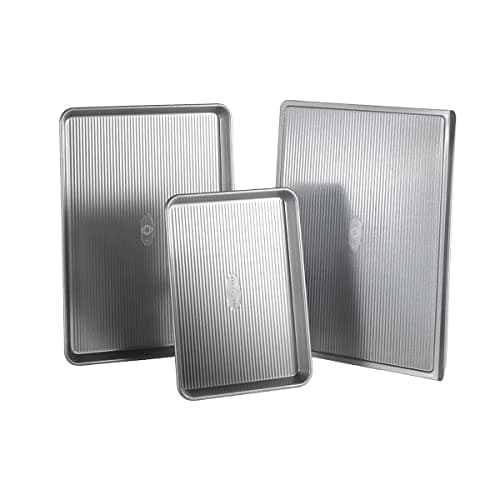
Two quarter-sheet pans - the same argument as two half sheets in a full oven, made in cookware for batch cooking.
A small wire rack that fits inside one, for roasting and reheating.
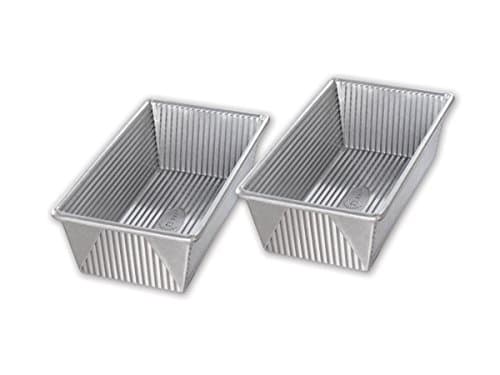
A 1 lb loaf pan, which is the size that fits and the size recipes assume.
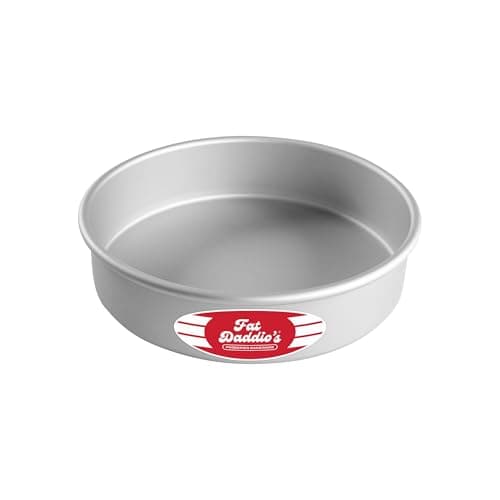
An 8-inch round, if you bake cakes.
Pre-cut parchment, trimmed to your pan, which saves cutting a roll every time.
These are the products this page's reasoning actually points at. Same rules as everywhere else on the site: published specs, a stated trade-off, and a live price only where one exists.
Top pick · The full-size referenceSpecs read September 3, 2026
Nordic Ware Naturals Half Sheet, 18 x 13 in
18 by 13 inches will not fit most countertop ovens - it is here to size against, and a quarter sheet is the version that does.
Best for: Roasting vegetables, sheet-pan dinners, cookies - the pan you use most weeks
Published specifications for the Nordic Ware Naturals Half Sheet, 18 x 13 in
Exterior dimensions
17.9 x 12.9 x 1 in
Material
Aluminum
Rim
Encapsulated steel rim
Gauge
Not published by Nordic Ware
Warranty
Lifetime
Dishwasher
Hand wash recommended. Automatic dishwasher use is not advised
Made in
America of domestic and imported materials
Good
Aluminum conducts at 237 W/m-K, which is why it browns evenly and a steel pan does not
The encapsulated steel rim is the reason it does not warp in a hot oven
Lifetime warranty on a pan this cheap
Not good
Nordic Ware does not publish a gauge figure, so thickness cannot be compared like for like
Bare aluminum stains and reacts with acid
Not dishwasher safe by the maker's own advice
The trade-off. Bare aluminum discolors and reacts with acid. It will look used within a month and Nordic Ware advises against the dishwasher.
Skip this if. You want a pan that stays looking new, or you will not hand wash. Buy an aluminized-steel coated pan instead and accept the coating as a wear item.
A quarter sheet pan at 13 by 9 inches fits most full-size countertop ovens; an eighth sheet at 9 by 6 fits nearly all of them. Measure the interior and subtract about two inches from each dimension for clearance before buying.
›Can you use glass bakeware in a toaster oven?
Check the oven's manual first, and keep glass away from the top element on a lower rack position. The element sits inches from the food, which is closer to broiler conditions than to conventional oven heat, and Pyrex publishes that glass is not broiler safe.
›Why does food brown faster in a toaster oven?
The heating element is a few inches from the food rather than a foot away, so radiant heat is far more intense and direct. Check earlier than the recipe says, and tent with foil if the top is running ahead of the middle.
›Can you use silicone bakeware in a toaster oven?
Keep it well away from the upper element. Silicone is rated to a temperature but not to direct radiant contact, and a close top element can exceed what a mat or mold is rated for. Never use it under a broil setting.
›Does a metal or dark pan work better in a small oven?
Metal, and preferably light-colored. Dark coated pans absorb more radiant heat, and in a small cavity with a close element that effect is amplified - drop the temperature by about 25F or expect fast top browning.
Sources
Every figure on this page came from one of these. Follow them and check our arithmetic — that is the point.