Heads up: some links on this page earn us a commission at no extra cost to you. It does not change what we recommend or the order. How we are funded.
The short answer
Stoneware and ceramic hold heat far better than metal or glass and conduct it far worse. That makes them excellent for dishes you want to stay hot at the table and for long slow bakes, and poor for anything that needs a browned, crisp base. Glazed ceramic is non-reactive, so acidic dishes are fine. The real constraint is thermal shock: no preheated empty dish, no cold liquid into a hot one, no hot dish onto a wet counter.
What this covers
Stoneware, porcelain and earthenware baking dishes - the glazed ceramic gratin dishes, casseroles, pie plates and ramekins that sit between glass and enameled cast iron in most kitchens. Our ledger has audited glass and metal bakeware and enameled cast iron, and no separately audited ceramic dish, so this page explains the material and points at searches rather than naming models we have not checked - the method is here.
How ceramic bakes
The defining property is that ceramic conducts heat poorly and stores it well. Metal is the opposite: aluminum conducts at roughly 237 watts per meter-kelvin and holds comparatively little. Glass sits between them, closer to ceramic.
Aluminum
Glass
Stoneware and ceramic
Enameled cast iron
Conducts heat
Very well
Poorly
Poorly
Moderately
Stores heat
Little
Some
A lot
A great deal
Browns a base
Best
Slowly and pale
Slowly and pale
Well
Stays hot at the table
No
Somewhat
Yes - this is its advantage
Yes
Non-reactive
No - it reacts with acid
Yes
Yes, if glazed
Yes
Broiler
Yes
No
Usually not - check the maker
No
Thermal shock risk
None
Real and published
Real
Real
Stovetop
Sheet pans no; clad pans yes
No
No
Yes
The third and fourth rows are the whole decision. Ceramic trades browning for heat retention, and whether that is a good trade depends entirely on the dish.
Where ceramic genuinely wins
Anything served from the dish. Gratins, lasagne, baked pasta, crumbles - all of them arrive at the table hot and stay hot, and the dish looks better than a metal tin.
Long slow bakes. Where you want steady gentle heat rather than fast browning, poor conduction becomes a virtue.
Acidic dishes. Glazed ceramic is non-reactive, so tomato, wine and citrus are a non-issue - unlike bare aluminum, which reacts.
Individual portions. Ramekins, cocottes and small gratin dishes have no practical equivalent in metal.
Bread with a lid. A covered ceramic baker traps steam much as an enameled Dutch oven does, at less weight - though with less thermal mass.
Where it loses
Anywhere you want a crisp, browned base. A pie in ceramic browns slowly on the bottom; roasted vegetables in a ceramic dish steam more and caramelize less than the same vegetables on a bare aluminum sheet pan.
It is also heavy, it chips, and it cannot go on a burner. If the reason you want ceramic is heat retention plus oven-to-table looks, enameled cast iron does both better and browns on the stove first - the comparison is in stainless steel versus enameled cast iron and the pots are in best enameled Dutch ovens.
Thermal shock, which is the real rule
Ceramic does not have a temperature ceiling so much as a rate-of-change limit, exactly as glass does. Pyrex publishes this for glass bakeware and it is a genuine breakage mechanism rather than a legal disclaimer - glass versus metal bakeware.
It is also the reason the small-vessel end of this category is worth reading carefully: the ramekins we audited mostly publish no maximum oven temperature at all, and only one of the three mentions thermal shock.
Do not preheat an empty ceramic dish, unless the maker specifically publishes that you can.
Do not add cold liquid to a hot dish, which is the classic gratin failure.
Do not put a hot dish on a wet or cold counter. Use a dry board or a cloth.
Do not take a dish from the refrigerator straight into a hot oven. Let it stand while the oven heats.
No broiler, unless the maker publishes broiler safety - most do not.
Unglazed stoneware behaves differently again: some of it is designed to be soaked before use so the water turns to steam in the oven. That is a specific product instruction, not a general rule, and it applies to very few dishes. Read what the maker publishes.
Glazed and unglazed
The glaze is a glass layer fused to the clay body, and it does the same job enamel does on cast iron: it makes the surface non-porous, non-reactive and cleanable.
Glazed is what almost all modern ceramic bakeware is. Non-reactive, washable, and it will chip on impact like any glass surface.
Unglazed or partially glazed is porous, absorbs oil and odor over time, and often stains permanently. Some bread bakers prefer it deliberately.
Crazing - a fine crack network in an intact glaze - is normal aging and not a failure, the same as on enameled cast iron.
On lead and cadmium: the reasonable version of that concern applies to decorative or unbranded imported earthenware rather than to bakeware from manufacturers who publish food-safe formulations. Buy from a maker that documents its materials, which is the same standard applied in non-toxic bakeware.
Care
Let it cool before washing. Thermal shock at the sink is as real as thermal shock in the oven.
Hot water, detergent, a soft brush. Most glazed ceramic is dishwasher safe; check the maker.
For baked-on food, soak it. Never use a metal scourer on a glaze.
Baking soda paste lifts stains from a glaze without scratching it.
Store it where it will not be knocked. Chips are the failure mode, and they are permanent.
The care routine is the same one enameled cast iron gets, for the same reason: both surfaces are glass, and glass minds impact rather than detergent.
What to buy
For lasagne, gratins and oven-to-table: one glazed ceramic dish around 9 by 13 inches, or a glass dish if seeing the base matters more than presentation.
If you want heat retention and versatility:an enameled Dutch oven, which does everything ceramic does and browns on the stove.
Ramekins, which have no metal equivalent and are worth owning if you make individual desserts.
The audited alternatives to ceramic
Glass for seeing the base, aluminum for browning it, enameled iron for heat retention with stovetop use. Ceramic sits between them and wins on presentation.
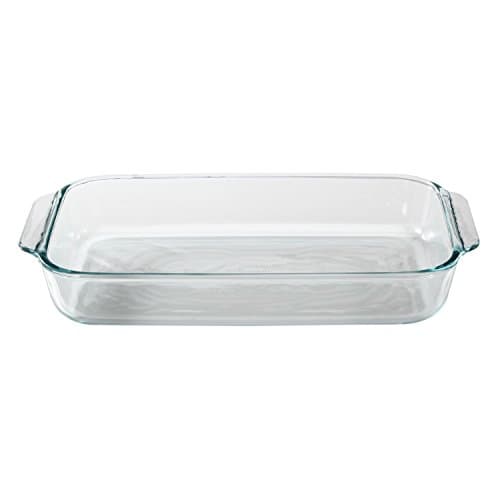
Pyrex Basics Oblong Glass Baking Dish, 3 qt
Casseroles, gratins and baked pasta - wet dishes that go oven to table to fridge
These are the products this page's reasoning actually points at. Same rules as everywhere else on the site: published specs, a stated trade-off, and a live price only where one exists.
Top pick · The glass comparisonSpecs read September 3, 2026
Pyrex Basics Oblong Glass Baking Dish, 3 qt
Non-reactive like ceramic and transparent, which ceramic is not - you can see whether the base is cooked.
Best for: Casseroles, gratins and baked pasta - wet dishes that go oven to table to fridge
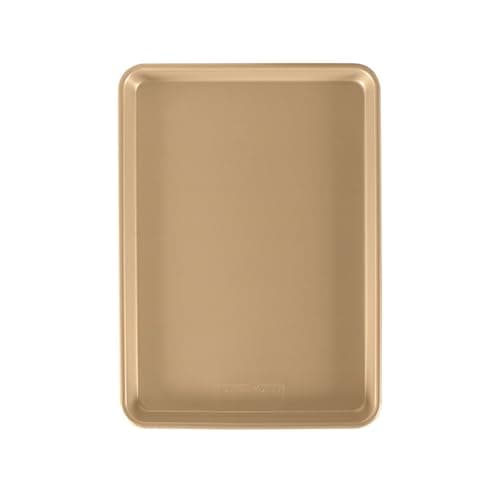
Published specifications for the Nordic Ware Naturals Half Sheet, 18 x 13 in
Exterior dimensions
17.9 x 12.9 x 1 in
Material
Aluminum
Rim
Encapsulated steel rim
Gauge
Not published by Nordic Ware
Warranty
Lifetime
Dishwasher
Hand wash recommended. Automatic dishwasher use is not advised
Made in
America of domestic and imported materials
Good
Aluminum conducts at 237 W/m-K, which is why it browns evenly and a steel pan does not
The encapsulated steel rim is the reason it does not warp in a hot oven
Lifetime warranty on a pan this cheap
Not good
Nordic Ware does not publish a gauge figure, so thickness cannot be compared like for like
Bare aluminum stains and reacts with acid
Not dishwasher safe by the maker's own advice
The trade-off. Bare aluminum discolors and reacts with acid. It will look used within a month and Nordic Ware advises against the dishwasher.
Skip this if. You want a pan that stays looking new, or you will not hand wash. Buy an aluminized-steel coated pan instead and accept the coating as a wear item.
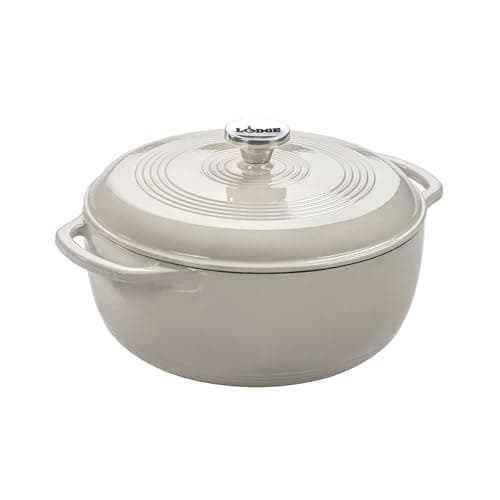
Published specifications for the Lodge Enameled Cast Iron Dutch Oven, 6 qt
Material
Cast iron with porcelain enamel, inside and out
Capacity
6 qt
Induction
Yes - the iron under the enamel is ferrous
Seasoning
None required - enamel is not a seasoning surface
Acid
Safe for tomato and wine, unlike bare iron
Oven maximum
Set by the knob material - check the specific SKU; Lodge publishes a lower ceiling than for bare iron
Good
Non-reactive, so it handles the acidic cooking bare iron cannot
No seasoning to maintain
Considerably cheaper than the French enameled pots it copies
Not good
Chipped enamel is not repairable, unlike bare iron's seasoning
Oven ceiling is lower than bare cast iron because of the knob
Heavy, and the enamel makes it heavier than bare iron of the same capacity
The trade-off. The enamel is a glass layer. Chip it and the pot is not restorable the way bare iron is, and Lodge's enamel chips more readily than the premium brands'.
Skip this if. You already own a large stainless stockpot and rarely braise. This duplicates it for most weeknight cooking.
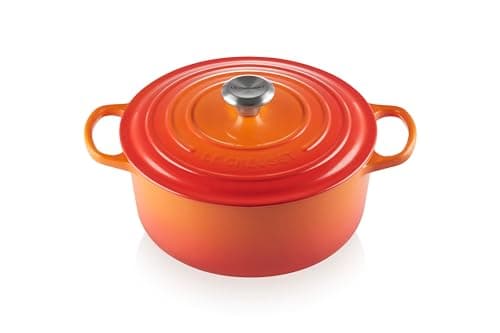
Published specifications for the Le Creuset Signature Round Dutch Oven, 5.5 qt
Material
Cast iron with porcelain enamel inside and out
Capacity
5.5 qt
Interior enamel
Sand-colored, so browning and fond stay visible
Knob
Stainless steel, rated to 500F
Induction
Yes - the iron under the enamel is ferrous
Dishwasher
Dishwasher safe; Le Creuset recommends hand washing
Warranty
Limited lifetime
Made in
France
Good
The pale interior is a genuine cooking advantage: you can see whether the fond is browning or burning
Wide, low-profile handles that a hand in an oven mitt actually fits
The one enameled pot with a real secondhand market, which changes the true cost of ownership
Not good
Costs several times a Lodge enameled pot of the same capacity
The pale interior stains permanently, and Le Creuset says so
Chipped enamel is not repairable on any enameled pot, this one included
The trade-off. You are paying a large multiple of what a Lodge enameled pot costs for a difference in enamel quality, finish and resale value rather than in cooking.
Skip this if. You braise a few times a year. The cooking difference over a Lodge enameled pot is small; the price difference is not.
It holds heat better, which is why food stays hot at the table, and it looks better serving. Glass lets you see whether the base is cooked, which stoneware does not. Both conduct poorly, so neither browns a base the way metal does.
›Can ceramic bakeware go under the broiler?
Usually not - most makers do not publish broiler safety, and direct radiant heat is a thermal-shock risk. Check what the specific manufacturer states rather than assuming, and default to no.
›Why did my ceramic dish crack?
Almost certainly thermal shock: an empty dish preheated, cold liquid added to a hot dish, a hot dish set on a wet counter, or a cold dish put straight into a hot oven. It is a rate-of-change limit rather than a temperature ceiling.
›Is ceramic bakeware non-reactive?
Glazed ceramic is, so tomato, wine and citrus are a non-issue - unlike bare aluminum, which reacts with acid. Unglazed stoneware is porous and will absorb oil and odor over time.
›Does ceramic bakeware brown food?
Poorly. It conducts heat far worse than metal, so bases stay pale and roasted vegetables steam more than they caramelize. If browning is the point, use a bare aluminum sheet pan instead.
Sources
Every figure on this page came from one of these. Follow them and check our arithmetic — that is the point.