Heads up: some links on this page earn us a commission at no extra cost to you. It does not change what we recommend or the order. How we are funded.
The short answer
Own both, in specific shapes. Clad stainless is the right material for skillets, saucepans and stockpots, because it responds quickly, weighs little and pours easily. Enameled cast iron is the right material for a Dutch oven, because braising, bread and long low cooking all reward thermal mass and none of them require responsiveness. Neither material has a coating that wears out, so this is not a durability question - it is a physics one.
What they have in common
It is worth starting here, because these two are more alike than most cookware comparisons on this site.
Neither has a coating that wears out. Stainless is protected by a self-repairing chromium oxide layer; enamel is glass fused to iron and does not degrade from cooking.
Both are non-reactive. Tomato, wine and vinegar are fine in either, which bare cast iron and carbon steel cannot claim.
Both are effectively permanent. No published lifespan question, no replacement interval, lifetime or limited lifetime warranties across the brands here.
Both work on induction. Clad stainless has a magnetic exterior; enameled iron has iron under the glass.
So this is not a durability comparison. It is about thermal behavior and weight, and those two split the kitchen cleanly.
Mass against responsiveness
Cast iron conducts heat about three times better than stainless but far worse than aluminum, and it has enormous thermal mass. Clad stainless conducts well through its aluminum core and has comparatively little mass.
Clad stainless
Enameled cast iron
Heats up
Quickly
Slowly - several minutes to be genuinely ready
Responds to a heat change
Almost immediately
Barely - turning it down does very little for minutes
Holds temperature when food goes in
Drops noticeably
Barely drops
Weight, 5 to 6 qt
Manageable one-handed empty
A two-handed lift empty; heavy full
Best at
Sauces, boiling, anything you adjust
Braises, bread, long low simmers, deep frying
Worst at
Long low cooking that wants stability
Anything needing a quick temperature change
Pouring
Easy, often with a lip
Awkward and heavy
Oven ceiling
500F to 600F by brand
Set by the knob, not the pot
Every line follows from mass. There is no brand in this table that changes the physics.
The practical consequence: if a recipe says "reduce the heat and simmer", stainless does what you asked and enameled iron does not - it carries on at the temperature it had for several minutes. That is a fault when making a delicate sauce and a virtue when braising.
Which shape belongs in which material
Stainless should own
Saucepans, because reducing a sauce requires adjusting the heat and watching it respond - what size saucepan.
Skillets, because weight matters when you lift and tilt a pan.
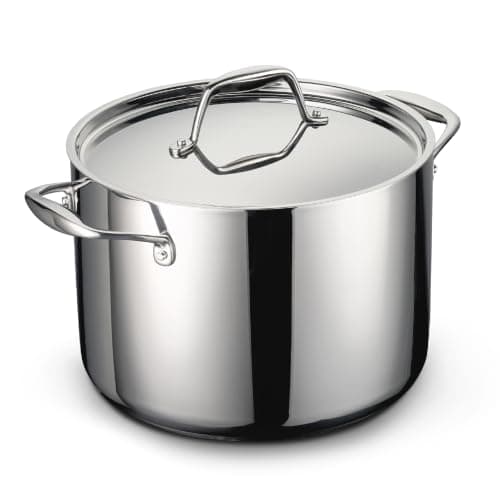
Stockpots, because boiling water needs no thermal mass and eight quarts of enameled iron is unliftable when full - best stockpots.
Saute pans, for the same weight reason.
Enameled cast iron should own
The Dutch oven, which is the shape the material exists for - what size Dutch oven.
Anything braised, where mass keeps the temperature steady for hours.
Bread, where a preheated heavy pot with a lid makes a domestic oven behave like a steam oven.
A 5.5 to 6 qt enameled Dutch oven full of braise is a two-handed lift from a low oven, and it is the single most common reason an expensive pot stops being used. If lifting is difficult, that is a legitimate reason to prefer clad stainless even for jobs enameled iron does better.
Handle geometry is the mitigating factor and it is rarely published. Wide, low-profile loop handles that fit a hand in an oven mitt are what separates a pot you use from a pot you avoid, and it is the specific thing people notice moving from a budget pot to a premium one - noted in our Le Creuset review.
Care differs more than you would expect
Both are low-maintenance and their failure modes are opposite.
Stainless fails at pitting - small dark craters, usually from salt in cold water - and at delamination on disc-bottom pans. Everything else is cosmetic: cleaning burnt stainless.
Enamel fails at chips, which are mechanical and unrepairable. It does not care about detergent or scrubbing but does mind metal utensils, impact and being heated empty: enameled cast iron care.
Enamel also stains permanently if the interior is pale, and Le Creuset publishes that. Staub's black matte interior sidesteps it at the cost of hiding the fond - our Staub review covers the trade.
Which to buy first
If you own neither: clad stainless first. It covers more of the week - a clad saucepan and a skillet do more jobs than any single pot.
If you braise, bake bread or make stews: add a 6 qt enameled Dutch oven. It is the one piece stainless genuinely cannot replicate.
If you boil more than you braise:a clad stockpot instead of a larger pot.
We do not make or sell clad stainless cookware or enameled cast iron. Both link to the same retailer, both pay us the same commission rate, and we earn exactly the same whichever one you buy — or nothing at all if you buy neither, which is sometimes the right answer. Most of the comparison pages that rank for this question are published by companies that sell one of the two. How we are funded.
What to buy, if you are buying
These are the products this page's reasoning actually points at. Same rules as everywhere else on the site: published specs, a stated trade-off, and a live price only where one exists.
Top pick · What stainless should ownSpecs read September 3, 2026
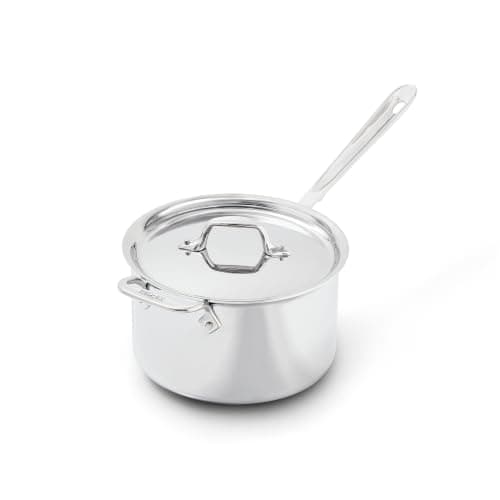
All-Clad D3 Stainless Saucepan, 3 qt
A clad saucepan responds instantly and pours cleanly, which is exactly what enameled iron cannot do.
Best for: Rice, custards and reductions - anything that scorches in a disc-bottom pan
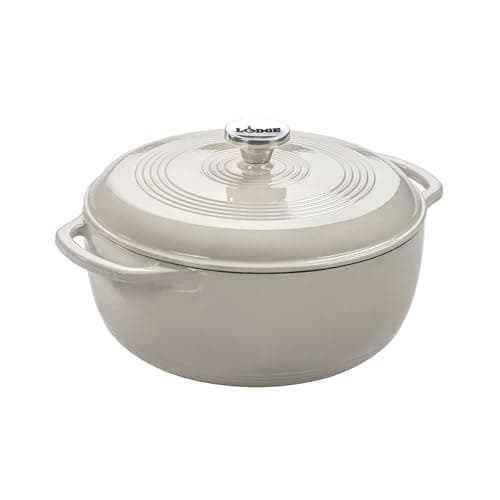
Published specifications for the Lodge Enameled Cast Iron Dutch Oven, 6 qt
Material
Cast iron with porcelain enamel, inside and out
Capacity
6 qt
Induction
Yes - the iron under the enamel is ferrous
Seasoning
None required - enamel is not a seasoning surface
Acid
Safe for tomato and wine, unlike bare iron
Oven maximum
Set by the knob material - check the specific SKU; Lodge publishes a lower ceiling than for bare iron
Good
Non-reactive, so it handles the acidic cooking bare iron cannot
No seasoning to maintain
Considerably cheaper than the French enameled pots it copies
Not good
Chipped enamel is not repairable, unlike bare iron's seasoning
Oven ceiling is lower than bare cast iron because of the knob
Heavy, and the enamel makes it heavier than bare iron of the same capacity
The trade-off. The enamel is a glass layer. Chip it and the pot is not restorable the way bare iron is, and Lodge's enamel chips more readily than the premium brands'.
Skip this if. You already own a large stainless stockpot and rarely braise. This duplicates it for most weeknight cooking.
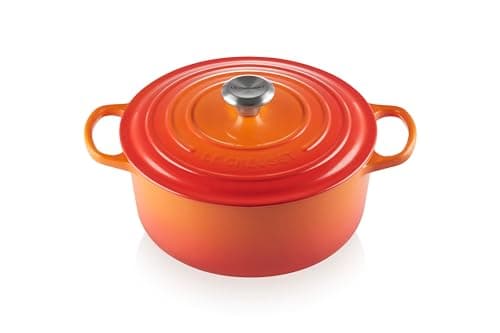
Published specifications for the Le Creuset Signature Round Dutch Oven, 5.5 qt
Material
Cast iron with porcelain enamel inside and out
Capacity
5.5 qt
Interior enamel
Sand-colored, so browning and fond stay visible
Knob
Stainless steel, rated to 500F
Induction
Yes - the iron under the enamel is ferrous
Dishwasher
Dishwasher safe; Le Creuset recommends hand washing
Warranty
Limited lifetime
Made in
France
Good
The pale interior is a genuine cooking advantage: you can see whether the fond is browning or burning
Wide, low-profile handles that a hand in an oven mitt actually fits
The one enameled pot with a real secondhand market, which changes the true cost of ownership
Not good
Costs several times a Lodge enameled pot of the same capacity
The pale interior stains permanently, and Le Creuset says so
Chipped enamel is not repairable on any enameled pot, this one included
The trade-off. You are paying a large multiple of what a Lodge enameled pot costs for a difference in enamel quality, finish and resale value rather than in cooking.
Skip this if. You braise a few times a year. The cooking difference over a Lodge enameled pot is small; the price difference is not.
›Is enameled cast iron better than stainless steel?
Neither is better overall - they suit different shapes. Clad stainless responds quickly and weighs little, which suits saucepans, skillets and stockpots. Enameled cast iron holds temperature, which suits Dutch ovens, braises and bread. Most kitchens want both.
›Can enameled cast iron replace a stainless steel pan?
Not for anything you need to adjust. Enameled iron carries on at the temperature it had for several minutes after you turn the heat down, which is a virtue when braising and a fault when making a sauce. It is also much heavier to lift and pour.
›Which is more durable, stainless or enameled cast iron?
Both are effectively permanent, with different failure modes. Stainless fails at pitting or base delamination; enamel fails at chips from impact or metal utensils, which are unrepairable. Neither has a coating that wears out with cooking.
›Do both work on induction?
Yes. Clad stainless has a magnetic stainless exterior, and enameled cast iron has ferrous iron under the glass. Enameled iron couples especially well because the base is flat and heavy.
›Which should I buy first?
Clad stainless, because a skillet and a saucepan cover more of a week's cooking than any single pot. Add a 5.5 to 6 qt enameled Dutch oven when you find yourself braising or baking bread - that is the one job stainless cannot replicate.
Sources
Every figure on this page came from one of these. Follow them and check our arithmetic — that is the point.