Heads up: some links on this page earn us a commission at no extra cost to you. It does not change what we recommend or the order. How we are funded.
The short answer
Use a heavy pot at least five inches deep, filled no more than a third with oil - an enameled cast iron Dutch oven is the best domestic answer, and a clad stainless stockpot is the lighter one. Depth matters because oil bubbles up violently when wet food goes in; mass matters because oil temperature crashes when food is added and a thin pot never recovers. Do not deep fry in a skillet, a nonstick pan, or any pot without a flat, stable base.
Depth is a safety specification
When wet food enters hot oil, the water flashes to steam and the oil foams upward - sometimes dramatically. The rule that prevents this becoming a fire is simple and not negotiable: fill the pot no more than one third with oil, leaving at least twice that depth of empty space above it.
That is why a skillet is the wrong vessel. A 10-inch skillet with two inches of sides cannot hold enough oil to submerge anything while still leaving headroom. The pot you want is at least five inches deep, and preferably closer to seven.
Vessel
Suitable?
Why
Enameled Dutch oven, 5.5 to 6 qt
Best
Deep, heavy, non-reactive, lidded, stable
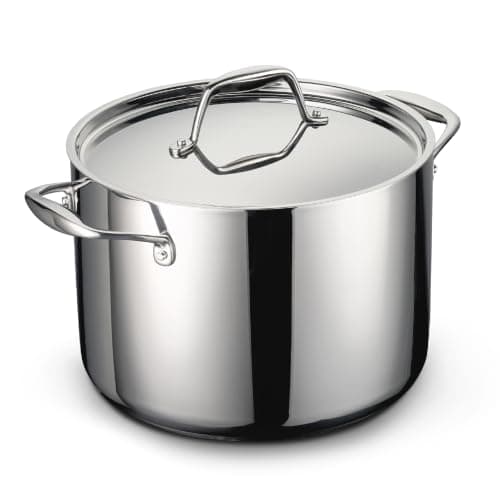
Clad stainless stockpot, 8 qt
Very good
Deep and stable, recovers a little slower, much lighter
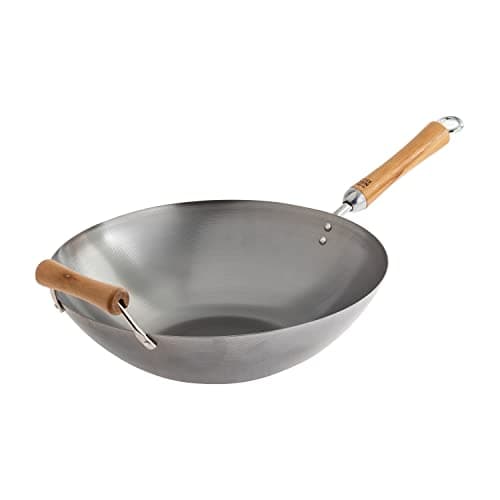
Flat-bottom carbon steel wok
Very good
The sloped shape gives depth with less oil
Bare cast iron Dutch oven
Good
Excellent mass; oil is neutral so seasoning is fine
Skillet or saute pan
No
Not enough depth for the one-third rule
Nonstick anything
No
Frying temperatures sit at or above the published ceilings
Thin aluminum stockpot
No
Temperature crashes and recovers slowly; it can also warp
Anything with a loose or single long handle
No
You may need to move several pounds of hot oil
Two of these rows are safety judgments rather than performance ones. Depth and stability are not preferences.
Thermal recovery is the performance question
Frying works at a specific temperature band. Below it, food absorbs oil and turns greasy; above it, the outside burns before the inside cooks. The moment food goes in, the oil temperature drops - and how far it drops depends on the mass of the pot and the volume of oil.
A heavy enameled Dutch oven holds a great deal of stored energy, so the drop is small and the recovery quick. A thin pot with the same oil in it drops further and takes longer to come back, which means the second batch is worse than the first. This is the same thermal mass argument made in best pans for searing steak, with higher stakes.
More oil also means more stability, which is one reason the one-third rule and good frying are not in tension: a 6 qt pot filled to two quarts recovers better than a 3 qt pot filled to one.
The thermometer is not optional
Oil gives almost no visual cue between 300F and 375F, and the difference between them is greasy food and crisp food. A clip-on probe or an instant-read thermometer is the cheapest meaningful upgrade to frying anyone can make. Frying thermometers cost less than a pan.
Do not rely on a pan's heat indicator for this. Thermo-Spot and similar features report the pan surface at a much lower band and are designed for stovetop cooking, as described in best nonstick pans for eggs.
The rules that actually matter
One third full, maximum. Measure with water first if you are unsure, then dry the pot completely.
Dry the food. Water is what causes the violent foaming, so pat everything dry and shake off excess batter.
Lower food in, away from you. Never drop it.
Keep a lid within reach. A lid smothers an oil fire; water spreads it. Never use water.
Use the back burner and turn pot handles inward.
Let the oil cool completely before moving the pot. This is where most burns happen.
Enameled cast iron has one relevant weakness: it dislikes being heated empty and it dislikes sudden temperature change. Add the oil before the heat, and do not put a hot pot on a wet surface. The care rules are in enameled cast iron care.
Oil, quantity and reuse
Use a neutral oil with a high smoke point. Two to three quarts suits a 6 qt pot at the one-third rule, which is enough to fry in batches without the temperature collapsing.
Strained and stored in a sealed container away from light, frying oil is reusable several times. It is finished when it darkens, smells rancid, foams persistently or starts smoking at a lower temperature than it used to. Never pour it down a drain - let it solidify or seal it in a container for disposal.
Afterward
Enameled interiors handle frying well and clean with hot water and a little detergent. Bare cast iron is fine too - oil is neutral, so nothing is stripped, and a fry session arguably improves the seasoning. Clad stainless may show a brown film of polymerized oil, which comes off with the methods in cleaning burnt stainless.
Vessels deep enough to fry in safely
Every one of these is at least five inches deep with two secure handles. That combination is the specification, and it is not negotiable.
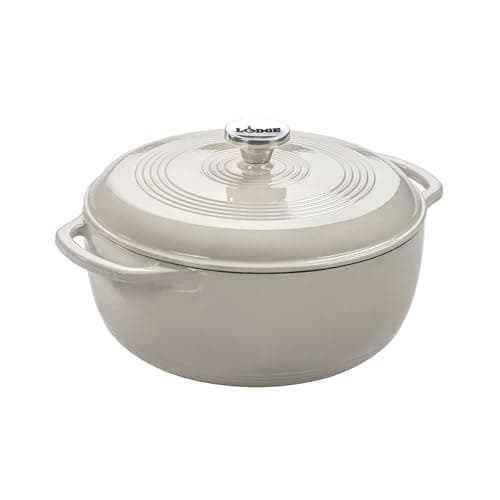
Lodge Enameled Cast Iron Dutch Oven, 6 qt
Braises, stews, tomato sauce, bread - anything long and wet
If you already own a Dutch oven, you already own the right pot - what size Dutch oven covers whether yours is big enough.
What to buy, if you are buying
These are the products this page's reasoning actually points at. Same rules as everywhere else on the site: published specs, a stated trade-off, and a live price only where one exists.
Top pick · The best domestic frying vesselSpecs read September 3, 2026
Lodge Enameled Cast Iron Dutch Oven, 6 qt
Deep, heavy, enameled so it is non-reactive, and its mass is exactly what stops the oil temperature collapsing.
Best for: Braises, stews, tomato sauce, bread - anything long and wet
Published specifications for the Lodge Enameled Cast Iron Dutch Oven, 6 qt
Material
Cast iron with porcelain enamel, inside and out
Capacity
6 qt
Induction
Yes - the iron under the enamel is ferrous
Seasoning
None required - enamel is not a seasoning surface
Acid
Safe for tomato and wine, unlike bare iron
Oven maximum
Set by the knob material - check the specific SKU; Lodge publishes a lower ceiling than for bare iron
Good
Non-reactive, so it handles the acidic cooking bare iron cannot
No seasoning to maintain
Considerably cheaper than the French enameled pots it copies
Not good
Chipped enamel is not repairable, unlike bare iron's seasoning
Oven ceiling is lower than bare cast iron because of the knob
Heavy, and the enamel makes it heavier than bare iron of the same capacity
The trade-off. The enamel is a glass layer. Chip it and the pot is not restorable the way bare iron is, and Lodge's enamel chips more readily than the premium brands'.
Skip this if. You already own a large stainless stockpot and rarely braise. This duplicates it for most weeknight cooking.
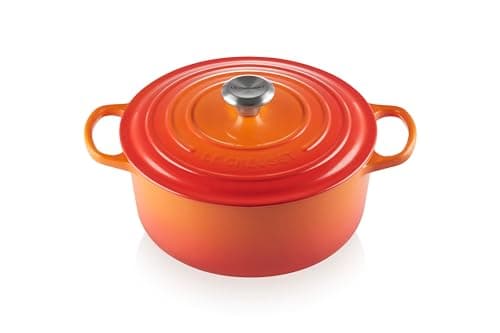
Published specifications for the Le Creuset Signature Round Dutch Oven, 5.5 qt
Material
Cast iron with porcelain enamel inside and out
Capacity
5.5 qt
Interior enamel
Sand-colored, so browning and fond stay visible
Knob
Stainless steel, rated to 500F
Induction
Yes - the iron under the enamel is ferrous
Dishwasher
Dishwasher safe; Le Creuset recommends hand washing
Warranty
Limited lifetime
Made in
France
Good
The pale interior is a genuine cooking advantage: you can see whether the fond is browning or burning
Wide, low-profile handles that a hand in an oven mitt actually fits
The one enameled pot with a real secondhand market, which changes the true cost of ownership
Not good
Costs several times a Lodge enameled pot of the same capacity
The pale interior stains permanently, and Le Creuset says so
Chipped enamel is not repairable on any enameled pot, this one included
The trade-off. You are paying a large multiple of what a Lodge enameled pot costs for a difference in enamel quality, finish and resale value rather than in cooking.
Skip this if. You braise a few times a year. The cooking difference over a Lodge enameled pot is small; the price difference is not.
A heavy pot at least five inches deep - an enameled cast iron Dutch oven of 5.5 to 6 quarts is the best domestic answer. Its mass keeps the oil temperature stable when food goes in, and its depth allows the one-third fill rule with room to spare.
›Can you deep fry in a nonstick pan?
No. Frying temperatures sit at or above the published ceilings for coated pans, which run 400F to 450F across the ledger, and a skillet is not deep enough to hold oil safely regardless of its coating.
›How full should a pot be when deep frying?
No more than one third full with oil, leaving at least twice that depth of empty space above. Wet food flashes water to steam and the oil foams upward, and headroom is what stops that becoming a fire.
›Why does my fried food come out greasy?
The oil was too cool, usually because too much food went in at once and a thin pot could not recover. Fry in smaller batches, use a thermometer, and use a heavier pot with more oil in it - both add thermal stability.
›Can you reuse frying oil?
Several times, if you strain it and store it sealed away from light. It is finished when it darkens, foams persistently, smells rancid or starts smoking lower than it used to. Never pour it down a drain.
Sources
Every figure on this page came from one of these. Follow them and check our arithmetic — that is the point.