Heads up: some links on this page earn us a commission at no extra cost to you. It does not change what we recommend or the order. How we are funded.
The short answer
The oil has passed its smoke point — by far the most common. Use a higher-smoke-point oil or less heat.
Old residue on the pan is burning off — clean it properly.
Seasoning is curing, on cast iron or carbon steel — expected, and deliberate.
A new pan's factory coating is burning away — wash before first use.
The pan is simply too hot, usually preheated empty — turn it down.
1. The oil has passed its smoke point
This accounts for most pan smoke. Every fat has a temperature at which it begins to break down and release visible smoke, and that temperature varies enormously between fats. Unless you have chosen the oil for the heat, you will hit it.
Fat
Roughly
Suits
Butter
Lowest - the milk solids brown then burn
Gentle cooking, finishing
Extra virgin olive oil
Low to moderate
Sauteing, not searing
Coconut oil
Moderate
Medium heat
Regular olive oil, light
Moderate to high
General cooking
Canola, vegetable, sunflower
High
Searing, frying, seasoning pans
Grapeseed
High
Searing, seasoning pans
Refined avocado oil
Highest in common use
Very high heat searing
Clarified butter or ghee
High - solids removed
Butter flavor at heat
Smoke points vary by refinement and by how fresh the oil is. Refined oils go higher than unrefined ones.
The telltale: it starts smoking shortly after the oil goes in, the smoke is thin and bluish, and it smells acrid rather than of food. The fix is a higher-smoke-point oil for searing, or a lower heat for the oil you have. Butter for flavor added at the end, not at the start.
Oil at its smoke point is also oil breaking down chemically and tasting worse. It is a culinary problem before it is anything else - food cooked in smoking oil picks up a bitter note.
2. Old residue burning off
A pan that smokes before you add anything, or smokes from the outside and the rim rather than the cooking surface, is burning off what was left from last time. Spattered oil on the exterior and under the rim polymerizes, then carbonizes.
This is extremely common on pans that look clean inside, because nobody washes the outside of a skillet. A degreasing wash including the exterior and base fixes it - how to clean burnt pans.
On a coated pan the same thing happens as an invisible film on the cooking surface, which smokes at surprisingly low temperatures and also causes sticking - how to clean nonstick pans.
3. Seasoning curing, on bare iron or steel
On cast iron and carbon steel, smoke during seasoning is the process working. Polymerization happens at and above the oil's smoke point - you are deliberately taking the oil past it so it hardens into a film rather than staying as oil.
Expect a lot of smoke, ventilate properly, and use a thin coat. If the pan smokes heavily during ordinary cooking rather than during seasoning, the coat was too thick and did not fully polymerize - seasoning carbon steel and cast iron seasoning and care.
4. A new pan
Most carbon steel ships with a protective coating to prevent rust in transit - beeswax on de Buyer pans, lacquer or oil on others. It must be scrubbed off before first use, and if it is not, it smokes heavily and smells unpleasant the first time the pan gets hot - carbon steel problems and fixes.
New coated and clad pans can also carry manufacturing residue. Washing any new pan before first use takes a minute and avoids this entirely.
5. The pan is just too hot
Usually an empty pan preheated on high. With no food or liquid to absorb energy, the surface temperature climbs far faster than people expect, and cast iron keeps climbing after you turn the heat down because of its thermal mass.
Preheat on medium, not high, for almost everything.
Add the oil once the pan is hot, not at the start - then it spends less time at temperature.
On coated pans, never preheat empty. This is the one case where overheating is a genuine safety matter rather than a cooking one - is nonstick safe.
Match burner to pan base, or the exposed ring overheats while the middle is fine - cookware for gas stoves.
6. The food, not the pan
Sugar, marinades, honey glazes, milk solids and small dry particles all burn well below the temperature the pan is at. Smoke that starts when the food goes in, and smells of what you are cooking, is this.
Nothing is wrong with the pan. Lower the heat, or accept that a sugary glaze added at the start will burn and add it in the last minutes instead.
A pan that smokes from the outside is usually carrying residue from last time. Nobody washes the exterior of a skillet.
Diagnosing it in ten seconds
Before anything is added? Residue, or a new pan, or simply too hot.
As soon as the oil goes in? Wrong oil for the heat.
Only when food goes in? The food - sugar, marinade or dairy.
From the outside and rim? Exterior residue.
Smells acrid and chemical? Oil breaking down, or a factory coating.
Smells of hot metal only? The pan is dangerously hot and empty - take it off the heat.
When smoke actually matters
Mostly it is a cooking problem rather than a hazard. Two exceptions:
A coated pan smoking is past where its coating is happy. PTFE degrades when badly overheated, and an empty coated pan on high heat is how that happens. Take it off the heat and ventilate.
Oil approaching its flash point is a fire risk. If oil is smoking heavily, remove the pan from the heat rather than adding food to it, and never add water.
Otherwise, smoke means turn the heat down and check which oil you are using - cookware for deep frying covers oil temperature management where it matters most.
Where smoke is normal, and where it is a warning
On bare iron and steel, smoke during seasoning is the process working. On a coated pan it means the coating is too hot.
All-Clad D3 Stainless 10 in Fry Pan
One good open-stock stainless pan bought instead of a cheap full set
These are the products this page's reasoning actually points at. Same rules as everywhere else on the site: published specs, a stated trade-off, and a live price only where one exists.
Top pick · Least likely to smoke unexpectedlySpecs read September 3, 2026
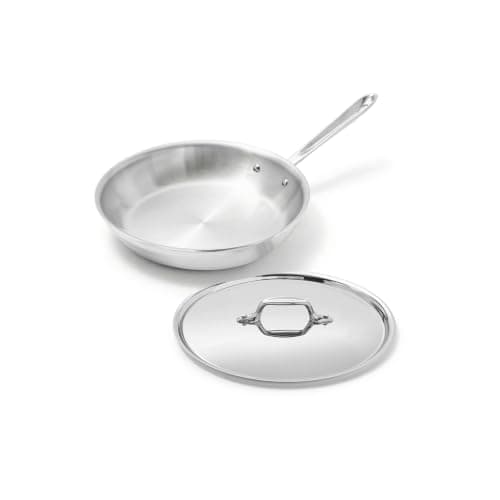
All-Clad D3 Stainless 10 in Fry Pan
Clad stainless spreads heat evenly, so you get no overheated ring producing smoke while the rest of the pan is fine.
Best for: One good open-stock stainless pan bought instead of a cheap full set
Published specifications for the All-Clad D3 Stainless 10 in Fry Pan
Construction
Fully bonded tri-ply, aluminum core
Oven maximum
600F, oven and broiler safe
Induction
Yes - compatible with any stovetop
Dishwasher
Handwash only (All-Clad published)
Handle
Double-riveted stainless
Weight
3.0 lb (model 4110)
Warranty
Limited lifetime
Made in
Bonded, engineered and assembled in Canonsburg, PA
Good
600F is the highest oven ceiling of any stainless pan on this site
The one pan here whose manufacturing location is published down to the town
Genuinely repairable-adjacent: rivets are the only failure point and the warranty covers them
Not good
Hand wash only
The flared rim makes it a poor pan for anything with liquid
Costs several times what a Tramontina or Cuisinart pan of the same construction costs
The trade-off. Hand wash only. All-Clad publishes that plainly, and it is a real daily cost on a pan you will use every day.
Skip this if. You want a dishwasher-safe pan, or you are buying a whole kitchen on a fixed budget - one D3 skillet costs what a full clad set can cost.
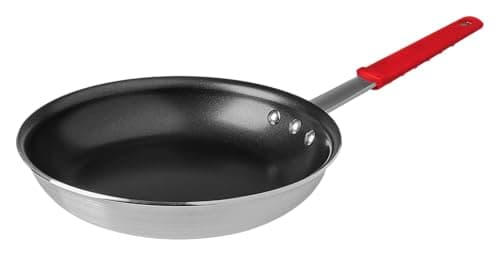
Published specifications for the Tramontina Professional Restaurant Fry Pan, 10 in
Body
Heavy-gauge aluminum
Coating
PTFE nonstick
Induction
No - aluminum body is not ferrous
Coating lifespan
Not published, by this or any nonstick maker
Good
Cheap enough that replacing it every couple of years is a real plan rather than a failure
Heavy gauge for a nonstick pan, so it does not warp on the first hot burner
Silicone handle sleeve that actually stays cool
Not good
Not induction compatible
PTFE, which some buyers will rule out on principle
No published coating lifespan, so the value case is unverifiable by design
The trade-off. It is PTFE. That is fine at normal cooking temperatures, and it is not a pan to preheat empty on high.
Skip this if. You want to avoid PTFE entirely. Buy ceramic instead and accept the shorter release life rather than pretending either one lasts forever.
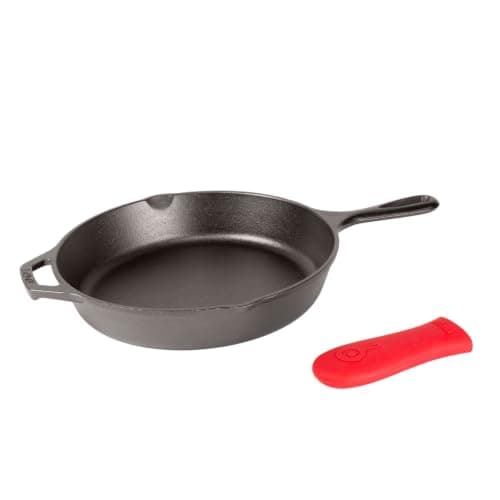
Published specifications for the Lodge Seasoned Cast Iron Skillet, 10.25 in (L8SK3)
Diameter
10.25 in
Weight
5.66 lb
Oven maximum
550F
Induction
Yes - bare iron is ferrous
Seasoning
Pre-seasoned with soy-based vegetable oil, no synthetic chemicals
Warranty
Lifetime
Made in
USA
Care
Hand wash. Lodge's own instructions permit warm soapy water
Good
Effectively unbreakable and fully restorable - a rusted one can be stripped and re-seasoned
Holds heat better than anything else at the price, which is what a sear needs
Lodge publishes its seasoning method openly, so the maintenance is not a mystery
Not good
Heavy
Heats unevenly on a small burner: cast iron conducts at roughly 50 W/m-K, so it is slow to spread and slow to react
Bare iron is reactive; long tomato braises will taste of it
The trade-off. It weighs 5.66 lb empty. You will feel that every time you move it full, and it is the single most common reason a cast iron skillet ends up in a cupboard.
Skip this if. You have wrist or shoulder trouble, or you cook mostly acidic braises. Carbon steel does most of the same jobs at roughly half the weight.
Most often the oil has passed its smoke point, which happens within seconds if you are using butter or extra virgin olive oil at searing heat. If the pan smokes before anything is added, it is either old residue burning off, a new pan's factory coating, or the pan is simply too hot.
›Is it bad if my pan smokes?
Usually it is a cooking problem rather than a hazard - smoking oil breaks down and tastes bitter. Two cases do matter: a coated pan producing smoke is hotter than its coating tolerates, and heavily smoking oil is approaching a fire risk, so take the pan off the heat.
›Why does my pan smoke when there is nothing in it?
Either residue is burning off - often spattered oil on the exterior and under the rim, which nobody washes - or it is a new pan still carrying its factory anti-rust coating, or the pan has simply been preheated empty on high heat and is far hotter than it needs to be.
›Which oil should I use to avoid smoking?
For searing and high heat, use a refined high-smoke-point oil such as canola, grapeseed or refined avocado. Keep butter and extra virgin olive oil for gentler cooking or add them at the end for flavor. Clarified butter and ghee give butter flavor at much higher heat.
›Is smoke normal when seasoning cast iron?
Yes - it is the process working. Polymerization happens at and above the oil's smoke point, so you are deliberately taking it past that so it hardens into a film. Ventilate well and use a very thin coat. Heavy smoking during ordinary cooking afterward means the coat was too thick.
Sources
Every figure on this page came from one of these. Follow them and check our arithmetic — that is the point.