Heads up: some links on this page earn us a commission at no extra cost to you. It does not change what we recommend or the order. How we are funded.
The short answer
Material
Method
Never
Coated nonstick
Warm water soak, soft sponge, baking soda paste
Metal, abrasives, oven cleaner
Bare cast iron
Coarse salt, chainmail, or boil water in it
Long soaking, dishwasher
Enameled cast iron
Baking soda simmer, then a nylon brush
Metal scourers, thermal shock
Bare aluminum
Boil water with cream of tartar
Baking soda, oven cleaner, dishwasher
Aluminized bakeware
Baking soda paste, warm soak
Oven cleaner, dishwasher
Carbon steel
Salt scrub or scrape, then re-oil
Long soaking, detergent marathons
Clad stainless
Deglaze warm, baking soda simmer, oxalic acid
Nothing much - it is the toughest
Before you scrub anything
Two rules apply to every material and prevent most of the damage people do while cleaning.
Let the pan cool before it meets water. Cold water into a hot pan is the main cause of warping, and on enamel it causes crazing - why pans warp.
Soak warm, not cold. Warm water and a little dish soap left for twenty minutes does more than any amount of force, and it does it without abrading anything.
Stainless steel has its own dedicated page, because it tolerates methods nothing else does and is the material people burn most often - cleaning burnt stainless. This page covers everything else.
Coated nonstick and ceramic
The most fragile case, and the one where instinct does the most harm. There is no abrasive method available to you at all.
Cool the pan, then fill with warm water and a drop of dish soap. Leave twenty minutes.
Soft sponge only. Nothing green, nothing metal, no powders.
For stubborn spots, a paste of baking soda and water applied with a fingertip and left ten minutes, then rinsed.
For a scorched ring, simmer water with a splash of vinegar in the pan for a few minutes, then let it cool and wipe.
Never use oven cleaner, caustic degreasers or a dishwasher on a coated pan. And if the pan has a hazy brown film rather than a burnt patch, that is polymerized oil residue - a different problem with a different fix, and the most common reason a coated pan seems to have stopped working - how to clean nonstick pans.
Be honest about the economics. A coated pan with genuinely burnt, lifting coating is finished, and thirty minutes of careful work will not restore release - when to replace your cookware.
Bare cast iron and carbon steel
The opposite extreme: aggressive methods are fine, and water is the thing to be careful with. Seasoning is polymerized oil, and it will survive a scrub far better than the folklore suggests.
Coarse salt and a little oil, scrubbed with a paper towel or cloth - the traditional method, and it works.
A chainmail scrubber, which removes burnt food without stripping established seasoning.
Boil water in the pan for a few minutes to lift a scorched layer, then scrape with a wooden or metal spatula.
A stiff brush and hot water, with dish soap if you want it. Modern detergent does not dissolve polymerized seasoning.
For a truly welded-on mess: scrub back to bare metal with steel wool and re-season. This is a reset, not a failure - cast iron problems and fixes.
Enamel is glass fused to iron, so nothing bonds to it chemically - burnt food is sitting on the surface rather than gripping it. That means patience beats force.
Cover the burnt area with water, add a couple of spoons of baking soda, and simmer gently for ten to fifteen minutes.
Let it cool, then lift the softened residue with a nylon brush or a wooden spatula.
Repeat rather than escalating. Two gentle rounds beat one aggressive one.
For staining rather than residue, a baking soda paste left for an hour usually lifts it.
Avoid metal scourers, which scratch enamel permanently, and avoid taking a hot pot to cold water, which can craze the glaze - enameled cast iron care.
Bare aluminum and aluminized bakeware
The important thing here is chemistry: aluminum reacts with alkalis. Baking soda is alkaline, which makes it the wrong choice on bare aluminum even though it is the right choice almost everywhere else - it darkens and dulls the surface.
For burnt food: boil water in the pan with a spoon of cream of tartar, which is acidic, for ten minutes. This also brightens darkened aluminum.
Lemon juice or vinegar in simmering water works similarly.
For bakeware, a warm soak and a plastic scraper, then accept the patina - bare aluminum darkens with use and bakes better for it - bakeware care and cleaning.
These are the products this page's reasoning actually points at. Same rules as everywhere else on the site: published specs, a stated trade-off, and a live price only where one exists.
Top pick · The most forgiving surfaceSpecs read September 3, 2026
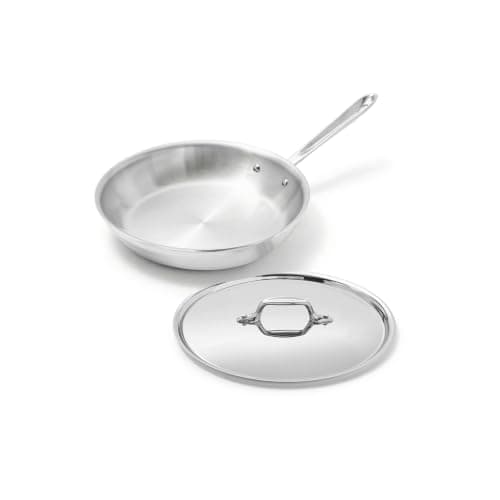
All-Clad D3 Stainless 10 in Fry Pan
Clad stainless survives every cleaning method on this page, which is a genuine reason to own one.
Best for: One good open-stock stainless pan bought instead of a cheap full set
Published specifications for the All-Clad D3 Stainless 10 in Fry Pan
Construction
Fully bonded tri-ply, aluminum core
Oven maximum
600F, oven and broiler safe
Induction
Yes - compatible with any stovetop
Dishwasher
Handwash only (All-Clad published)
Handle
Double-riveted stainless
Weight
3.0 lb (model 4110)
Warranty
Limited lifetime
Made in
Bonded, engineered and assembled in Canonsburg, PA
Good
600F is the highest oven ceiling of any stainless pan on this site
The one pan here whose manufacturing location is published down to the town
Genuinely repairable-adjacent: rivets are the only failure point and the warranty covers them
Not good
Hand wash only
The flared rim makes it a poor pan for anything with liquid
Costs several times what a Tramontina or Cuisinart pan of the same construction costs
The trade-off. Hand wash only. All-Clad publishes that plainly, and it is a real daily cost on a pan you will use every day.
Skip this if. You want a dishwasher-safe pan, or you are buying a whole kitchen on a fixed budget - one D3 skillet costs what a full clad set can cost.
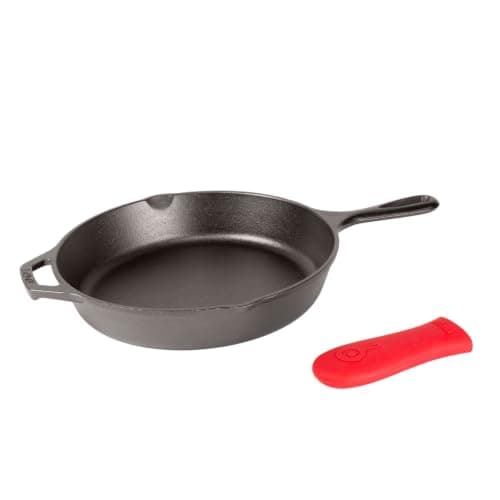
Published specifications for the Lodge Seasoned Cast Iron Skillet, 10.25 in (L8SK3)
Diameter
10.25 in
Weight
5.66 lb
Oven maximum
550F
Induction
Yes - bare iron is ferrous
Seasoning
Pre-seasoned with soy-based vegetable oil, no synthetic chemicals
Warranty
Lifetime
Made in
USA
Care
Hand wash. Lodge's own instructions permit warm soapy water
Good
Effectively unbreakable and fully restorable - a rusted one can be stripped and re-seasoned
Holds heat better than anything else at the price, which is what a sear needs
Lodge publishes its seasoning method openly, so the maintenance is not a mystery
Not good
Heavy
Heats unevenly on a small burner: cast iron conducts at roughly 50 W/m-K, so it is slow to spread and slow to react
Bare iron is reactive; long tomato braises will taste of it
The trade-off. It weighs 5.66 lb empty. You will feel that every time you move it full, and it is the single most common reason a cast iron skillet ends up in a cupboard.
Skip this if. You have wrist or shoulder trouble, or you cook mostly acidic braises. Carbon steel does most of the same jobs at roughly half the weight.
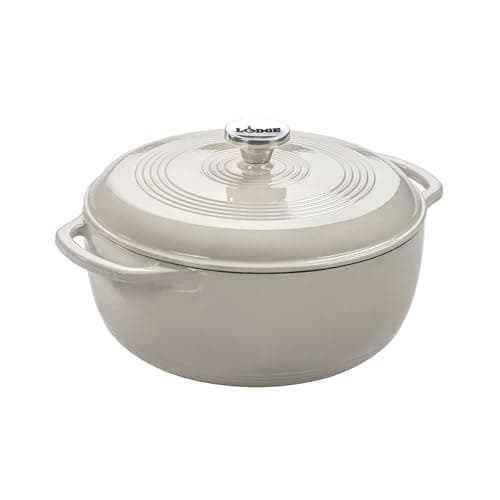
Published specifications for the Lodge Enameled Cast Iron Dutch Oven, 6 qt
Material
Cast iron with porcelain enamel, inside and out
Capacity
6 qt
Induction
Yes - the iron under the enamel is ferrous
Seasoning
None required - enamel is not a seasoning surface
Acid
Safe for tomato and wine, unlike bare iron
Oven maximum
Set by the knob material - check the specific SKU; Lodge publishes a lower ceiling than for bare iron
Good
Non-reactive, so it handles the acidic cooking bare iron cannot
No seasoning to maintain
Considerably cheaper than the French enameled pots it copies
Not good
Chipped enamel is not repairable, unlike bare iron's seasoning
Oven ceiling is lower than bare cast iron because of the knob
Heavy, and the enamel makes it heavier than bare iron of the same capacity
The trade-off. The enamel is a glass layer. Chip it and the pot is not restorable the way bare iron is, and Lodge's enamel chips more readily than the premium brands'.
Skip this if. You already own a large stainless stockpot and rarely braise. This duplicates it for most weeknight cooking.
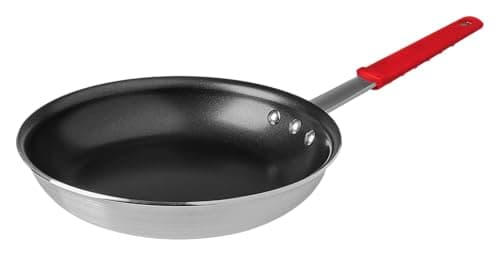
Published specifications for the Tramontina Professional Restaurant Fry Pan, 10 in
Body
Heavy-gauge aluminum
Coating
PTFE nonstick
Induction
No - aluminum body is not ferrous
Coating lifespan
Not published, by this or any nonstick maker
Good
Cheap enough that replacing it every couple of years is a real plan rather than a failure
Heavy gauge for a nonstick pan, so it does not warp on the first hot burner
Silicone handle sleeve that actually stays cool
Not good
Not induction compatible
PTFE, which some buyers will rule out on principle
No published coating lifespan, so the value case is unverifiable by design
The trade-off. It is PTFE. That is fine at normal cooking temperatures, and it is not a pan to preheat empty on high.
Skip this if. You want to avoid PTFE entirely. Buy ceramic instead and accept the shorter release life rather than pretending either one lasts forever.
It depends on the material. For most pans, cover the burnt area with water, add baking soda, and simmer gently before lifting the softened residue with a nylon brush. Bare aluminum is the exception - use an acid like cream of tartar instead, because alkaline baking soda dulls aluminum.
›Can you use baking soda on all pans?
No. Baking soda is alkaline and alkalis react with aluminum, so it darkens and dulls bare aluminum pans and bakeware. Use an acidic method there - cream of tartar, lemon juice or vinegar in simmering water. Baking soda is excellent on stainless, enamel and coated pans.
›How do you clean a burnt nonstick pan?
Gently and with no abrasives at all. Cool the pan, soak in warm water with dish soap for twenty minutes, then use a soft sponge. A baking soda paste left on a stubborn spot helps. Never use oven cleaner, metal scourers or a dishwasher, and accept that lifting coating means the pan is finished.
›Can you use oven cleaner on pans?
No. Oven cleaner is strongly caustic - it permanently etches aluminum, attacks nonstick coatings, and is not intended for food surfaces. It is one of the few cleaning products that will turn a dirty pan into a ruined one.
›How do you clean burnt cast iron without ruining the seasoning?
Coarse salt with a little oil scrubbed with a cloth, a chainmail scrubber, or boiling water in the pan to lift the layer before scraping. Modern dish soap does not dissolve polymerized seasoning, so soap is fine. What actually harms cast iron is leaving it wet, so dry it on the burner and oil it while warm.
Sources
Every figure on this page came from one of these. Follow them and check our arithmetic — that is the point.