Heads up: some links on this page earn us a commission at no extra cost to you. It does not change what we recommend or the order. How we are funded.
The short answer
Symptom
Cause
Fix
Tacky, sticky surface
Too much oil when seasoning
Re-bake hot with oil wiped to nearly dry
Seasoning flaking off
Thick seasoning built in heavy layers
Scrub the loose material off, re-season thin
Food sticks
Thin seasoning, or pan not preheated
Preheat properly; cook fatty foods to build up
Metallic taste
Acidic food on thin seasoning
Keep acid brief; build seasoning first
Rust
Stored wet
Scrub back, dry on heat, re-season
Rough, pebbly surface
Factory finish, or carbon buildup
Leave it, or scrub off the buildup
Pan rocks or spins
Warped, which is rare
Usually unfixable - check the stove first
Sticky or tacky surface
The most common seasoning failure, and it is always the same cause: too much oil. Oil polymerizes into a hard film only in a very thin layer. Applied thickly, the surface polymerizes while the oil underneath does not, leaving a soft, varnish-like layer that stays tacky and picks up fingerprints.
The fix is to scrub the tacky material off with hot water and a stiff brush, or with coarse salt, then re-season correctly. The instruction that matters is counterintuitive: apply oil, then wipe the pan as though you are trying to remove all of it. The residue left behind is the correct amount.
Lodge publishes its own method, and it is worth following rather than improvising - cast iron seasoning and care quotes it.
Seasoning flaking off in black specks
Black flakes in the food, or patches lifting like old paint. This is thick seasoning built in heavy layers that never bonded properly to the iron beneath. It is the same root cause as the sticky problem, one stage further along.
It is not dangerous - it is polymerized oil, which is food. It is unpleasant, and the fix is mechanical. Scrub off everything that is loose, using steel wool if necessary, and accept that you will end up with a patchy pan. Then cook fatty things in it for a few weeks. Seasoning built by cooking is far more durable than seasoning built in the oven.
Do not try to save a flaking pan by adding another layer on top. You are building on a surface that has already failed to bond. Take it back to something solid first.
Food sticks
Three separate causes, and they need different responses.
The pan was not hot enough. The most frequent reason by far. Cast iron heats slowly and unevenly, and needs several minutes on medium to come up properly. A pan that feels hot at the center is often still cool at the edge.
The seasoning is thin, which is normal on a new pan. Pre-seasoned from the factory means usable, not finished. Cook bacon, sear, fry, and avoid delicate eggs for the first month.
The food was not ready to release. Protein bonds to hot metal and then releases on its own once a crust forms. If a steak will not lift, it is not stuck - it is not ready. Wait thirty seconds and try again.
Eggs are the hardest test and the worst thing to judge a pan by. A coated pan does them better and always will - best nonstick pans for eggs.
A metallic taste in the food
Acid dissolving iron. Seasoning is a barrier, but it is a thin organic one and acid degrades it. A long tomato simmer on a pan without well-established seasoning will taste of iron and will strip the pan at the same time.
Deglazing with wine is fine - it takes a minute. A two-hour braise is not. Roughly thirty minutes is the practical limit on a mature pan, and less on a new one - cooking acidic foods and reactive cookware covers which pans to use instead.
Rust
Iron plus water plus air. The cause is always storage: the pan went away damp, or it sat in a sink, or it lives somewhere humid without a film of oil on it. Surface rust is a twenty-minute fix and deep pitting is a longer job, both covered in full in restoring rusty cast iron.
The prevention is one habit: dry the pan on the burner rather than on a towel. Thirty seconds of heat drives off water a towel leaves behind, and a wipe of oil while it is warm finishes the job.
A rough, pebbly cooking surface
Two different things that look alike.
Factory texture
Modern Lodge and most current production have a slightly pebbled surface from sand casting, where vintage pans were machined smooth. It is cosmetic. Seasoning fills it in over time and cooking performance is essentially unaffected. Some people sand pans smooth; it is optional and it removes the factory seasoning - vintage cast iron buying guide covers the difference.
Carbon buildup
Hard, uneven, crusty deposits, usually starting at the edges and on the outside of the pan. This is burnt-on food and polymerized grease accumulated over years, and it is worth removing because it flakes eventually. Scrub with steel wool, or use the oven's self-clean cycle on a bare pan if you are prepared to re-season from scratch.
Most cast iron problems come from storage and heat management rather than from the pan. Both are habits rather than purchases.
A pan that rocks or spins
Genuinely warped cast iron is rare, because the material is thick enough to crack rather than bend. Before concluding the pan is warped, check the stove - glass cooktops are not always flat, and a pan that rocks on one burner may sit perfectly on another.
Where a pan is genuinely warped, there is no home repair. Where it is cracked, it is finished, and the crack will grow. Lodge's lifetime warranty is worth a claim in that case - cookware warranties explained.
Smoking, and a smell that will not leave
Smoke during seasoning is expected. You are heating oil past its smoke point deliberately. Ventilate, and use an oil with a high smoke point.
Smoke during ordinary cooking means the pan is too hot. Cast iron retains heat, so it keeps climbing after you think you have stopped adding energy.
A rancid smell means old oil that never polymerized, usually from over-oiling before storage. Heat the pan until the smell goes, then re-oil thinly.
Fish or garlic carrying over is a sign of soft, unpolymerized seasoning. A properly hard surface does not hold flavors.
Three things that are not problems
Cast iron folklore generates as much worry as it resolves.
Soap. Modern dish soap is a detergent and does not dissolve polymerized seasoning. Lodge's own published guidance permits it. The rule against it dates from lye-based soap.
Black residue on a paper towel. Usually carbon and seasoning particulate rather than the seasoning coming off. If the pan cooks well, it is fine.
An uneven, patchy appearance. Seasoning is not a paint finish. A pan that looks mottled and cooks well is a working pan.
The equivalent page for the other bare-metal material is carbon steel problems and fixes, and most of the diagnoses transfer with the timescales shortened.
Pans cheap enough to learn on
Every problem on this page is recoverable, and the pans here are inexpensive enough that experimenting carries no real risk.
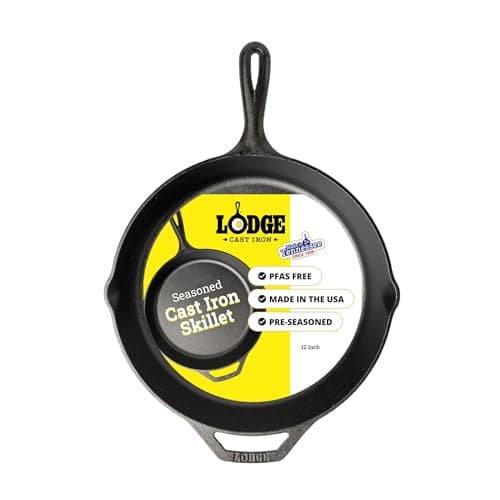
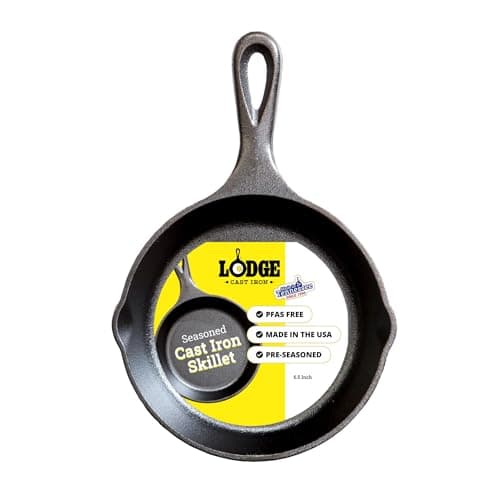
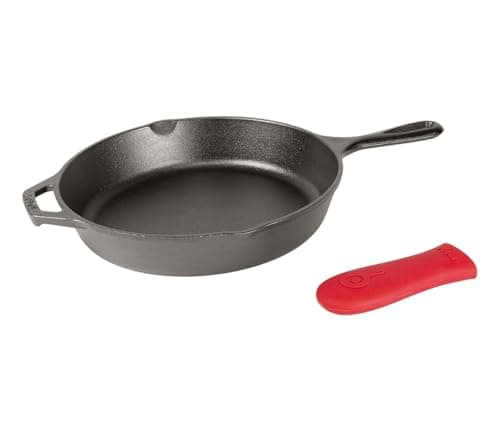
Lodge Seasoned Cast Iron Skillet, 10.25 in (L8SK3)
Searing, cornbread, and anyone who wants one pan that cannot be worn out
These are the products this page's reasoning actually points at. Same rules as everywhere else on the site: published specs, a stated trade-off, and a live price only where one exists.
Top pick · The pan worth rescuingSpecs read September 3, 2026
Lodge Seasoned Cast Iron Skillet, 10.25 in (L8SK3)
Cheap enough that nobody agonizes over experiments, and published at 550F with a lifetime warranty, so there is no wrong way to learn on one.
Best for: Searing, cornbread, and anyone who wants one pan that cannot be worn out
Published specifications for the Lodge Seasoned Cast Iron Skillet, 10.25 in (L8SK3)
Diameter
10.25 in
Weight
5.66 lb
Oven maximum
550F
Induction
Yes - bare iron is ferrous
Seasoning
Pre-seasoned with soy-based vegetable oil, no synthetic chemicals
Warranty
Lifetime
Made in
USA
Care
Hand wash. Lodge's own instructions permit warm soapy water
Good
Effectively unbreakable and fully restorable - a rusted one can be stripped and re-seasoned
Holds heat better than anything else at the price, which is what a sear needs
Lodge publishes its seasoning method openly, so the maintenance is not a mystery
Not good
Heavy
Heats unevenly on a small burner: cast iron conducts at roughly 50 W/m-K, so it is slow to spread and slow to react
Bare iron is reactive; long tomato braises will taste of it
The trade-off. It weighs 5.66 lb empty. You will feel that every time you move it full, and it is the single most common reason a cast iron skillet ends up in a cupboard.
Skip this if. You have wrist or shoulder trouble, or you cook mostly acidic braises. Carbon steel does most of the same jobs at roughly half the weight.
Too much oil. Oil polymerizes into a hard film only in a very thin layer, so a thick application leaves soft, unpolymerized oil underneath a hardened surface. Scrub the tacky layer off and re-season, wiping the pan as though you are trying to remove all the oil.
›Why is the seasoning flaking off my cast iron?
The seasoning was built too thick, in heavy layers that never bonded properly to the iron. Scrub off everything loose, accept a patchy pan, and rebuild by cooking fatty foods rather than by adding more oven layers. Never add a new layer over a flaking one.
›Why does food stick to my cast iron skillet?
Usually the pan was not preheated long enough - cast iron heats slowly and needs several minutes on medium. The other causes are thin seasoning on a new pan, and food that simply is not ready to release yet, because protein lets go on its own once a crust forms.
›Can you use soap on cast iron?
Yes. Modern dish soap is a detergent and does not dissolve polymerized seasoning, and Lodge's own published guidance permits it. The rule against soap dates from lye-based soaps that genuinely would strip a pan, and it has outlived the products that justified it.
›Is a rough cast iron surface a defect?
No. Modern pans are sand cast and have a slightly pebbled texture where vintage pans were machined smooth. It is cosmetic, seasoning fills it in over time, and cooking performance is essentially unaffected. Hard crusty deposits are different and worth scrubbing off.
Sources
Every figure on this page came from one of these. Follow them and check our arithmetic — that is the point.