Heads up: some links on this page earn us a commission at no extra cost to you. It does not change what we recommend or the order. How we are funded.
The short answer
Problem
Usual cause
Fix
Sticky, tacky surface
Oil applied too thickly when seasoning
Scrub back, re-season in very thin coats
Food sticks everywhere
Pan not hot enough, or seasoning too young
Preheat properly; keep cooking in it
Blotchy, uneven color
Normal - a burner heats unevenly
Nothing. It evens out with use
Rust spots
Put away damp
Scrub off, dry on the burner, re-oil
Seasoning flaking off
Built too thick, too fast
Scrub the loose layer back and rebuild thin
Warped base that spins
Thermal shock, or a burner smaller than the base
Largely permanent - manage it
Metallic taste
Long acidic cooking on young seasoning
Move acid elsewhere; rebuild seasoning
One principle covers most of this page
Almost every carbon steel complaint traces back to seasoning that is too thick, applied too fast, or too young to have been built by cooking. Seasoning is polymerized oil - fat heated past its smoke point until it cross-links into a hard film - and thin layers polymerize fully while thick ones stay soft underneath.
So the fix for a surprising number of these is the same: scrub back to something solid and rebuild in coats thin enough to look like you have wiped the oil off. The full method is in seasoning carbon steel.
The surface is sticky or tacky
The most common first-week problem, and the most misdiagnosed. A tacky pan is not dirty and it is not under-seasoned. It is over-oiled: enough oil was left on the surface that the outer layer polymerized while the layer beneath stayed soft, leaving a varnish-like film that never quite hardens.
Scrub the tacky layer back with a stiff brush, hot water and a little soap, or a chainmail scrubber.
Dry the pan completely on a burner.
Apply oil and then wipe it off as if you had made a mistake. That residue is the correct amount.
Heat until it stops smoking, let it cool, repeat two or three times.
A chainmail scrubber is the one accessory genuinely worth owning for this material. It removes stuck residue and failed seasoning without stripping good seasoning, which no sponge manages.
Food sticks to it
Two causes, and they need opposite responses.
The pan is not hot enough
This is the majority case and it is technique rather than a fault. Bare steel needs a real preheat: medium heat, several minutes, oil added after the pan is hot rather than before. The water-droplet test used on stainless works here too and is described in why food sticks to stainless steel.
The seasoning is too young
A pan seasoned once in an oven has a base layer, not a working surface. Carbon steel is seasoned by cooking in it - frying, searing, anything with fat - over weeks. Cook things that are forgiving first (bacon, potatoes, steak) and leave eggs and fish until the surface has darkened. Attempting an omelet in week one and concluding the pan is faulty is the classic error.
It has gone blotchy and uneven
Not a fault. A domestic burner heats a ring, so the seasoning darkens in a ring, and a new pan often develops a bullseye pattern before it evens out. Straw-gold, brown, blue-black and gray patches are all normal stages.
It evens out over months of use. If it bothers you visually, cook more things that cover the whole base - a full pan of potatoes rather than one steak in the middle. What it is not is a reason to strip and start again, which is how most people make a cosmetic issue into a real one.
It has rust spots
Carbon steel rusts faster than cast iron for a simple reason: it is thinner, so it cools faster and holds less residual heat to drive off moisture. A pan put away slightly damp will bloom orange.
Scrub the rust off with a chainmail scrubber, steel wool or a scouring pad. It comes off.
Wash, dry, and heat the pan dry on the burner until no moisture remains.
Wipe a very thin film of oil onto the warm pan.
If the rust was widespread, strip and re-season fully.
The procedure is the same one used for cast iron, in more detail, in restoring rusty cast iron. Prevention is a storage habit rather than a cooking one - how to store pots and pans covers drying on the burner and leaving a paper towel in the pan.
The seasoning is flaking off
Flakes mean layers that never bonded - again, too thick, too fast, or seasoning built on top of residue rather than on clean steel. The flakes themselves are hardened cooking oil, so they are unappetizing rather than hazardous.
Scrub back to the layer that is firmly attached. You do not usually need to strip to bare metal: a patchy but solid base is a fine foundation. Then rebuild thin. If large sheets are lifting across the whole pan, a full strip is faster than patching.
It has warped - the one that is not fixable
This is the fault worth understanding in advance, because unlike everything else on this page it does not fully reverse. Thin steel moves when heated unevenly, and three things cause it:
Thermal shock: a hot pan into cold water, or cold liquid into a screaming-hot pan.
A burner much smaller than the base, which heats the center while the rim stays cool.
Thin gauge. A 2 mm pan warps more readily than a 3 mm one, which is why de Buyer publishing 3 mm at 11 inches is a genuinely useful specification and why so few competitors publish anything.
Your stove
How much a warp matters
What to do
Gas
Little - the flame reaches a curved base fine
Live with it
Electric coil
Some - contact is reduced but not lost
Preheat longer, accept slower response
Smooth top / radiant
A lot - the pan rocks and contact is poor
The pan is effectively finished for this stove
Induction
A lot - a domed base couples badly
Same. Move the pan to a gas kitchen or replace it
A warp is a stove-specific verdict rather than an absolute one. The same pan can be perfectly usable on gas and useless on induction.
Prevention is simple: let the pan cool before it goes anywhere near water, and match pan diameter to burner. That second point is the same argument made in what size carbon steel pan.
Food tastes metallic
Almost always acid on young seasoning. Tomato, wine, vinegar and citrus dissolve iron much faster than neutral foods, and on a thin seasoning layer they reach bare steel quickly - stripping the seasoning and leaving a taste in the dish.
Move long acidic cooking to stainless, enameled cast iron or glass, and rebuild the seasoning. Short contact - a splash of wine to deglaze, lemon at the end - is fine on a mature pan. The same principle applies to bare cast iron and is covered in is cast iron cookware safe.
The handle is uncomfortable or gets hot
Not fixable, and worth knowing before buying rather than after. A welded steel handle - the restaurant standard on the Matfer - conducts heat and needs a towel. A riveted handle with a shaped profile is easier to hold and gives you two rivet heads inside the pan to clean around. Neither is a defect; they are different trade-offs, and they are compared in best carbon steel pans.
When to actually give up
A warp on a smooth-top or induction stove. The pan is not broken, but it is finished for that kitchen.
A crack or a hole, which is vanishingly rare in steel.
A handle that has come loose on a welded pan, which cannot be re-riveted.
Everything else on this page is recoverable, which is the actual argument for the material. The broader replace-or-keep framework is in when to replace your cookware.
Pans whose published specs predict fewer of these problems
Thickness is the spec that matters most for warping, and de Buyer is one of the very few makers that publishes one. Lodge arrives pre-seasoned, which removes the step where most first-week faults are created.
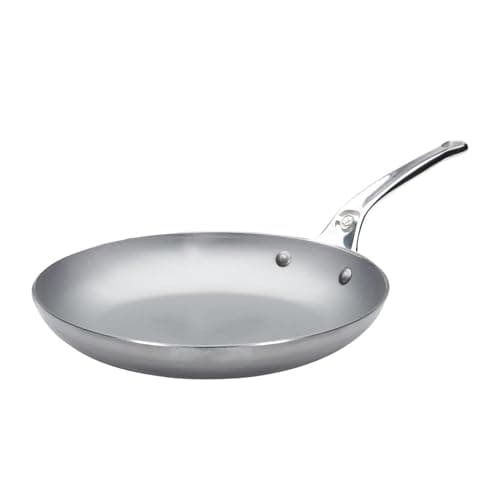
de Buyer MINERAL B PRO Carbon Steel Fry Pan, 11 in
Someone who wants cast-iron searing without cast-iron weight
If you are starting over rather than fixing, is carbon steel worth it is the page to read first.
What to buy, if you are buying
These are the products this page's reasoning actually points at. Same rules as everywhere else on the site: published specs, a stated trade-off, and a live price only where one exists.
Top pick · The pan with published thicknessSpecs read September 3, 2026
de Buyer MINERAL B PRO Carbon Steel Fry Pan, 11 in
3 mm published at 11 inches, which is the specification that predicts warping better than any brand name does.
Best for: Someone who wants cast-iron searing without cast-iron weight
Too much oil was left on the surface when seasoning, so the top layer hardened while the layer underneath stayed soft. Scrub the tacky film back, then re-season with oil applied and then wiped off - the residue left behind is the correct amount.
›Why does food stick to my carbon steel pan?
Either the pan was not hot enough before the food went in, or the seasoning is still young. Bare steel needs a genuine preheat with oil added after the pan is hot, and a new pan needs weeks of regular cooking before it releases eggs.
›Can you fix a warped carbon steel pan?
Not reliably. Thin steel that has domed or cupped will not return to flat. On gas it is usually still usable; on a smooth top or induction hob a warped base rocks and couples poorly, and the pan is effectively finished for that stove.
›Is a blotchy carbon steel pan a problem?
No. Uneven color is normal - a burner heats in a ring, so the seasoning darkens in a ring, often as a bullseye before it evens out. Stripping a blotchy pan turns a cosmetic issue into a real one.
›How do you get rust off a carbon steel pan?
Scrub it off with chainmail, steel wool or a scouring pad, wash and dry the pan completely on the burner, then wipe a very thin film of oil onto the warm metal. Widespread rust is worth a full strip and re-season.
Sources
Every figure on this page came from one of these. Follow them and check our arithmetic — that is the point.