The oldest cooking material in a modern kitchen, with no coating and no published lifespan problem. The questions worth asking are about iron, acid and enamel.
Heads up: some links on this page earn us a commission at no extra cost to you. It does not change what we recommend or the order. How we are funded.
The short answer
Yes, for the great majority of people. Bare cast iron has no synthetic coating, and its cooking surface is polymerized oil bonded to iron - a food fat that has been heated until it hardens. The one real chemistry is that small amounts of iron transfer into food, more from a new or poorly seasoned pan and much more from long acidic cooking. That is a non-issue for most people and a reason to talk to a clinician for anyone with an iron-storage condition such as hemochromatosis. Enameled cast iron is a different material with a different question: the enamel is glass, and once it chips inside the pot, retire it.
What the cooking surface actually is
A seasoned cast iron pan is not coated in the sense a nonstick pan is. Seasoning is oil that has been heated past its smoke point so that it polymerizes - the fat molecules cross-link into a hard, solid, plastic-like film bonded to the iron. Lodge seasons its pans with vegetable oil and publishes exactly that.
Three consequences follow, and they are the reason the safety conversation about cast iron is so different from the one about coated pans:
There is no manufactured coating chemistry to ask about. The surface is cooking oil that has been heated.
It is repairable. Damage the seasoning and you re-season - the process is in cast iron seasoning and care. Nothing about a stripped pan is unsafe; it is simply bare iron.
Flakes of seasoning are food fat. Unappetizing, not hazardous, and a sign the seasoning was built too thick or too fast.
This contrasts sharply with nonstick, where the surface is a manufactured polymer with a lifespan no maker publishes - covered in is nonstick cookware safe.
Iron transfer, which is the real chemistry
Cooking in bare iron transfers some iron into the food. This is well established and uncontroversial as a mechanism. What varies is how much, and the variables are known:
What increases iron transfer
Why
A new or newly stripped pan
The seasoning film is the barrier; less film means more contact
Acidic ingredients
Acid dissolves iron far faster than neutral food does
Long cooking times
Contact time is the multiplier on everything else
Stirring and scraping
Mechanical contact with the metal, not just the seasoning
High-moisture cooking
Water is the medium the transfer happens in
A quick sear of a steak in a well-seasoned pan sits at the low end of every row in this table. A two-hour tomato sauce sits at the high end of all of them.
We will not publish a milligram figure. We run no lab and test nothing, and any number we quoted would be borrowed from a study we had not read in its own context - our method is here, and it is the same reason this site carries no star ratings.
For most people dietary iron from a pan is unremarkable. The group for whom it is a genuine question is people with an iron-storage condition such as hemochromatosis, and that is a conversation with a doctor rather than with a cookware site. If bare iron is ruled out, enameled cast iron gives you the same thermal behavior with a glass barrier between food and metal.
Acid: the practical rule
Acidic food in bare cast iron does three things: it dissolves iron faster, it strips seasoning, and it can pick up a metallic taste. None of it is dangerous. All of it is avoidable.
Short acidic contact is fine. Deglazing with wine, finishing with a squeeze of lemon, a quick pan sauce - a well-seasoned pan handles these.
Long acidic cooking is not. A tomato sauce simmered for an hour or more belongs in enameled cast iron, stainless or glass.
Storing acidic food in the pan is the worst case and the easiest to avoid. Move leftovers to a container.
This is the single biggest practical argument for owning one enameled piece alongside bare iron. It closes the one real gap in a bare-iron kitchen, which is why bare versus enameled cast iron ends up recommending both rather than either.
Rust is not a safety problem
Rust on a cast iron pan is iron oxide, and it is the least serious fault the material has. It is not toxic, it does not ruin the pan, and it comes off. A pan found rusted in a garage restores to better than new, and the process is in restoring rusty cast iron.
What rust does mean is that the seasoning has failed locally, so re-season after removing it. The most common cause is a warm damp pan going into a closed cupboard, which is a storage habit rather than a cooking one - how to store pots and pans covers the fix.
Enameled cast iron is a different question
Enamel is powdered glass fused to iron at high temperature. It is inert, non-reactive and entirely unlike a nonstick coating: it does not wear away with use and it has no lifespan to publish. It has one failure mode, and it is mechanical.
Chips
A chip inside the cooking area exposes bare iron, which then rusts under a rim of glass, and the chip edge can shed further. That pot should be retired from cooking. A chip on the outside or on the rim is cosmetic - rim chipping is the most common complaint on every budget enameled pot, including the Cuisinart in our ledger.
Crazing and staining
Crazing - a fine network of cracks in an otherwise intact glaze - is normal aging rather than a failure. Staining of a pale interior is normal too, and Le Creuset publishes that it is permanent. Neither is a reason to stop using the pot; both are covered as keep-it faults in when to replace your cookware.
Lead and cadmium
The reasonable version of this concern applies to decorative or unbranded imported enamelware rather than to cookware from the major manufacturers, who publish food-safe enamel formulations. Buy from a brand that documents its materials, which is the same advice this site gives about every other claim.
The practical verdict
Bare cast iron is safe for general cooking and its surface is polymerized cooking oil rather than a manufactured coating.
Keep long acidic cooking out of it. That is one rule and it solves the only genuine chemistry issue.
If you have an iron-storage condition, ask a clinician and default to enameled.
Rust is cosmetic and fixable. Flaking seasoning is fat, not a hazard.
Retire an enameled pot chipped inside and ignore chips on the outside.
Bare iron, and the enameled pieces that close its one gap
Two bare pans for searing and two enameled pots for anything acidic. Owning one of each is the answer far more often than choosing between them.
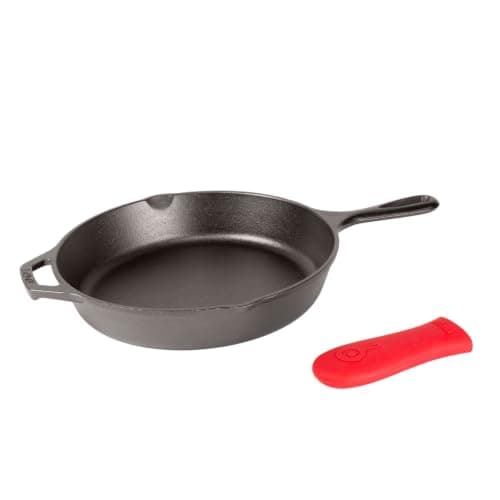
Lodge Seasoned Cast Iron Skillet, 10.25 in (L8SK3)
Searing, cornbread, and anyone who wants one pan that cannot be worn out
These are the products this page's reasoning actually points at. Same rules as everywhere else on the site: published specs, a stated trade-off, and a live price only where one exists.
Top pick · The bare iron referenceSpecs read September 3, 2026
Lodge Seasoned Cast Iron Skillet, 10.25 in (L8SK3)
Pre-seasoned with vegetable oil, published 550F, made in Tennessee, and the pan the whole question is usually about.
Best for: Searing, cornbread, and anyone who wants one pan that cannot be worn out
Published specifications for the Lodge Seasoned Cast Iron Skillet, 10.25 in (L8SK3)
Diameter
10.25 in
Weight
5.66 lb
Oven maximum
550F
Induction
Yes - bare iron is ferrous
Seasoning
Pre-seasoned with soy-based vegetable oil, no synthetic chemicals
Warranty
Lifetime
Made in
USA
Care
Hand wash. Lodge's own instructions permit warm soapy water
Good
Effectively unbreakable and fully restorable - a rusted one can be stripped and re-seasoned
Holds heat better than anything else at the price, which is what a sear needs
Lodge publishes its seasoning method openly, so the maintenance is not a mystery
Not good
Heavy
Heats unevenly on a small burner: cast iron conducts at roughly 50 W/m-K, so it is slow to spread and slow to react
Bare iron is reactive; long tomato braises will taste of it
The trade-off. It weighs 5.66 lb empty. You will feel that every time you move it full, and it is the single most common reason a cast iron skillet ends up in a cupboard.
Skip this if. You have wrist or shoulder trouble, or you cook mostly acidic braises. Carbon steel does most of the same jobs at roughly half the weight.
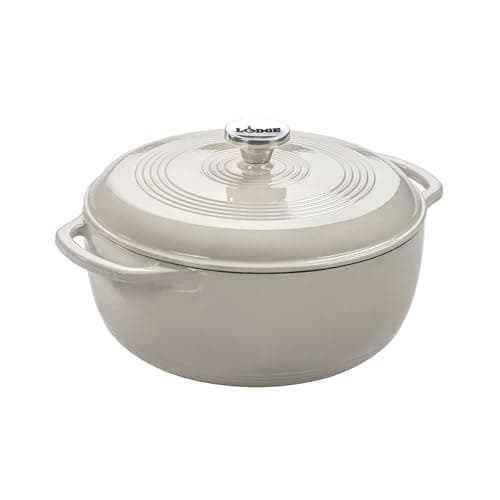
Published specifications for the Lodge Enameled Cast Iron Dutch Oven, 6 qt
Material
Cast iron with porcelain enamel, inside and out
Capacity
6 qt
Induction
Yes - the iron under the enamel is ferrous
Seasoning
None required - enamel is not a seasoning surface
Acid
Safe for tomato and wine, unlike bare iron
Oven maximum
Set by the knob material - check the specific SKU; Lodge publishes a lower ceiling than for bare iron
Good
Non-reactive, so it handles the acidic cooking bare iron cannot
No seasoning to maintain
Considerably cheaper than the French enameled pots it copies
Not good
Chipped enamel is not repairable, unlike bare iron's seasoning
Oven ceiling is lower than bare cast iron because of the knob
Heavy, and the enamel makes it heavier than bare iron of the same capacity
The trade-off. The enamel is a glass layer. Chip it and the pot is not restorable the way bare iron is, and Lodge's enamel chips more readily than the premium brands'.
Skip this if. You already own a large stainless stockpot and rarely braise. This duplicates it for most weeknight cooking.
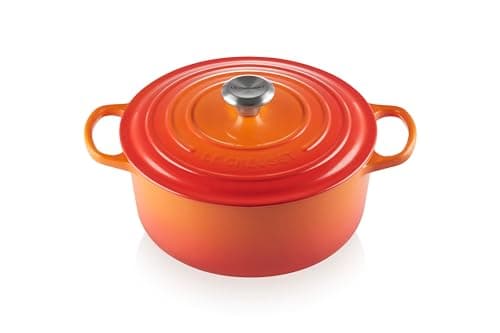
Published specifications for the Le Creuset Signature Round Dutch Oven, 5.5 qt
Material
Cast iron with porcelain enamel inside and out
Capacity
5.5 qt
Interior enamel
Sand-colored, so browning and fond stay visible
Knob
Stainless steel, rated to 500F
Induction
Yes - the iron under the enamel is ferrous
Dishwasher
Dishwasher safe; Le Creuset recommends hand washing
Warranty
Limited lifetime
Made in
France
Good
The pale interior is a genuine cooking advantage: you can see whether the fond is browning or burning
Wide, low-profile handles that a hand in an oven mitt actually fits
The one enameled pot with a real secondhand market, which changes the true cost of ownership
Not good
Costs several times a Lodge enameled pot of the same capacity
The pale interior stains permanently, and Le Creuset says so
Chipped enamel is not repairable on any enameled pot, this one included
The trade-off. You are paying a large multiple of what a Lodge enameled pot costs for a difference in enamel quality, finish and resale value rather than in cooking.
Skip this if. You braise a few times a year. The cooking difference over a Lodge enameled pot is small; the price difference is not.
For most people, yes. There is no synthetic coating - the surface is cooking oil polymerized onto iron. The one real chemistry is iron transfer into food, which increases with acidic ingredients, long cooking and a poorly seasoned pan.
›Can you cook tomatoes in cast iron?
Briefly, yes. A long acidic simmer is the problem: it dissolves iron faster, strips seasoning and can leave a metallic taste. Cook a long tomato sauce in enameled cast iron, stainless or glass, and never store acidic food in a bare pan.
›Is it safe to use a rusty cast iron pan?
Rust is iron oxide and is not toxic, but it means the seasoning has failed there. Scrub the rust off and re-season before cooking. A rusted pan is fully recoverable - it is the least serious fault the material has.
›Is flaking seasoning dangerous?
No. Seasoning is polymerized cooking oil, so flakes are hardened food fat. They are unappetizing and a sign the seasoning was built too thick or too fast. Scrub the loose layer back and rebuild it in thinner coats.
›Should you keep using a Dutch oven with chipped enamel?
Not if the chip is inside the cooking area with dark iron showing - the exposed iron rusts and the chip edge can shed. Chips on the outside or the rim are cosmetic. Enamel cannot be repaired at home or by the manufacturer.
Sources
Every figure on this page came from one of these. Follow them and check our arithmetic — that is the point.