Heads up: some links on this page earn us a commission at no extra cost to you. It does not change what we recommend or the order. How we are funded.
The short answer
For almost everyone, yes. Stainless has no coating to wear off and no seasoning to maintain, and its food-contact surface is protected by a passive chromium oxide layer that reforms on its own whenever it is scratched. Two caveats are worth knowing: 300-series stainless - the 18/10 and 18/8 used for cooking surfaces - contains nickel, which matters if you are nickel-sensitive, and a pitted or badly damaged interior no longer has an intact passive layer. Neither is a reason for most kitchens to avoid the material.
What makes stainless stainless
Stainless steel is iron alloyed with at least about eleven percent chromium. The chromium reacts with oxygen at the surface to form an extremely thin, transparent chromium oxide film - the passive layer - which is what stops the iron underneath from rusting.
The useful property of that layer is that it is self-repairing. Scratch it with a metal spatula and it reforms within moments from the chromium already in the alloy. This is the fundamental difference between stainless and a coated pan: there is nothing to wear away, because the protective layer is made continuously by the metal itself.
It is also why a scratched stainless pan is not a compromised pan, while a scratched nonstick pan eventually is. What that means for coated cookware is in is nonstick cookware safe.
Grades, and where the nickel is
The numbers on a cookware listing describe chromium and nickel content by percentage. They are worth reading because they are one of the few honest specifications in the category, and they are explained in full in stainless steel grades explained.
Grade
Composition
Where it is used
Contains nickel
18/10 (304 family)
18% chromium, 10% nickel
Cooking surfaces on quality clad pans
Yes
18/8 (304 family)
18% chromium, 8% nickel
Cooking surfaces, functionally similar
Yes
18/0 (430)
18% chromium, no nickel
Magnetic exteriors, budget interiors, some bakeware
No
200 series
Chromium with manganese substituted for nickel
Very cheap cookware and flatware
Low
18/10 and 18/8 both sit in the 304 family. The difference between them is small; the difference between either and 18/0 is corrosion resistance.
Both clad sets we recommend publish an 18/10 interior. That is the composition you want for a cooking surface, because nickel is what gives 304-family steel its resistance to acids and salt - the two things cooking involves most.
If you are nickel-sensitive
Nickel allergy is common and it is the one genuinely material-specific reason someone might need to avoid ordinary stainless cookware. We are not a medical publication and will not tell you what your threshold is - that is a conversation with a clinician. What we can do is be precise about which materials contain nickel and which do not.
Contains nickel: 18/10 and 18/8 cooking surfaces, which is nearly every quality clad pan.
No nickel: 18/0 stainless, bare cast iron, carbon steel, enameled cast iron, glass bakeware, bare and anodized aluminum bakeware.
Coated pans: the food contact surface is the coating, not the metal under it - the two coating chemistries are compared in PTFE versus ceramic nonstick.
The practical replacement for a clad saucepan, if nickel is ruled out, is enameled cast iron: non-reactive, no coating to wear, and it handles the acidic cooking that bare iron cannot. The sizing is in what size Dutch oven. For frying, bare cast iron and carbon steel are both nickel-free - cast iron versus carbon steel compares them.
Pitting is the one real failure mode
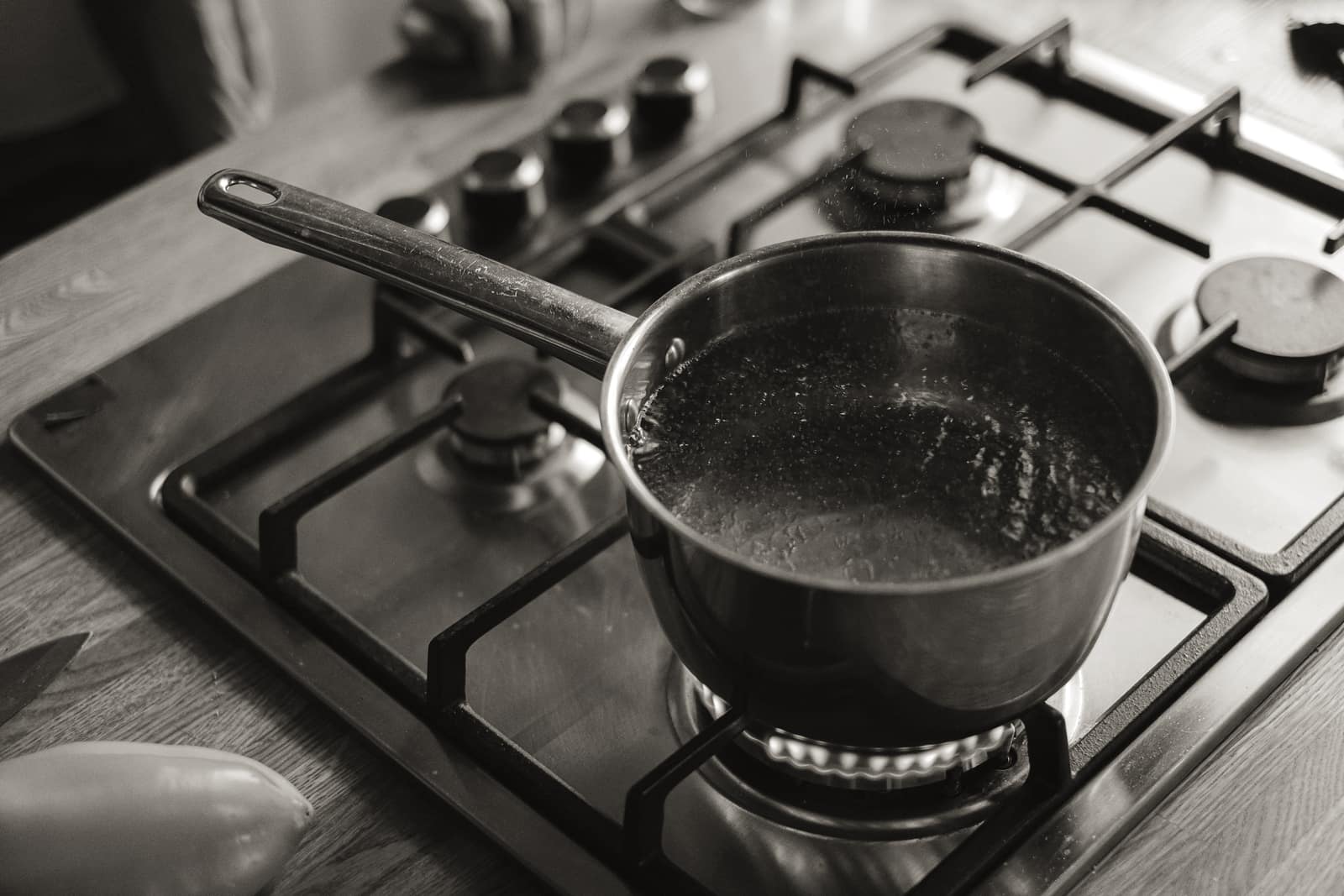
Pitting is localized corrosion: small dark craters in an otherwise shiny interior. It happens where the passive layer has been breached in one spot and cannot re-form fast enough, and by far the most common cause is salt dropped into cold water and left to sit at the bottom of the pan while it heats.
Unlike scratches, pitting does not heal. It is one of only two faults that genuinely end a stainless pan, and it is listed as such in when to replace your cookware.
Add salt after the water boils, and stir it in. This single habit prevents almost all domestic pitting.
Do not leave acidic or salty food in the pan overnight. Cooking in it is fine; storing in it is what causes trouble.
Rinse and dry after washing, particularly if your water is hard.
Rainbow staining, cloudy white patches and blue-gold sheen are not pitting and not damage. They are cosmetic, they come off with an acid wash, and the methods are in cleaning burnt stainless.
Acid, long cooks and what actually transfers
Metals do move from cookware into food in small quantities, and the variables that increase it are well understood: a new pan, a damaged surface, long cooking times, and acidic ingredients like tomato, wine and vinegar. A brand-new pan transfers more in its first few uses than at any point afterward, because the surface finish is still settling.
What we will not do is put a number on it. We run no lab, we test nothing, and any figure we quoted would be borrowed from a study we did not read in context. Our method is here, and it is the same reason this site publishes no star ratings.
What follows from the mechanism, rather than from any test, is practical and uncontroversial: simmering a tomato sauce for six hours is a job for enameled cast iron or glass rather than for bare metal, and storing that sauce in the pan afterward is worse than cooking it there. The reactive-material comparison is in cookware materials compared.
The practical verdict
For general cooking, stainless is the least demanding material in the kitchen. No coating to fail, no seasoning to maintain, no lifespan nobody will publish.
Buy an 18/10 or 304-family interior where the maker states it, because corrosion resistance is exactly what you want in a food-contact surface.
Salt after boiling and do not store food in the pan. That is the entire maintenance routine.
If you avoid nickel, enameled cast iron and bare iron cover almost everything a clad set does.
Retire a pitted pan, and ignore every cosmetic mark that is not a pit.
Published compositions, plus the nickel-free option
Three pans whose makers state an 18/10 interior, and one enameled pot for anyone who needs to avoid nickel entirely.
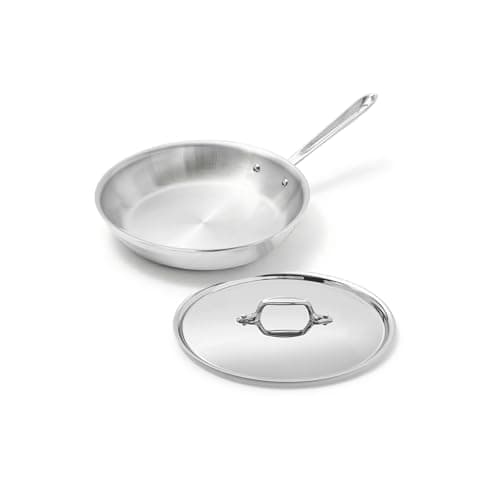
All-Clad D3 Stainless 10 in Fry Pan
One good open-stock stainless pan bought instead of a cheap full set
18/10 clad cookware on Amazon is the search that filters for a stated interior grade rather than an unqualified "stainless" claim.
What to buy, if you are buying
These are the products this page's reasoning actually points at. Same rules as everywhere else on the site: published specs, a stated trade-off, and a live price only where one exists.
Top pick · The best-documented stainless surfaceSpecs read September 3, 2026
All-Clad D3 Stainless 10 in Fry Pan
18/10-family interior, published construction, and a maker that states its factory town - which is as checkable as this category gets.
Best for: One good open-stock stainless pan bought instead of a cheap full set
Published specifications for the All-Clad D3 Stainless 10 in Fry Pan
Construction
Fully bonded tri-ply, aluminum core
Oven maximum
600F, oven and broiler safe
Induction
Yes - compatible with any stovetop
Dishwasher
Handwash only (All-Clad published)
Handle
Double-riveted stainless
Weight
3.0 lb (model 4110)
Warranty
Limited lifetime
Made in
Bonded, engineered and assembled in Canonsburg, PA
Good
600F is the highest oven ceiling of any stainless pan on this site
The one pan here whose manufacturing location is published down to the town
Genuinely repairable-adjacent: rivets are the only failure point and the warranty covers them
Not good
Hand wash only
The flared rim makes it a poor pan for anything with liquid
Costs several times what a Tramontina or Cuisinart pan of the same construction costs
The trade-off. Hand wash only. All-Clad publishes that plainly, and it is a real daily cost on a pan you will use every day.
Skip this if. You want a dishwasher-safe pan, or you are buying a whole kitchen on a fixed budget - one D3 skillet costs what a full clad set can cost.
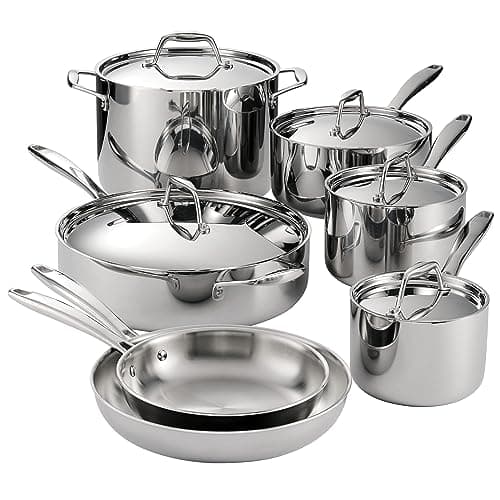
Published specifications for the Tramontina Signature Tri-Ply Clad 12-Piece Set
Construction
Tri-ply: 18/10 stainless, aluminum core, magnetic stainless exterior
Pieces
8 in and 10 in fry pans; 1.5, 2 and 3 qt covered saucepans; 5 qt covered deep saute; 8 qt covered stockpot
Oven maximum
500F on the 80116-249DS listing; other SKUs in the line are listed at 350F
Induction
Yes - magnetic stainless exterior
Dishwasher
Listed dishwasher safe
Handles
Precision cast, riveted
Certification
NSF-certified on the 80116-249DS line
Country of origin
Not asserted - retail listings disagree across SKUs (Brazil and China both appear)
Good
Fully clad, not disc-bottom: the aluminum runs up the sidewalls, so sauces do not scorch in a ring at the base
NSF certification on the flagship SKU is a real, checkable third-party mark rather than a marketing badge
Induction-ready without paying an induction premium
Not good
Retail listings disagree on the oven maximum across SKUs in the same line, which is a documentation problem, not a cooking one
Handles run hot on gas
The 12-piece count includes lids; the useful-item count is seven
The trade-off. Handles are the weak point. They are riveted and sturdy, but they get hot on a gas ring in a way the more expensive clad brands' do not.
Skip this if. You want a set you can leave in the oven above 500F, or you cook mostly eggs and pancakes and would rather spend the money on one good nonstick pan.
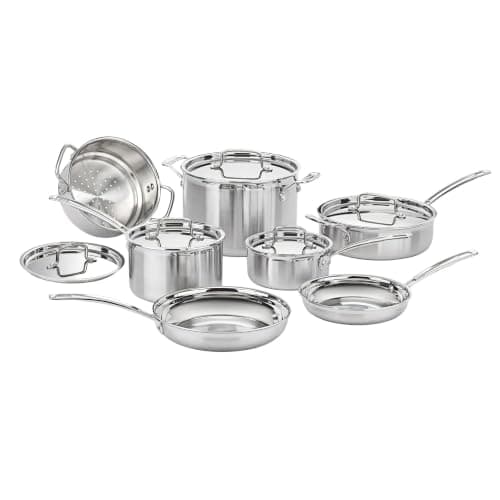
Published specifications for the Cuisinart MultiClad Pro MCP-12N 12-Piece Set
Construction
Tri-ply: 18/10 stainless interior, pure aluminum core, brushed stainless exterior
Pieces
1.5 and 3 qt covered saucepans; 8 in and 10 in skillets; 3.5 qt covered saute; 8 qt covered stockpot; steamer insert
Oven maximum
500F per the Cuisinart use-and-care manual, which the Amazon listing we cite now matches. Major retail listings still advertise 550F; Cuisinart has confirmed the manual figure
Induction
Yes
Dishwasher
Dishwasher safe
Handles
Riveted solid stainless, cool-grip profile
Warranty
Lifetime
Good
Heat runs up the sidewalls, not just across the base
Genuinely dishwasher safe, which the pricier clad brands often are not
Lifetime warranty on a set at this price
Not good
Published oven maximum contradicts the retail listing for the same product
Handle spine is divisive
No 12-inch skillet in the box, which is the pan most people reach for second
The trade-off. The cool-grip handles have a sharp spine that some people find uncomfortable on a full 8-quart stockpot.
Skip this if. You want the higher oven ceiling that major retail listings advertise. The manual says 500F and Cuisinart has confirmed the manual is correct.
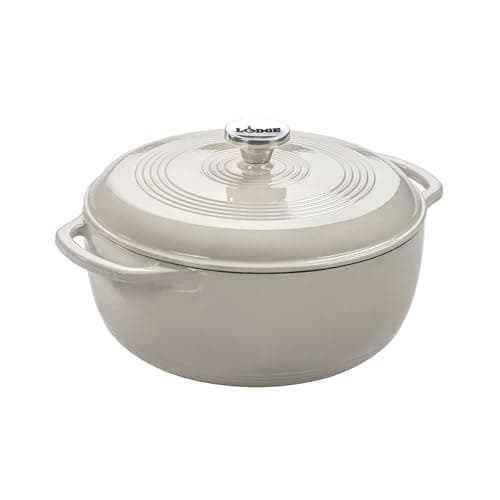
Published specifications for the Lodge Enameled Cast Iron Dutch Oven, 6 qt
Material
Cast iron with porcelain enamel, inside and out
Capacity
6 qt
Induction
Yes - the iron under the enamel is ferrous
Seasoning
None required - enamel is not a seasoning surface
Acid
Safe for tomato and wine, unlike bare iron
Oven maximum
Set by the knob material - check the specific SKU; Lodge publishes a lower ceiling than for bare iron
Good
Non-reactive, so it handles the acidic cooking bare iron cannot
No seasoning to maintain
Considerably cheaper than the French enameled pots it copies
Not good
Chipped enamel is not repairable, unlike bare iron's seasoning
Oven ceiling is lower than bare cast iron because of the knob
Heavy, and the enamel makes it heavier than bare iron of the same capacity
The trade-off. The enamel is a glass layer. Chip it and the pot is not restorable the way bare iron is, and Lodge's enamel chips more readily than the premium brands'.
Skip this if. You already own a large stainless stockpot and rarely braise. This duplicates it for most weeknight cooking.
For almost everyone, yes. There is no coating to wear off and no seasoning to maintain, and the surface is protected by a self-repairing passive chromium oxide layer. The two caveats are nickel content in 18/10 and 18/8 grades, and pitting, which permanently breaches that layer in one spot.
›Does stainless steel cookware contain nickel?
The 300-series grades used for cooking surfaces do - 18/10 is 18 percent chromium and 10 percent nickel, 18/8 is 8 percent. 18/0 stainless contains no nickel, as do cast iron, carbon steel, enameled cast iron and glass.
›What causes little pits in a stainless steel pan?
Almost always salt added to cold water and left sitting on the base while it heats. That breaches the passive layer in one spot faster than it can re-form. Adding salt after the water boils, and stirring it in, prevents nearly all of it.
›Are rainbow stains on stainless steel a problem?
No. Rainbow sheen, cloudy white patches and dulling are cosmetic and reversible with an acid wash. They are not pitting and they do not affect how the pan cooks or how safe it is.
›Is it safe to cook tomato sauce in stainless steel?
Cooking in it is normal. Long acidic simmers and storing acidic food in the pan increase metal transfer, so a six-hour sauce is better suited to enameled cast iron or glass, and leftovers belong in a container rather than in the pan.
Sources
Every figure on this page came from one of these. Follow them and check our arithmetic — that is the point.