Capacity is the number on the box. Base diameter is the number that decides whether four chicken thighs fit in one layer, and nobody prints it in the headline.
Heads up: some links on this page earn us a commission at no extra cost to you. It does not change what we recommend or the order. How we are funded.
The short answer
5.5 to 6 quarts for almost everyone. It braises for four, bakes a standard loaf, and still fits in a normal cupboard.
3.5 to 4 quarts only if you cook for one or two and know it. It is a lovely size and it will not hold a whole chicken.
7 quarts and up if you regularly cook for six, batch cook, or want to braise a large cut whole. Expect real weight.
Buy one, not two. A second Dutch oven is the least-used pot in most kitchens that own two.
Why 5.5 to 6 quarts is the default
This is one of the few sizing questions in cookware with a genuinely dominant answer. Between five and a half and six quarts, a round Dutch oven will:
Hold a three to four pound chicken with the lid on.
Braise short ribs or thighs for four, in a single layer, which is the point.
Take a standard no-knead bread loaf with room for oven spring.
Make soup or chili for a week without threatening to boil over.
Still lift, full, with two hands and oven mitts.
Every major brand builds its flagship at 5.5 or 6 quarts for this reason, and if you buy nothing else from this page, buy that size.
Size by size
Capacity
Serves
What it does well
Where it runs out
2 to 3 qt
1
Rice, small braises, side dishes, reheating
Anything with bones in it
3.5 to 4 qt
1 to 2
Braises for two, small loaves, everyday soup
A whole chicken, a full batch of chili
5 qt
2 to 4
Almost everything a 5.5 does, in slightly less cupboard
Large cuts, and bread with a tall rise
5.5 to 6 qt
3 to 5
The whole repertoire: chicken, bread, braises, stock
Batch cooking for eight
7 to 7.5 qt
5 to 7
Large cuts whole, big batches, feeding a crowd
Your wrists, and most cupboard shelves
9 qt and up
Batch cooking only
Stock, canning-scale cooking, whole pork shoulder
Everyday use - it is too heavy empty
Serving figures assume a braise as the main dish. A pot used mainly for soup stretches one size further.
Base diameter is the number nobody advertises
Capacity tells you what the pot holds. Base diameter tells you what you can sear, and searing is the first step of nearly every dish a Dutch oven is bought for.
A tall narrow seven-quart pot and a wide low five-quart pot can hold similar volumes and behave completely differently: the wide one browns four thighs at once, the tall one steams them because they overlap. If a listing gives interior diameter, read it; if it gives only quarts, look at the photograph and judge the proportion.
The same principle applies to skillets, where rim diameter and cooking surface differ by two inches on a sloped pan - the arithmetic is in what size cast iron skillet.
Round or oval
Round is the default and should be, for two reasons. It matches a burner, so the base heats evenly, and it is the shape every recipe assumes. Oval pots exist to take a long cut - a rack, a leg, a whole fish - and they pay for it by overhanging the burner at both ends, so the middle is hot and the ends are not.
Buy oval only if you have a specific long thing you cook often. As a first Dutch oven it is the wrong choice, and on a smooth-top stove it is worse still, for the reasons in cast iron on glass top stoves.
Weight is a size decision
Enameled cast iron is heavy before you put anything in it, and the weight climbs faster than the capacity does. A 7-quart pot full of stew is a two-handed lift from a low oven, and that is the point at which people quietly stop using the pot they bought.
Two things make the weight manageable at any size: wide, low-profile handles that a hand in an oven mitt actually fits, and storing the pot somewhere you are not lifting it above waist height. Le Creuset's handle geometry is the specific thing people notice when they move up from a budget pot, and it is a real difference rather than a finish detail.
Handle width is the spec that decides whether a large pot gets used. It is rarely published, and it is visible in every product photograph.
The knob sets the oven ceiling
Whatever size you buy, the oven rating comes from the knob rather than the pot. Le Creuset publishes a stainless knob rated to 500F on the Signature line; Staub's rating is knob-dependent and varies by SKU; Lodge and Cuisinart both publish ceilings set by the knob rather than the iron.
If you bake bread, this matters - most no-knead recipes preheat the pot at 450F to 500F and a phenolic knob may be rated below that. Several brands sell a stainless replacement knob, which is a small purchase that raises the ceiling on a pot you already own. Every published figure we have is collected in oven-safe cookware temperatures.
Enameled or bare, at this size
Bare cast iron Dutch ovens exist and they are cheaper, lighter for the capacity and camp-oven durable. What they cannot do is acid: a long tomato or wine braise in bare iron strips seasoning and picks up a metallic taste. Since acidic braises are most of what a Dutch oven is for, enameled is the right answer for an indoor pot.
Default, any household of two to five:a 6 qt enameled pot, which is the size and the price most people should land on.
You want it to be the last one you buy:the 5.5 qt Le Creuset for the pale interior, or the Staub cocotte if permanent staining would bother you more than losing sight of the fond.
You cook for one: buy 3.5 to 4 qt, and accept that a whole chicken is out.
The four pots this sizing guide points at
Three are 5 to 6 quarts because that is the size that suits most households. Base diameter, not capacity, is what decides whether you can sear before you braise.
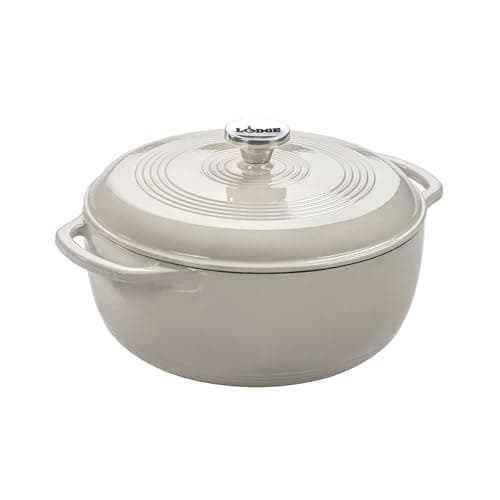
Lodge Enameled Cast Iron Dutch Oven, 6 qt
Braises, stews, tomato sauce, bread - anything long and wet
If you want to see how capacities are priced across the category, 6-quart Dutch ovens on Amazon is the search that covers the size most kitchens need.
What to buy, if you are buying
These are the products this page's reasoning actually points at. Same rules as everywhere else on the site: published specs, a stated trade-off, and a live price only where one exists.
Top pick · The size and price most people should buySpecs read September 3, 2026
Lodge Enameled Cast Iron Dutch Oven, 6 qt
Six quarts of enameled cast iron without the French price, which is the sweet spot for a household of two to four.
Best for: Braises, stews, tomato sauce, bread - anything long and wet
Published specifications for the Lodge Enameled Cast Iron Dutch Oven, 6 qt
Material
Cast iron with porcelain enamel, inside and out
Capacity
6 qt
Induction
Yes - the iron under the enamel is ferrous
Seasoning
None required - enamel is not a seasoning surface
Acid
Safe for tomato and wine, unlike bare iron
Oven maximum
Set by the knob material - check the specific SKU; Lodge publishes a lower ceiling than for bare iron
Good
Non-reactive, so it handles the acidic cooking bare iron cannot
No seasoning to maintain
Considerably cheaper than the French enameled pots it copies
Not good
Chipped enamel is not repairable, unlike bare iron's seasoning
Oven ceiling is lower than bare cast iron because of the knob
Heavy, and the enamel makes it heavier than bare iron of the same capacity
The trade-off. The enamel is a glass layer. Chip it and the pot is not restorable the way bare iron is, and Lodge's enamel chips more readily than the premium brands'.
Skip this if. You already own a large stainless stockpot and rarely braise. This duplicates it for most weeknight cooking.
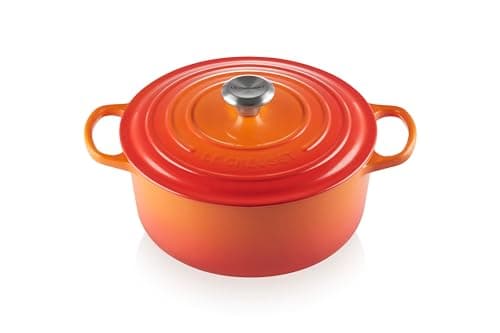
Published specifications for the Le Creuset Signature Round Dutch Oven, 5.5 qt
Material
Cast iron with porcelain enamel inside and out
Capacity
5.5 qt
Interior enamel
Sand-colored, so browning and fond stay visible
Knob
Stainless steel, rated to 500F
Induction
Yes - the iron under the enamel is ferrous
Dishwasher
Dishwasher safe; Le Creuset recommends hand washing
Warranty
Limited lifetime
Made in
France
Good
The pale interior is a genuine cooking advantage: you can see whether the fond is browning or burning
Wide, low-profile handles that a hand in an oven mitt actually fits
The one enameled pot with a real secondhand market, which changes the true cost of ownership
Not good
Costs several times a Lodge enameled pot of the same capacity
The pale interior stains permanently, and Le Creuset says so
Chipped enamel is not repairable on any enameled pot, this one included
The trade-off. You are paying a large multiple of what a Lodge enameled pot costs for a difference in enamel quality, finish and resale value rather than in cooking.
Skip this if. You braise a few times a year. The cooking difference over a Lodge enameled pot is small; the price difference is not.
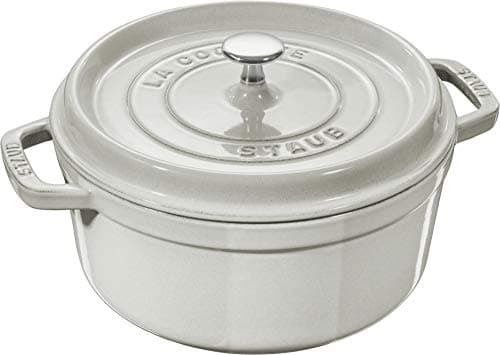
Published specifications for the Staub Round Cocotte, 5.5 qt
Material
Cast iron with enamel inside and out
Capacity
5.5 qt
Interior enamel
Black matte and textured - does not show staining
Lid
Self-basting spikes on the underside
Knob
Metal; the oven rating is set by the knob, so check the specific SKU
Induction
Yes
Warranty
Limited lifetime
Made in
France
Good
Black matte interior is the practical answer to the staining complaint about pale enamel
Heavier lid than most, which matters more than the spikes do on a long braise
Textured interior takes a hard sear better than a glossy enamel does
Not good
You cannot see the fond, which is a real loss on anything you are building a sauce from
Heavy even by enameled cast iron standards
Priced with Le Creuset, so the same skip-if applies
The trade-off. The black matte interior hides fond as well as it hides stains, so you judge browning by smell and by lifting the food rather than by looking.
Skip this if. You want to watch the fond develop. Buy the sand-colored interior instead and accept that it will discolor.
Five and a half to six quarts suits most households. It holds a three to four pound chicken, braises for four in a single layer, takes a standard bread loaf and still fits a normal cupboard. Buy 3.5 to 4 quarts only if you cook for one or two.
›Is a 5 quart Dutch oven big enough?
For two to four people, yes, for almost everything. It runs out on a whole chicken with room to spare and on bread with a tall rise. The step from 5 to 5.5 quarts is small in capacity and noticeable in versatility.
›Should I buy a round or oval Dutch oven?
Round, unless you regularly cook a long cut like a rack or a whole fish. An oval pot overhangs the burner at both ends, so the middle heats and the ends do not - and that is worse still on a smooth-top stove.
›Does the size affect how hot a Dutch oven can go in the oven?
No, but the knob does. Every brand rates its pots by the knob material rather than the iron, so the ceiling varies by SKU. Several sell a stainless replacement knob that raises the rating on a pot you already own.
›Do I need more than one Dutch oven?
Almost certainly not. In kitchens that own two, the second is usually the least-used pot in the cupboard. Buy the size that covers your normal cooking and add a stockpot instead if you need more volume.
Sources
Every figure on this page came from one of these. Follow them and check our arithmetic — that is the point.