The manufacturers hedge and the internet panics. The real risks are scratching and thermal cycling, both of which come from how you move the pan rather than from its weight.
Heads up: some links on this page earn us a commission at no extra cost to you. It does not change what we recommend or the order. How we are funded.
The short answer
Lift, never slide. Nearly every scratched cooktop was scratched by a pan being dragged, not by a pan sitting still.
Check the base is smooth and clean. A rough casting or a grain of grit under the pan is what actually does the damage.
Preheat gently, on medium. Cast iron holds heat, so it needs less power than you think, and a radiant element cycling under a heavy pan is the thermal stress that worries manufacturers.
Keep the diameter close to the element. A pan much wider than the ring traps heat against the glass.
The short version: yes, with rules
Cast iron works on a glass or ceramic smooth top. It is ferrous, so it works on induction too. The reason this question exists at all is that cooktop manufacturers write cautious language into their manuals about heavy cookware, and that language gets repeated online as a prohibition.
The caution is not baseless. There are two real risks and they are worth naming precisely, because once you know what they are the mitigation is obvious and costs nothing.
Risk one: scratching
A ceramic-glass cooktop is hard, but it is not scratch-proof, and bare cast iron has a casting surface that ranges from smooth to distinctly rough depending on the maker and the era. Modern Lodge castings are considerably smoother than vintage ones, though none of them are polished.
What almost always causes the scratch is not the pan alone - it is the pan plus grit. A grain of salt, a crumb, a fleck of burnt-on sugar under the base becomes an abrasive point under twelve pounds of iron, and dragging the pan an inch drags that point across the glass.
Wipe the cooktop before the pan goes on. This is the whole fix.
Lift the pan on and lift it off. Never rotate it, never slide it to a different ring.
Run a hand over the base of a new pan. If it feels genuinely rough, it can be smoothed with sandpaper - or buy an enameled piece, which has a glazed base.
Enameled cast iron has a smoother base than bare iron in almost every case, which is why it is the easier version of this material on a smooth top. Check the base rim on a budget enameled pot though - unglazed rims are common and they are rougher than the glaze.
Risk two: thermal cycling
A radiant smooth top works by cycling an element on and off under the glass to hold a set temperature. Put a pan with very high thermal mass on it and the pattern changes: the glass under the pan gets hotter for longer, and the temperature difference between the covered area and the surrounding glass increases.
This is the reason for the manufacturer caution, and it is why the mitigation is about heat rather than weight:
Preheat on medium, not high. Cast iron does not need high heat to get hot, it needs time - which is the same lesson as cooking on electric stoves generally.
Do not use a pan much wider than the element. Overhang traps heat against glass that is not designed to be under a pan.
Never put a cold pan on a hot element or a hot pan on a cold cooktop more abruptly than you have to.
Avoid two-burner griddles on a smooth top entirely. They bridge elements and cover glass between them, which is exactly the case the manuals warn about.
Which cast iron suits a smooth top
Piece
On a smooth top
Why
8 to 10 in skillet
Ideal
Matches a standard element and is light enough to lift cleanly
12 in skillet
Fine, with care
Heavy, and it overhangs most elements - preheat gently
Enameled Dutch oven
Ideal
Glazed base, and it mostly sits still on a low simmer
Grill pan
Workable
Ridges do not touch the glass; the flat rim does. Same rules apply
Two-burner reversible griddle
Avoid
Bridges two elements and covers glass between them
Oval or irregular pots
Avoid
Overhang at both ends concentrates heat off the element
Vintage or rough-cast pans
Check first
Older castings are rougher; smooth the base or use it elsewhere
Nothing in this table is about weight in isolation. It is about how much glass the pan covers and how well the base sits.
If your smooth top is induction
Induction changes the picture in cast iron's favor. The glass is not the heat source - the pan is - so the thermal cycling concern largely disappears, and the response is immediate rather than lagging. Cast iron is strongly ferrous, so it couples extremely well.
The scratching rule is unchanged, because it is still a glass surface. One extra caution: a very heavy pan dropped onto an induction hob is a real breakage risk, and induction surfaces are no tougher than radiant ones. The material guide for that stove is cookware for induction.
If you would rather not
It is a completely legitimate decision. If the lifting discipline sounds like a chore, or the cooktop is new and you would rather not think about it, clad stainless does most of what a cast iron skillet does with none of the caution: it is light, flat, induction-ready and published to 500F or 600F depending on the brand.
What you give up is the thermal mass that makes cast iron sear the way it does - the comparison is in stainless steel versus cast iron. Carbon steel is the middle answer: much lighter than cast iron, similar searing behavior, and a smoother base. It is compared in cast iron versus carbon steel, with the caveat that carbon steel warps more readily, which matters more on a flat surface than on a gas ring.
The routine, in four lines
Wipe the glass. Every time, before the pan goes down.
Lift on, lift off. Never slide, never rotate.
Medium heat, longer preheat. High heat buys nothing with cast iron.
Match the pan to the element, and skip the two-burner griddle.
Cast iron that suits a smooth top, and the alternative
Smaller pans and enameled bases are the easy version of this material on glass. The clad skillet is here because opting out is a reasonable choice.
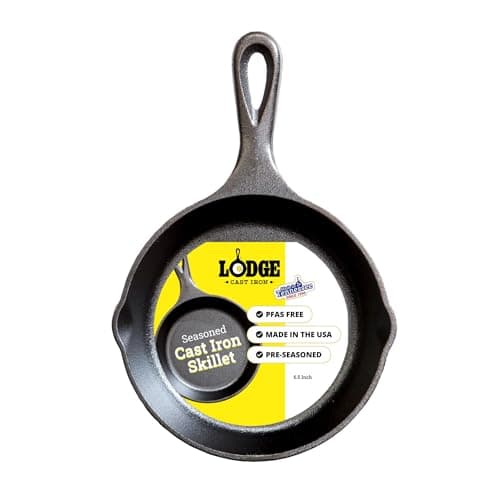
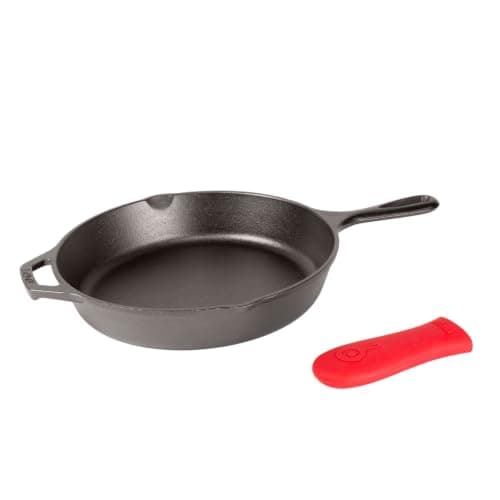
Lodge Seasoned Cast Iron Skillet, 10.25 in (L8SK3)
Searing, cornbread, and anyone who wants one pan that cannot be worn out
These are the products this page's reasoning actually points at. Same rules as everywhere else on the site: published specs, a stated trade-off, and a live price only where one exists.
Top pick · The size that suits a smooth topSpecs read September 3, 2026
Lodge Seasoned Cast Iron Skillet, 10.25 in (L8SK3)
Ten inches sits close to a standard element, weighs little enough to lift one-handed, and is the pan most people should own anyway.
Best for: Searing, cornbread, and anyone who wants one pan that cannot be worn out
Published specifications for the Lodge Seasoned Cast Iron Skillet, 10.25 in (L8SK3)
Diameter
10.25 in
Weight
5.66 lb
Oven maximum
550F
Induction
Yes - bare iron is ferrous
Seasoning
Pre-seasoned with soy-based vegetable oil, no synthetic chemicals
Warranty
Lifetime
Made in
USA
Care
Hand wash. Lodge's own instructions permit warm soapy water
Good
Effectively unbreakable and fully restorable - a rusted one can be stripped and re-seasoned
Holds heat better than anything else at the price, which is what a sear needs
Lodge publishes its seasoning method openly, so the maintenance is not a mystery
Not good
Heavy
Heats unevenly on a small burner: cast iron conducts at roughly 50 W/m-K, so it is slow to spread and slow to react
Bare iron is reactive; long tomato braises will taste of it
The trade-off. It weighs 5.66 lb empty. You will feel that every time you move it full, and it is the single most common reason a cast iron skillet ends up in a cupboard.
Skip this if. You have wrist or shoulder trouble, or you cook mostly acidic braises. Carbon steel does most of the same jobs at roughly half the weight.
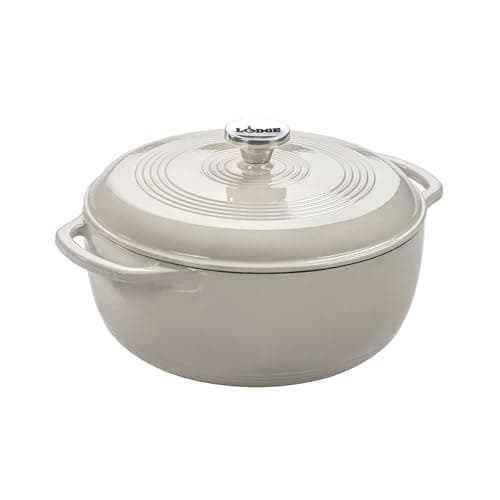
Published specifications for the Lodge Enameled Cast Iron Dutch Oven, 6 qt
Material
Cast iron with porcelain enamel, inside and out
Capacity
6 qt
Induction
Yes - the iron under the enamel is ferrous
Seasoning
None required - enamel is not a seasoning surface
Acid
Safe for tomato and wine, unlike bare iron
Oven maximum
Set by the knob material - check the specific SKU; Lodge publishes a lower ceiling than for bare iron
Good
Non-reactive, so it handles the acidic cooking bare iron cannot
No seasoning to maintain
Considerably cheaper than the French enameled pots it copies
Not good
Chipped enamel is not repairable, unlike bare iron's seasoning
Oven ceiling is lower than bare cast iron because of the knob
Heavy, and the enamel makes it heavier than bare iron of the same capacity
The trade-off. The enamel is a glass layer. Chip it and the pot is not restorable the way bare iron is, and Lodge's enamel chips more readily than the premium brands'.
Skip this if. You already own a large stainless stockpot and rarely braise. This duplicates it for most weeknight cooking.
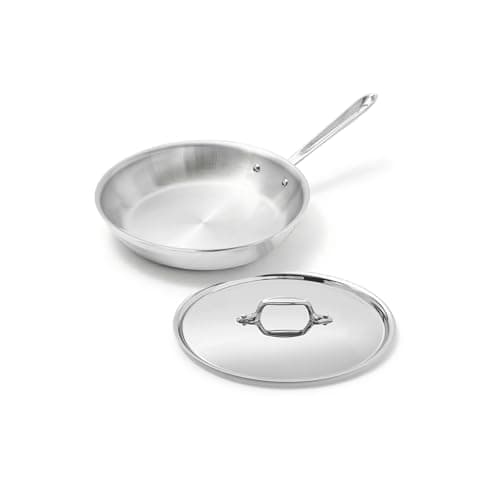
Published specifications for the All-Clad D3 Stainless 10 in Fry Pan
Construction
Fully bonded tri-ply, aluminum core
Oven maximum
600F, oven and broiler safe
Induction
Yes - compatible with any stovetop
Dishwasher
Handwash only (All-Clad published)
Handle
Double-riveted stainless
Weight
3.0 lb (model 4110)
Warranty
Limited lifetime
Made in
Bonded, engineered and assembled in Canonsburg, PA
Good
600F is the highest oven ceiling of any stainless pan on this site
The one pan here whose manufacturing location is published down to the town
Genuinely repairable-adjacent: rivets are the only failure point and the warranty covers them
Not good
Hand wash only
The flared rim makes it a poor pan for anything with liquid
Costs several times what a Tramontina or Cuisinart pan of the same construction costs
The trade-off. Hand wash only. All-Clad publishes that plainly, and it is a real daily cost on a pan you will use every day.
Skip this if. You want a dishwasher-safe pan, or you are buying a whole kitchen on a fixed budget - one D3 skillet costs what a full clad set can cost.
Yes. Lift the pan on and off rather than sliding it, wipe the glass first so no grit gets trapped underneath, preheat on medium rather than high, and keep the pan close to the size of the element. Those four habits cover both real risks.
›Will cast iron scratch a ceramic cooktop?
The pan alone rarely does. What scratches is grit trapped between a rough base and the glass while the pan is dragged. Wiping the cooktop and lifting rather than sliding removes almost all of the risk.
›Is enameled cast iron better than bare on a smooth top?
Generally yes, because a glazed base is smoother than a bare casting. Check the base rim on budget enameled pots though - unglazed rims are common and are rougher than the glaze around them.
›Can you use a cast iron griddle across two burners on a glass cooktop?
Avoid it. A two-burner griddle bridges elements and covers glass that is not designed to sit under a pan, which is exactly the situation cooktop manuals warn about.
›Does cast iron work on induction?
Very well - it is strongly ferrous, so it couples efficiently, and because the glass is not the heat source the thermal cycling concern largely disappears. The scratching rules still apply, and a heavy pan dropped on an induction hob can still crack it.
Sources
Every figure on this page came from one of these. Follow them and check our arithmetic — that is the point.