Heads up: some links on this page earn us a commission at no extra cost to you. It does not change what we recommend or the order. How we are funded.
The short answer
Buy flat-bottomed clad stainless with a smooth, unmarked base - it is the best match for a glass cooktop because heat transfers entirely by contact, so flatness matters more than material. Avoid anything warped, anything with a rough cast base, and any pan you would be tempted to slide rather than lift. Cast iron works but demands care. Lightweight coated aluminum is fine and heats fast. The two rules that prevent almost all damage: lift, never drag, and never let a pan boil dry.
Quick picks
The whole answer, on one screen. Tap a row to jump to the full write-up. Every pick below carries a stated trade-off further down — including the one at the top.
#
Product
Best for
Price
1
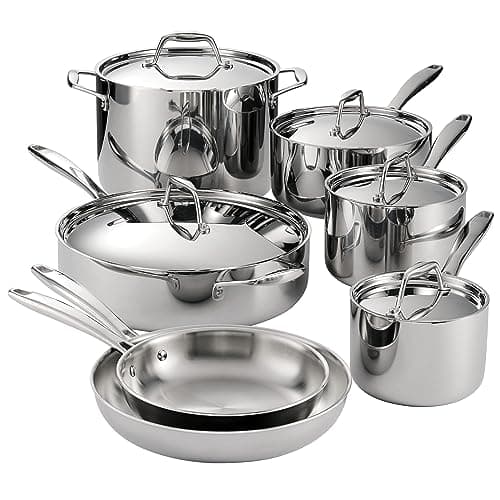
Tramontina Signature Tri-Ply Clad 12-Piece Set
Fully clad stainless with smooth, flat, ground bases - the construction that makes the most of a contact-only heat source.
Prices last checked September 27, 2026. Prices move constantly — the number on Amazon when you click is the real one.
Why flatness matters more than material here
A glass or ceramic cooktop has a radiant element under a sheet of ceramic glass. The glass gets hot and the pan sits on it, so heat moves into the pan almost entirely by direct contact. There is no flame wrapping around the sides and no magnetic field inducing heat in the metal.
The consequence is simple: any part of the base not touching the glass is not receiving heat. A pan with a slight dome in the middle - which is extremely common - has a ring of contact and a cold center, and oil runs to the edges. On a gas burner you would barely notice. On glass it is the difference between a pan that works and one that does not.
That is why flatness is the first specification, ahead of cladding, thickness or brand - cookware for electric stoves covers radiant and coil elements more broadly, including the rest of what smooth tops share with them.
Test any pan you already own: set it on a genuinely flat surface and try to rock it, then look along the base at eye level for daylight under the middle. A pan that spins freely when nudged, or pools oil at the rim, is domed and will disappoint on glass - why pans warp.
Material by material
Material
On glass
Watch for
Clad stainless
Best all-round match
Nothing - this is the default recommendation
Coated aluminum
Very good, heats fast
Thin bases warp; light pans are easy to lift
Hard-anodized
Good
Check it is genuinely flat; darker bases can hide grit
Disc-bottom stainless
Fine
The disc can separate and then rock
Bare cast iron
Works, with care
Rough casting plus weight is the scratch risk
Enameled cast iron
Works, with care
Heavy; a chipped base edge is abrasive
Carbon steel
Good
Thin pans can oil-can; watch flatness
Stoneware and glass
Avoid on the hob
Many makers exclude cooktop use entirely
Copper
Fine if flat
Soft base marks the glass with dragging
Clad stainless wins for an unexciting reason: bonded construction with a machined base stays flat, and a flat base is the whole game. Cladding also spreads the heat from the element ring across the base, which matters because a glass cooktop heats in a ring rather than evenly - disc bottom versus fully clad.
The cast iron question
Cast iron on glass is the argument everyone has. The short version: it works, the risk is real but overstated, and the risk is about handling rather than the material.
A rough, sand-cast base dragged across ceramic glass will scratch it. The same pan lifted on and off, with a clean base and a clean cooktop, generally will not. Weight is the other factor - dropping eight pounds of iron onto glass is a cracked cooktop, not a scratch. Cast iron on glass-top stoves works through it properly, including which manufacturers say what.
If you want the searing performance without the anxiety, carbon steel is much lighter with a smoother base, and clad stainless is lighter still - best pans for searing steak.
What actually damages a glass cooktop
Dragging pans. The single biggest cause of scratches, and entirely avoidable. Lift the pan, every time, even when it is heavy and you are tired.
Grit under the pan. A crumb of salt or sugar between a metal base and glass is an abrasive under load. Wipe the cooktop and the pan base.
Sugar spills left to burn on. Molten sugar bonds to ceramic glass and can pit it when scraped off. Clean sugary spills while warm, carefully.
Boiling a pan dry. An empty pan on a radiant element gets far hotter than the glass is designed for, and aluminum can transfer onto the surface as a permanent metallic mark.
Dropping things. Ceramic glass is strong in compression and poor against impact. This is the one that ends a cooktop rather than marking it.
Oversized pans. A pan much wider than its element traps heat against the glass around the edge, which stresses the surface.
Match the pan to the element
On glass, the element ring is drawn on the surface and the pan base should match it closely - roughly the same diameter, or very slightly larger. Too small and you waste the element and heat the glass; too large and heat spreads sideways under the pan and up around it.
If you are replacing the cooktop rather than the pans, the flat-base rule carries straight over to induction - and adds a magnetic requirement.
If you might move to induction
Worth thinking about now, because it costs nothing. Induction demands a flat base too, plus a magnetic one. Buying clad stainless with a ferrous exterior means your pans carry over unchanged if the cooktop is ever replaced, whereas plain aluminum lines will not - cookware for induction and gas versus induction cookware.
Keeping the surface clear
A clean cooktop is also a better-performing one, because burnt-on residue insulates the pan from the glass. Use a dedicated ceramic cooktop cream and a plastic scraper held at a low angle. Avoid abrasive pads, and avoid the oxalic acid cleaners that are right for stainless pans - cleaning burnt stainless.
White or gray marks that look like scratches are often metal transfer from a pan base rather than damage, and cooktop cream removes them.
Cooktop cream on Amazon — a clean surface transfers heat better and hides fewer abrasive crumbs.
Every pick, in full
Each write-up below gives the published specs, what the pan is genuinely good at, what it costs you, and who should skip it. The trade-off line is there on the top pick too — a recommendation with no downside is an advertisement.
Top pick · Best set for a glass cooktopSpecs read September 3, 2026
Tramontina Signature Tri-Ply Clad 12-Piece Set
Fully clad stainless with smooth, flat, ground bases - the construction that makes the most of a contact-only heat source.
Best for: A first kitchen that should not need replacing
Published specifications for the Tramontina Signature Tri-Ply Clad 12-Piece Set
Construction
Tri-ply: 18/10 stainless, aluminum core, magnetic stainless exterior
Pieces
8 in and 10 in fry pans; 1.5, 2 and 3 qt covered saucepans; 5 qt covered deep saute; 8 qt covered stockpot
Oven maximum
500F on the 80116-249DS listing; other SKUs in the line are listed at 350F
Induction
Yes - magnetic stainless exterior
Dishwasher
Listed dishwasher safe
Handles
Precision cast, riveted
Certification
NSF-certified on the 80116-249DS line
Country of origin
Not asserted - retail listings disagree across SKUs (Brazil and China both appear)
Good
Fully clad, not disc-bottom: the aluminum runs up the sidewalls, so sauces do not scorch in a ring at the base
NSF certification on the flagship SKU is a real, checkable third-party mark rather than a marketing badge
Induction-ready without paying an induction premium
Not good
Retail listings disagree on the oven maximum across SKUs in the same line, which is a documentation problem, not a cooking one
Handles run hot on gas
The 12-piece count includes lids; the useful-item count is seven
The trade-off. Handles are the weak point. They are riveted and sturdy, but they get hot on a gas ring in a way the more expensive clad brands' do not.
Skip this if. You want a set you can leave in the oven above 500F, or you cook mostly eggs and pancakes and would rather spend the money on one good nonstick pan.
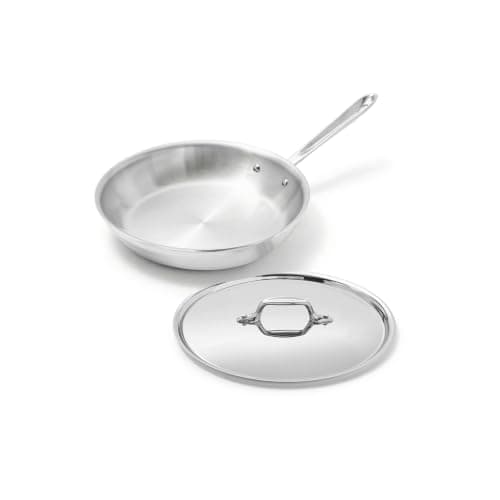
Published specifications for the All-Clad D3 Stainless 10 in Fry Pan
Construction
Fully bonded tri-ply, aluminum core
Oven maximum
600F, oven and broiler safe
Induction
Yes - compatible with any stovetop
Dishwasher
Handwash only (All-Clad published)
Handle
Double-riveted stainless
Weight
3.0 lb (model 4110)
Warranty
Limited lifetime
Made in
Bonded, engineered and assembled in Canonsburg, PA
Good
600F is the highest oven ceiling of any stainless pan on this site
The one pan here whose manufacturing location is published down to the town
Genuinely repairable-adjacent: rivets are the only failure point and the warranty covers them
Not good
Hand wash only
The flared rim makes it a poor pan for anything with liquid
Costs several times what a Tramontina or Cuisinart pan of the same construction costs
The trade-off. Hand wash only. All-Clad publishes that plainly, and it is a real daily cost on a pan you will use every day.
Skip this if. You want a dishwasher-safe pan, or you are buying a whole kitchen on a fixed budget - one D3 skillet costs what a full clad set can cost.
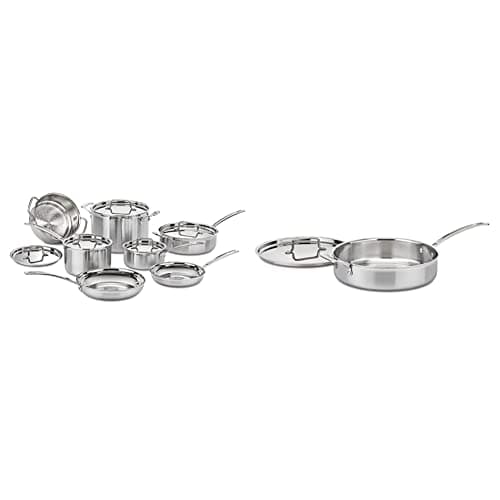
Published specifications for the Cuisinart MultiClad Pro MCP-12N 12-Piece Set
Construction
Tri-ply: 18/10 stainless interior, pure aluminum core, brushed stainless exterior
Pieces
1.5 and 3 qt covered saucepans; 8 in and 10 in skillets; 3.5 qt covered saute; 8 qt covered stockpot; steamer insert
Oven maximum
500F per the Cuisinart use-and-care manual. Amazon listings say 550F; Cuisinart has confirmed the manual figure
Induction
Yes
Dishwasher
Dishwasher safe
Handles
Riveted solid stainless, cool-grip profile
Warranty
Lifetime
Good
Heat runs up the sidewalls, not just across the base
Genuinely dishwasher safe, which the pricier clad brands often are not
Lifetime warranty on a set at this price
Not good
Published oven maximum contradicts the retail listing for the same product
Handle spine is divisive
No 12-inch skillet in the box, which is the pan most people reach for second
The trade-off. The cool-grip handles have a sharp spine that some people find uncomfortable on a full 8-quart stockpot.
Skip this if. You want the higher oven ceiling that the Amazon listing advertises. The manual says 500F and Cuisinart has confirmed the manual is correct.
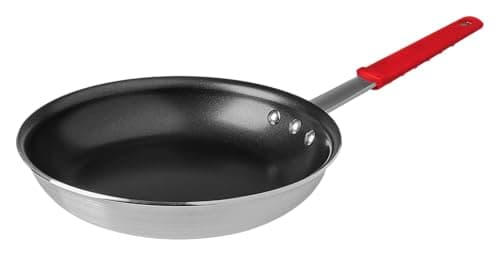
Published specifications for the Tramontina Professional Restaurant Fry Pan, 10 in
Body
Heavy-gauge aluminum
Coating
PTFE nonstick
Induction
No - aluminum body is not ferrous
Coating lifespan
Not published, by this or any nonstick maker
Good
Cheap enough that replacing it every couple of years is a real plan rather than a failure
Heavy gauge for a nonstick pan, so it does not warp on the first hot burner
Silicone handle sleeve that actually stays cool
Not good
Not induction compatible
PTFE, which some buyers will rule out on principle
No published coating lifespan, so the value case is unverifiable by design
The trade-off. It is PTFE. That is fine at normal cooking temperatures, and it is not a pan to preheat empty on high.
Skip this if. You want to avoid PTFE entirely. Buy ceramic instead and accept the shorter release life rather than pretending either one lasts forever.
Flat-bottomed clad stainless steel. A glass cooktop transfers heat purely by contact, so a machined flat base matters more than the material, and bonded cladding spreads the ring-shaped heat of the element across the base. Smooth exteriors also reduce the risk of marking the glass.
›Can you use cast iron on a glass top stove?
Yes, with care. The risk comes from handling rather than the material - a rough cast base dragged across ceramic glass will scratch it, and dropping a heavy pan can crack the surface. Lift rather than slide, keep both the base and cooktop clean, and it works fine.
›What should you not use on a glass cooktop?
Warped or domed pans, anything with a rough or chipped base, round-bottomed woks, and most stoneware and glass vessels, which many makers exclude from cooktop use. Also avoid pans much wider than the element, which traps heat against the surrounding glass.
›Why does my pan not heat evenly on a glass stove?
Almost always because the base is not flat. Any part of the base that is not touching the glass receives no heat, so a slightly domed pan has a hot contact ring and a cold center. Check by looking along the base for daylight underneath, or seeing whether oil pools at the rim.
›How do you avoid scratching a glass cooktop?
Lift pans instead of sliding them, wipe both the cooktop and the pan base before cooking so no grit is trapped underneath, clean sugary spills while they are still warm, and never let a pan boil dry. Dragging and grit cause the overwhelming majority of scratches.
Sources
Every figure on this page came from one of these. Follow them and check our arithmetic — that is the point.