Cookware listings are written to be technically true. Most of the work is knowing which words are claims, which are decoration, and which numbers are measured somewhere you did not expect.
Heads up: some links on this page earn us a commission at no extra cost to you. It does not change what we recommend or the order. How we are funded.
The short answer
"Stainless steel" describes the surface you can see, not the construction underneath it.
"Tri-ply base" is a disc-bottom pan. "Tri-ply" alone usually means fully clad.
Diameter is measured rim to rim. The cooking surface is one to two inches smaller.
"Oven safe to X" is the handle's number, and the lid is often rated lower.
Missing weight, missing thickness and an unnamed coating are omissions, not oversights.
The construction words
"Stainless steel" on its own
This tells you what the pan is faced with, not what it is made of. A pan can be stainless on both surfaces with aluminum between - which is good - or stainless-faced over a thin aluminum disc welded to the base - which is much less good - or, on cheap pans, essentially solid stainless, which heats badly and unevenly because stainless is a poor conductor. Disc bottom versus fully clad is the distinction that matters most in the category.
"Tri-ply base" versus "tri-ply"
One word changes the product. "Tri-ply base", "encapsulated base" or "impact-bonded base" means the three layers exist only in the disc under the pan; the walls are single-ply stainless. "Tri-ply" or "fully clad" means the layers run up the sidewalls too. Sauces and anything that climbs the wall behave completely differently between the two. Tri-ply versus five-ply covers the next step up.
Grade numbers
18/10 and 18/8 describe chromium and nickel content in the food-contact layer, and the practical difference between them is small. 18/0 has no nickel, is magnetic, and is what the exterior of an induction-ready pan is usually made from. Stainless steel grades explained covers what each is for.
The numbers, and where they are measured
What the listing says
What it actually means
10 inch skillet
Measured rim to rim across the top. The flat cooking surface is typically 7.5 to 8.5 inches.
3 quart saucepan
Capacity to the absolute brim. Usable capacity is meaningfully less.
Oven safe to 450F
The rating of the lowest-rated part, usually the handle. Check whether the lid is separate.
Dishwasher safe
A claim about survival, not about longevity. The manual often says hand wash for best results.
12 piece set
Counts lids as pieces. A 12 piece set is often 7 pans and 5 lids.
Heavy gauge
Unregulated. It means nothing without a millimeter or a weight.
Induction compatible
Verifiable at home with a magnet. If it sticks firmly to the base, it works.
None of these is a lie. All of them are measured somewhere other than where a buyer assumes.
The rim-versus-cooking-surface gap is the one that causes the most regret, because it is the difference between fitting four chicken thighs and fitting three. What size skillet and what size saucepan work from the usable number rather than the printed one.
Coating language
A coated pan listing that does not name the coating is telling you something. The lines that publish a coating name and a chemistry - Thermolon, AMERICOAT, a named PTFE system - are the ones willing to be held to it. Nonstick coating names decoded translates the common ones.
"PFOA-free" is true of essentially every pan sold today. PFOA was phased out of US manufacturing years ago, so the phrase distinguishes nothing - is nonstick safe.
"Ceramic" means a silica-based sol-gel coating, not ceramic the material. It is a coating with a shorter life than PTFE - PTFE versus ceramic.
"Diamond-infused" and "granite" describe filler particles in an otherwise ordinary coating, and are marketing rather than a category - marble and granite coated cookware.
"Scratch resistant" without a published metal-utensil statement means use silicone.
What is missing, and why
The most informative part of a cookware listing is often the specification that is not there. Manufacturers publish numbers they are proud of.
Weight. Omitted when a pan is either flimsy or unexpectedly heavy. It is also the specification that best predicts whether you will use the pan.
Thickness in millimeters. Rare, and a strong positive signal when present. Made In and Misen publish it; most do not.
Country of manufacture. "Imported" is a choice. Lines that manufacture somewhere they want to advertise name the town - cookware made in the USA.
Coating lifespan. Nobody publishes it, in any market, at any price - how long nonstick lasts.
What the warranty excludes. "Lifetime warranty" almost always means limited lifetime, and the exclusions are where the detail lives - cookware warranties explained.
When a listing and the manufacturer's own manual disagree, the manual wins. Retail listings are written by people who did not make the pan, and the care instructions in the box are what the warranty is actually written against.
Words that mean nothing
"Professional", "restaurant grade", "chef quality", "commercial" and "premium" are unregulated in cookware. Some pans carrying them are genuinely what restaurants buy, which is a real and specific thing - restaurant cookware for home kitchens covers what that actually looks like, and it is usually plainer and cheaper than the word implies.
"Even heating" and "superior heat distribution" appear on disc-bottom pans and fully clad pans alike. "Ergonomic handle" appears on every pan sold. Treat all of them as filler and read the numbers instead.
A listing that names the foundry is making a claim it can be held to. One that says imported is making none.
The listing checklist
Is it fully clad or disc-bottom? Look for the word "base".
What is the cooking surface diameter, not the rim diameter?
What is the oven rating, and is the lid rated separately?
Is the coating named, and is metal-utensil safety published?
Is weight or thickness published anywhere?
Does the piece count include lids?
Does the manual agree with the listing on washing and heat?
Is a country named, or is it "imported"?
Eight questions, and most listings fail three or four of them. That is not a reason to walk away - it is a way to compare two pans that look identical on a search results page. Cookware set buying mistakes applies the same reading to sets.
Lines that publish enough to be judged
Chosen here for disclosure quality rather than for price - these are the listings the checklist above passes.
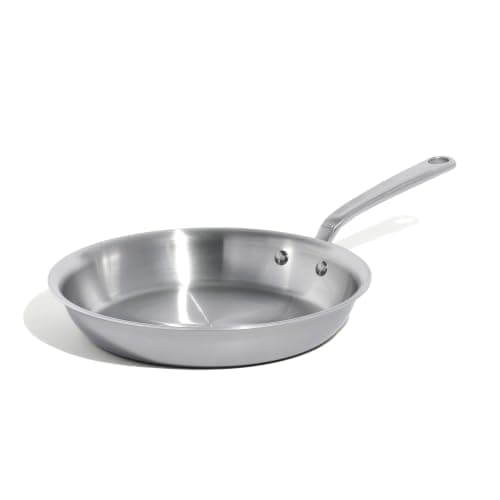
Made In Stainless Clad Frying Pan, 10 in
Anyone who wants five-ply construction and a published origin rather than a story
These are the products this page's reasoning actually points at. Same rules as everywhere else on the site: published specs, a stated trade-off, and a live price only where one exists.
Top pick · Best published specificationsSpecs read September 3, 2026
Made In Stainless Clad Frying Pan, 10 in
Names the country, counts the layers and states the thickness in millimeters - the disclosure standard to judge other listings against.
Best for: Anyone who wants five-ply construction and a published origin rather than a story
Published specifications for the Made In Stainless Clad Frying Pan, 10 in
Construction
5-ply, published as "5 layers of domestic and imported metal"
Layer metals
Not named on the product page
Thickness
2.7 mm
Total diameter
10.5 in
Cooking surface
7.5 in
Weight
2.25 lb
Handle
Stay Cool Handle, hollow build; attachment method not published
Oven maximum
800F (425C)
Induction
Compatible with gas, electric and induction
Dishwasher
Handwash preferred
Made in
Italy
Warranty
Published as limited or lifetime depending on the range; full terms are on a separate page
Good
Publishes a thickness in millimeters, which most of this bracket does not
Names the country - Italy - rather than saying imported
800F ceiling covers any oven or broiler use
Not good
The five layers are described as domestic and imported metal rather than named
Handwash preferred, on a pan with no coating to protect
Warranty terms live on a separate page rather than the product page
The trade-off. Made In publishes the ply count and the thickness but does not name the five metals on the product page, which All-Clad and Misen both do.
Skip this if. You want the cheapest fully clad pan that works. Tramontina is clad too, at a fraction of the price.
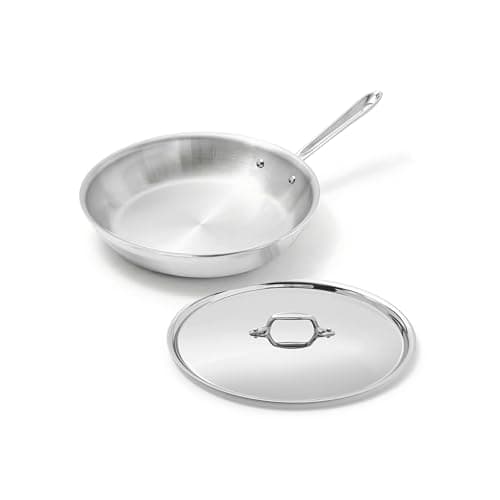
Published specifications for the All-Clad D3 Stainless 10 in Fry Pan
Construction
Fully bonded tri-ply, aluminum core
Oven maximum
600F, oven and broiler safe
Induction
Yes - compatible with any stovetop
Dishwasher
Handwash only (All-Clad published)
Handle
Double-riveted stainless
Weight
3.0 lb (model 4110)
Warranty
Limited lifetime
Made in
Bonded, engineered and assembled in Canonsburg, PA
Good
600F is the highest oven ceiling of any stainless pan on this site
The one pan here whose manufacturing location is published down to the town
Genuinely repairable-adjacent: rivets are the only failure point and the warranty covers them
Not good
Hand wash only
The flared rim makes it a poor pan for anything with liquid
Costs several times what a Tramontina or Cuisinart pan of the same construction costs
The trade-off. Hand wash only. All-Clad publishes that plainly, and it is a real daily cost on a pan you will use every day.
Skip this if. You want a dishwasher-safe pan, or you are buying a whole kitchen on a fixed budget - one D3 skillet costs what a full clad set can cost.
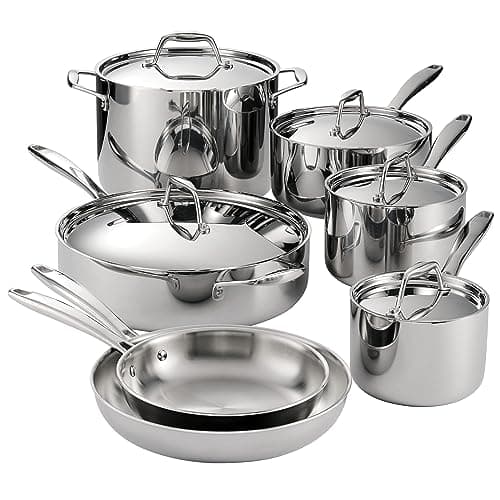
Published specifications for the Tramontina Signature Tri-Ply Clad 12-Piece Set
Construction
Tri-ply: 18/10 stainless, aluminum core, magnetic stainless exterior
Pieces
8 in and 10 in fry pans; 1.5, 2 and 3 qt covered saucepans; 5 qt covered deep saute; 8 qt covered stockpot
Oven maximum
500F on the 80116-249DS listing; other SKUs in the line are listed at 350F
Induction
Yes - magnetic stainless exterior
Dishwasher
Listed dishwasher safe
Handles
Precision cast, riveted
Certification
NSF-certified on the 80116-249DS line
Country of origin
Not asserted - retail listings disagree across SKUs (Brazil and China both appear)
Good
Fully clad, not disc-bottom: the aluminum runs up the sidewalls, so sauces do not scorch in a ring at the base
NSF certification on the flagship SKU is a real, checkable third-party mark rather than a marketing badge
Induction-ready without paying an induction premium
Not good
Retail listings disagree on the oven maximum across SKUs in the same line, which is a documentation problem, not a cooking one
Handles run hot on gas
The 12-piece count includes lids; the useful-item count is seven
The trade-off. Handles are the weak point. They are riveted and sturdy, but they get hot on a gas ring in a way the more expensive clad brands' do not.
Skip this if. You want a set you can leave in the oven above 500F, or you cook mostly eggs and pancakes and would rather spend the money on one good nonstick pan.
It means the three bonded layers exist only in a disc attached to the bottom of the pan, while the sidewalls are single-ply stainless. Fully clad or tri-ply without the word base means the layers run up the walls too, which changes how sauces and anything that climbs the wall behave.
›Is a 10 inch skillet actually 10 inches?
Across the rim, yes. The flat cooking surface is typically seven and a half to eight and a half inches, because the sides flare. That gap is the difference between fitting four chicken thighs and three, so buy on the cooking surface rather than the printed size.
›Does PFOA-free mean anything?
Almost nothing today. PFOA was phased out of US cookware manufacturing years ago, so essentially every pan on sale qualifies. It distinguishes nothing between two modern pans and should not influence a purchase.
›What does oven safe to 450F actually refer to?
The lowest-rated component, which is nearly always the handle rather than the pan body. Lids are frequently rated lower still and listed separately, so a pan rated 450F may have a 350F glass lid, and that is the real ceiling for covered cooking.
›Should I trust the listing or the manual?
The manual. Retail listings are written by sellers who did not manufacture the pan, while the care instructions in the box are what the manufacturer's warranty is written against. Where they disagree on washing or heat, follow the manual.
Sources
Every figure on this page came from one of these. Follow them and check our arithmetic — that is the point.