Heads up: some links on this page earn us a commission at no extra cost to you. It does not change what we recommend or the order. How we are funded.
The short answer
2 qt is the one to own if you own one. Rice for two to four, sauces, reheating, a single portion of pasta, boiling eggs.
3 to 4 qt is the second. Pasta for two, soup, blanching, and stock in small batches.
1 qt is a milk pan. Useful, and not a substitute for a 2 qt.
Buy fully clad, always, in this shape. A saucepan is mostly wall, and a disc bottom leaves the wall cold.
Two quarts, if you buy one
The saucepan is the pan most kitchens reach for most often, and the size that covers the most jobs is 2 quarts. It cooks rice for two to four, holds a sauce without reducing it to nothing, boils eggs, reheats soup, and takes a single portion of pasta at a push.
The common mistake is buying 1 or 1.5 quarts because it looks like the everyday size. It is a milk pan: fine for melting butter, warming a small amount of liquid or making a single serving of oatmeal, and too small for a cup of dry rice with its water.
Size by size
Capacity
What it does well
Where it runs out
1 to 1.5 qt
Melting butter, warming milk, one portion of oatmeal, a small sauce
Rice for two; anything that boils over
2 qt
Rice, most sauces, boiled eggs, reheating, vegetables for two
Pasta for two, soup for four
3 qt
Pasta for two, soup for three, blanching, small batches of stock
A pound of pasta, batch soup
4 qt
Soup for four, pasta for three, boiling corn, small braises
Stock, chili for a week
5 qt and up
This is a pot, not a saucepan
Handling - one long handle is wrong at this weight
The 2 qt and 3 qt rows overlap deliberately. If you own only one saucepan, either works; if you own two, buy one from each row.
Why two saucepans, not one
Almost every real meal uses two at once - rice in one and sauce in the other, potatoes in one and greens in the other. A kitchen with one saucepan spends a lot of time washing it mid-cook.
If you are buying open stock, 2 qt and 3 qt is the pair. Every clad set includes at least two saucepans for this reason: the Tramontina Signature has 1.5, 2 and 3 qt, and the Cuisinart MultiClad Pro has 1.5 and 3 qt. Whether a set is the right purchase at all is the subject of set versus open stock.
This is the shape where cladding matters most
A saucepan is proportionally more wall than any other pan. When you reduce a sauce or simmer rice, most of the food is touching a vertical surface rather than the base.
In a fully clad saucepan the aluminum runs up that wall, so the whole vessel heats and a sauce reduces evenly. In a disc-bottom saucepan the wall is single-layer stainless with nothing in it, so the base is hot and the sides are not - which is exactly how a béchamel or a tomato sauce catches in a ring at the bottom. The construction argument in full is disc bottom versus fully clad, and the roundup is best stainless steel saucepans.
This is the one shape where we would spend more rather than less. A premium clad saucepan is a noticeably better object than a budget one in a way a premium skillet is not, because the sidewall does more of the work.
Tall and narrow, or wide and low
Two saucepans of the same capacity can be quite different shapes, and it changes what they are good at.
Tall and narrow reduces evaporation, which is what you want for simmering rice, cooking grains and holding a stock.
Wide and low evaporates faster, which is what you want for reducing a sauce, and gives more base area for softening onions before the liquid goes in.
A saucier is a wide saucepan with curved walls and no corners, made for constant whisking. It is a specialist purchase and genuinely better at custards and risotto; it must be fully clad, because it is almost entirely wall.
Lids, handles and the small details
The lid should be included. A saucepan without one is half a pan.
Check the lid rating, not the pan rating, if you use the oven. A glass lid or phenolic knob is usually the lowest number in the box.
A pouring lip helps more in this shape than in any other, since saucepans are what you pour from.
A single long handle is correct up to about 4 qt. Above that you want two.
Volume markings inside are a genuine convenience and rare below premium lines.
These are the products this page's reasoning actually points at. Same rules as everywhere else on the site: published specs, a stated trade-off, and a live price only where one exists.
Top pick · The size most kitchens should buySpecs read September 3, 2026
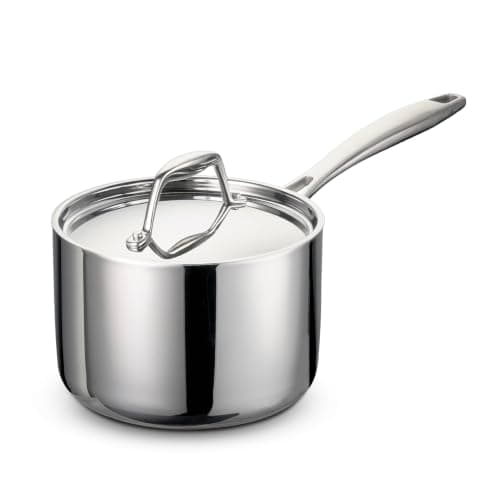
Tramontina Tri-Ply Clad Covered Saucepan, 2 qt
Two quarts of fully clad stainless - the most-used pan in most kitchens and the one people most often buy too small.
Best for: Sauces, grains and reheating, in the size a kitchen actually uses daily
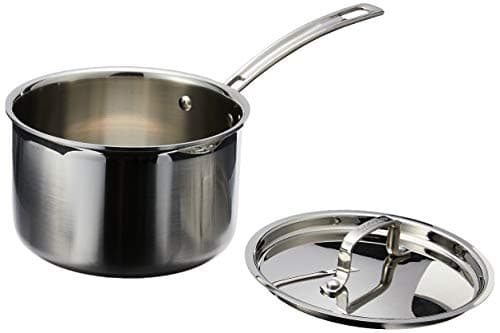
Published specifications for the Cuisinart MultiClad Pro Saucepan, 3 qt
Construction
Tri-ply: 18/10 stainless interior, pure aluminum core, brushed stainless exterior
Capacity
3 qt with lid
Oven maximum
500F per the Cuisinart use-and-care manual; retail listings say 550F
Induction
Yes
Dishwasher
Dishwasher safe
Handle
Riveted solid stainless, cool-grip profile
Warranty
Lifetime
Good
Genuinely dishwasher-safe clad stainless, which the premium brands are not
Fully clad rather than disc-bottom at an open-stock price
Lifetime warranty
Not good
Published oven maximum contradicts the retail listing for the same pan
The handle spine is divisive on larger pieces
No published country of manufacture
The trade-off. The oven ceiling is 500F per Cuisinart's manual, not the 550F some retail listings advertise. That is a documentation problem the buyer inherits.
Skip this if. You want the higher oven ceiling or the published US factory. That is All-Clad, and you pay for it.
Two quarts. It cooks rice for two to four, holds a sauce without over-reducing it, boils eggs and reheats soup. A 1 to 1.5 qt pan is a milk pan and will not cook a cup of dry rice with its water.
›Do you need more than one saucepan?
Most real meals use two at once - rice in one and sauce in the other. If you buy two, 2 qt and 3 qt is the pair. Every clad set includes at least two saucepans for exactly this reason.
›Should a saucepan be fully clad?
Yes, and more than any other shape. A saucepan is proportionally more wall than any other pan, so a disc-bottom design leaves the sides unheated and sauces catch in a ring at the base.
›What is the difference between a saucepan and a saucier?
A saucier is a wide saucepan with curved walls and no corners, designed for constant whisking. It is genuinely better at custards and risotto, and it must be fully clad because almost all of it is wall.
›When does a saucepan become a stockpot?
Around 4 to 5 quarts. Above that, a single long handle is the wrong design for the weight and you want a two-handled pot. Capacity for stock, chili and pasta is covered in our stockpot roundup.
Sources
Every figure on this page came from one of these. Follow them and check our arithmetic — that is the point.