Heads up: some links on this page earn us a commission at no extra cost to you. It does not change what we recommend or the order. How we are funded.
The short answer
Buy the saucepan first. Straight sides and a flat base hold more for their footprint, boil and simmer efficiently, and suit the rice, stock, vegetables and pasta that make up most saucepan work. A saucier trades capacity for a curved base with no corner, which lets a whisk reach every part of the pan and lets liquid reduce faster. It is the better pan for custards, risotto, polenta and pan sauces, and a second purchase rather than a first.
The difference, stated plainly
A saucepan has straight, usually vertical sides meeting a flat base at a distinct corner. A saucier has sides that curve continuously from the base to the rim, so there is no corner anywhere in the pan and the base is often slightly rounded too.
Everything else follows from that single geometric fact. Same material, same construction, same handle, same lid - one curve.
Why a corner matters
A whisk is round. A corner is not. Where the base meets the wall of a straight-sided saucepan, there is a ring the whisk cannot reach properly, and that ring is precisely where food scorches: it is heated from below and from the side simultaneously, and nothing is stirring it.
For boiling water this is irrelevant. For a custard thickened with egg yolk, or a roux, or polenta, or risotto, it is the difference between a smooth result and lumps with a scorched note. That is the whole case for the saucier.
A silicone spatula reaches a corner that a whisk cannot, which is why many cooks manage custards in a saucepan perfectly well. The saucier removes the need to think about it, it does not enable something otherwise impossible.
The second difference: evaporation
A saucier flares outward, so as liquid reduces, its surface area stays relatively large rather than shrinking into a narrow column. More surface means faster evaporation, which is what reducing a sauce actually is.
A straight-sided saucepan does the opposite, and that is sometimes what you want. Stock simmering for hours should not be reducing quickly. Rice absorbing a measured amount of water needs that water to stay in the pan. The straight-sided shape is better at holding liquid, which is the majority of saucepan work.
Which pan for which job
Job
Better shape
Why
Boiling water, blanching
Saucepan
Capacity per footprint, and shape is irrelevant
Rice and grains
Saucepan
Measured liquid should not evaporate away
Stock and long simmers
Saucepan
Tall and narrow limits evaporation
Pasta for one or two
Saucepan
Depth matters more than curve
Custard, creme anglaise
Saucier
No corner for eggs to scramble in
Risotto and polenta
Saucier
Constant stirring reaches everywhere
Pan sauces and reductions
Saucier
Larger surface area reduces faster
Roux and bechamel
Saucier
The whisk reaches the whole pan
Caramel
Saucier
Even heating, and easy to see the color change
Steaming vegetables
Saucepan
A lid and a basket need straight sides
Roughly six common jobs to one shape and four to the other. That ratio is the buying advice.
Cladding matters more in both than anywhere else
A saucepan is mostly wall. Unlike a skillet, where nearly all the cooking happens on the base, a saucepan heats its contents through the sides as much as the bottom. A disc-bottom saucepan has single-ply stainless walls that barely conduct, which produces a hot ring at the base and cool walls - disc bottom versus fully clad.
The saucier makes this worse, because its curve means an even larger proportion of the cooking surface is wall rather than base. A disc-bottom saucier is close to pointless - the shape exists to distribute heat around a curve, and single-ply walls will not do it. If you buy a saucier, buy a fully clad one - tri-ply versus five-ply.
Sizing them
A saucier holds noticeably less than a saucepan of the same nominal capacity feels like it should, because the curve removes volume from exactly where a straight-sided pan has most of it. A 3-quart saucier is closer in practical capacity to a 2-quart saucepan.
2 qt saucepan: the single most-used pot in most kitchens.
3 qt saucepan: the second one, for pasta for two and larger batches.
2 to 3 qt saucier: the useful size, if you buy one at all.
Anything over 4 qt: buy it straight-sided. At that size you are simmering and boiling, and the curve stops earning its space.
For the gentlest egg work, both shapes get beaten by a bowl over water - the temperature cap does what technique otherwise has to.
The third option nobody mentions
A great deal of what people buy a saucier for can be done in a skillet with sloped sides, which most kitchens already own. Pan sauces in particular belong in the pan the meat was cooked in, because the browned residue is the sauce - saute pan versus skillet.
Where a saucier genuinely has no substitute is a large quantity of something stirred continuously - risotto for six, polenta, or a batch of pastry cream. If you do not cook those, the honest answer is that you do not need the shape.
Which to buy
Your first pot:a 2 qt clad saucepan. There is no argument for starting with a saucier.
These are the products this page's reasoning actually points at. Same rules as everywhere else on the site: published specs, a stated trade-off, and a live price only where one exists.
Top pick · The saucepan to buy firstSpecs read September 3, 2026
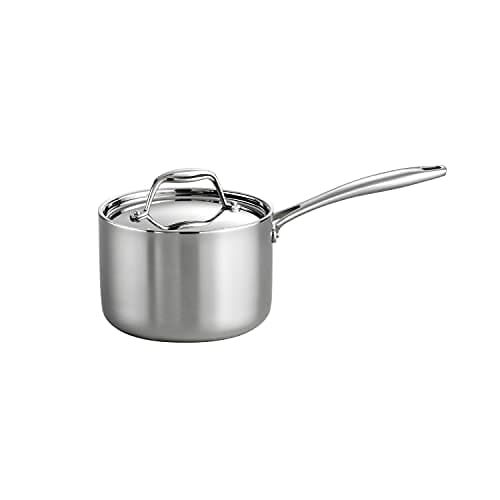
Tramontina Tri-Ply Clad Covered Saucepan, 2 qt
Two quarts of fully clad stainless is the single most useful pot size in a kitchen, and the shape most cooking assumes.
Best for: Sauces, grains and reheating, in the size a kitchen actually uses daily
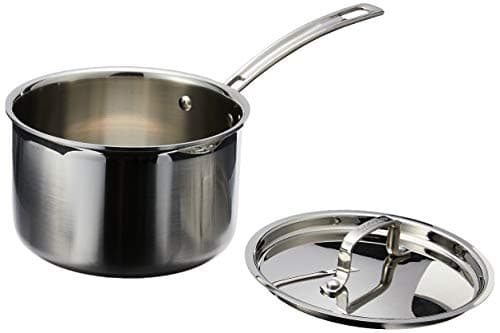
Published specifications for the Cuisinart MultiClad Pro Saucepan, 3 qt
Construction
Tri-ply: 18/10 stainless interior, pure aluminum core, brushed stainless exterior
Capacity
3 qt with lid
Oven maximum
500F per the Cuisinart use-and-care manual; retail listings say 550F
Induction
Yes
Dishwasher
Dishwasher safe
Handle
Riveted solid stainless, cool-grip profile
Warranty
Lifetime
Good
Genuinely dishwasher-safe clad stainless, which the premium brands are not
Fully clad rather than disc-bottom at an open-stock price
Lifetime warranty
Not good
Published oven maximum contradicts the retail listing for the same pan
The handle spine is divisive on larger pieces
No published country of manufacture
The trade-off. The oven ceiling is 500F per Cuisinart's manual, not the 550F some retail listings advertise. That is a documentation problem the buyer inherits.
Skip this if. You want the higher oven ceiling or the published US factory. That is All-Clad, and you pay for it.
›What is the difference between a saucepan and a saucier?
A saucepan has straight sides meeting a flat base at a corner. A saucier curves continuously from base to rim with no corner anywhere. That single geometric difference means a whisk reaches the whole saucier, and that liquid in it reduces faster.
›Do I need a saucier?
Only if you regularly make custards, risotto, polenta, roux or reduced pan sauces. For boiling, simmering, rice, stock and pasta, the straight-sided saucepan holds more for its footprint and is the better pan. Buy the saucepan first in every case.
›Can you use a saucier as a saucepan?
Yes, with less capacity than the nominal size suggests, because the curve removes volume from where a straight-sided pan has most of it. A 3 quart saucier is closer in practical capacity to a 2 quart saucepan, and it evaporates liquid faster.
›Why does food burn in the corner of my saucepan?
That ring is heated from below and from the side at once, and a round whisk cannot reach into it. Use a silicone spatula that gets into the corner, stir more often, or use a saucier, which has no corner for food to collect in.
›Does a saucier need to be fully clad?
More than any other shape. The curve means a large proportion of the cooking surface is sidewall, and a disc-bottom pan has single-ply walls that barely conduct heat. A disc-bottom saucier defeats the point of the shape entirely.
Sources
Every figure on this page came from one of these. Follow them and check our arithmetic — that is the point.