Heads up: some links on this page earn us a commission at no extra cost to you. It does not change what we recommend or the order. How we are funded.
The short answer
A saucier is a wide saucepan with curved walls and no corner where the base meets the side, so a whisk reaches everything. That matters for custard, risotto, polenta, pastry cream and any reduction you stir constantly - the places where a right angle traps food that then scorches. It must be fully clad, because it is almost entirely sidewall. If you make those dishes rarely, a 3 qt clad saucepan does the job with more care.
Quick picks
The whole answer, on one screen. Tap a row to jump to the full write-up. Every pick below carries a stated trade-off further down — including the one at the top.
#
Product
Best for
Price
1
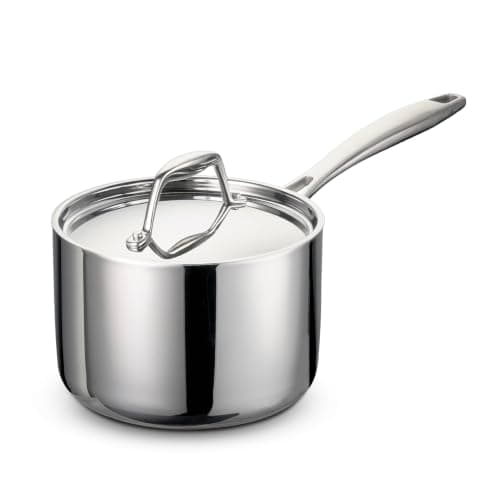
All-Clad D3 Stainless Saucepan, 3 qt
Fully clad with aluminum up the walls and a 600F ceiling - the shape a saucier improves on, from the brand that publishes most.
Prices last checked October 24, 2026. Prices move constantly — the number on Amazon when you click is the real one.
What we can tell you here
Our audited ledger contains clad saucepans rather than a separately audited saucier, so the product cards below are the saucepans this shape competes with, and sauciers themselves are pointed at with a tagged category search. The method is here — we only put a spec table on a product whose published specifications we have read.
The curve is the entire product
In a standard saucepan the base meets the wall at close to a right angle. A whisk is round; a corner is not. Food collects in that corner, sits there while everything else moves, and scorches.
A saucier replaces that corner with a continuous curve, so a whisk sweeps the whole interior in one motion. It is also wider and shallower for the same capacity, which means more evaporation and faster reduction.
Saucepan
Saucier
Wall to base junction
Near right angle
Continuous curve
Whisk reaches everywhere
No - corners trap
Yes
Shape for the same capacity
Taller, narrower
Wider, shallower
Evaporation
Slower - good for rice and stock
Faster - good for reduction
Stirring constantly
Awkward
This is what it is for
Boiling and blanching
Good
Good, with more splashing
Pouring
Good with a lip
Excellent - the flare pours cleanly
Cupboard space
Nests with other pans
Wide, so it nests badly
The first two rows are the reason it exists. The last row is the reason a lot of kitchens decide against it.
It must be fully clad
A saucier is proportionally more sidewall than any other pan on this site. That makes fully clad construction non-negotiable rather than preferable.
In a fully clad pan the aluminum runs from the base up to the rim, so the whole curved surface heats. In a disc-bottom pan the walls are single-layer steel with nothing in them, so a custard against the curve is sitting on cold metal while the base cooks — which is precisely the failure the shape was designed to prevent. The construction argument in full is disc bottom versus fully clad.
This is the one shape where we would pay up. The sidewall does most of the work, so the difference between a well-bonded pan and a cheap one is larger here than in a skillet.
What it is genuinely for
Custards and pastry cream, where egg in a corner becomes scrambled egg.
Risotto and polenta, which are twenty minutes of constant stirring.
Pan sauces and reductions, where the wider surface speeds evaporation.
Roux and béchamel, where flour in a corner catches and specks the sauce.
Caramel, where a hot spot in a corner is the difference between amber and burnt.
Notice how specific that list is. If none of those are regular in your kitchen, a saucier is a shape you will admire and not use, and a 2 or 3 qt clad saucepan is the better purchase.
A saucier competes with the pan you already own. That is the real question - not whether the curve helps, but whether it helps enough to justify a second saucepan.
Sizing
2 to 2.5 quarts is the working size. Most sauce work is small volumes, and a wide shallow pan of this capacity has plenty of base area.
3 to 3.5 quarts if you make risotto for four or reduce large quantities of stock.
Above 4 quarts the shape stops making sense — it becomes a wide pot you cannot whisk the whole of anyway.
Note that a saucier of a given capacity is wider than a saucepan of the same rating, so check it fits your burner. A pan much wider than the ring heats in a circle, which is the mismatch described in cookware for electric stoves.
Two honest alternatives
A clad saucepan and a better whisk
A flat-bottomed whisk reaches into corners far better than a balloon whisk, and it costs a fraction of a pan. For occasional custard, that is the sensible fix.
Thermal mass instead of geometry
For long low reductions the enemy is temperature swing rather than corners, and a heavy enameled pot holds a steadier temperature than a thin clad saucier — the trade set out in stainless steel versus enameled cast iron. Different problem, different fix.
What to check
Fully clad, stated. Not "encapsulated base" or "tri-ply base".
A genuinely continuous curve, not a rounded-off right angle. Read the cross-section in the photograph.
A lid, which many sauciers omit and which you want for risotto.
Sauciers are recommended here as a category, via a tagged search, because we have not audited a specific model. Fully clad is the one non-negotiable in this shape.
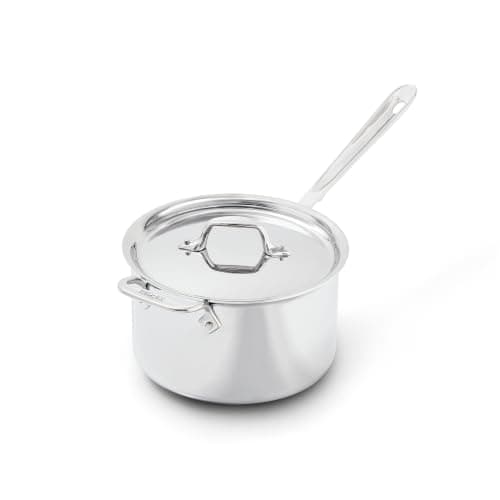
All-Clad D3 Stainless Saucepan, 3 qt
Rice, custards and reductions - anything that scorches in a disc-bottom pan
Each write-up below gives the published specs, what the pan is genuinely good at, what it costs you, and who should skip it. The trade-off line is there on the top pick too — a recommendation with no downside is an advertisement.
Top pick · Best saucier alternativeSpecs read September 3, 2026
All-Clad D3 Stainless Saucepan, 3 qt
Fully clad with aluminum up the walls and a 600F ceiling - the shape a saucier improves on, from the brand that publishes most.
Best for: Rice, custards and reductions - anything that scorches in a disc-bottom pan
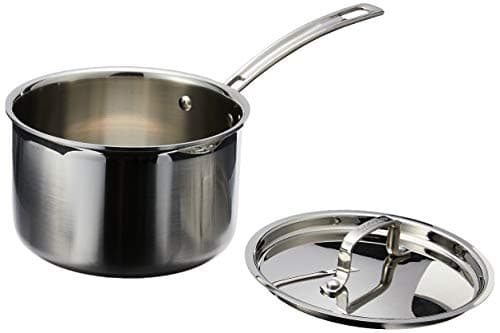
Published specifications for the Cuisinart MultiClad Pro Saucepan, 3 qt
Construction
Tri-ply: 18/10 stainless interior, pure aluminum core, brushed stainless exterior
Capacity
3 qt with lid
Oven maximum
500F per the Cuisinart use-and-care manual; retail listings say 550F
Induction
Yes
Dishwasher
Dishwasher safe
Handle
Riveted solid stainless, cool-grip profile
Warranty
Lifetime
Good
Genuinely dishwasher-safe clad stainless, which the premium brands are not
Fully clad rather than disc-bottom at an open-stock price
Lifetime warranty
Not good
Published oven maximum contradicts the retail listing for the same pan
The handle spine is divisive on larger pieces
No published country of manufacture
The trade-off. The oven ceiling is 500F per Cuisinart's manual, not the 550F some retail listings advertise. That is a documentation problem the buyer inherits.
Skip this if. You want the higher oven ceiling or the published US factory. That is All-Clad, and you pay for it.
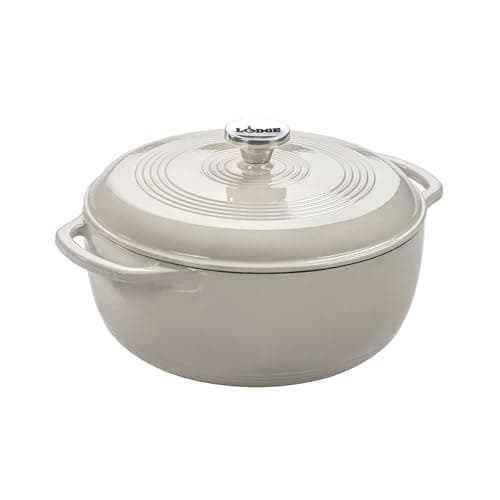
Published specifications for the Lodge Enameled Cast Iron Dutch Oven, 6 qt
Material
Cast iron with porcelain enamel, inside and out
Capacity
6 qt
Induction
Yes - the iron under the enamel is ferrous
Seasoning
None required - enamel is not a seasoning surface
Acid
Safe for tomato and wine, unlike bare iron
Oven maximum
Set by the knob material - check the specific SKU; Lodge publishes a lower ceiling than for bare iron
Good
Non-reactive, so it handles the acidic cooking bare iron cannot
No seasoning to maintain
Considerably cheaper than the French enameled pots it copies
Not good
Chipped enamel is not repairable, unlike bare iron's seasoning
Oven ceiling is lower than bare cast iron because of the knob
Heavy, and the enamel makes it heavier than bare iron of the same capacity
The trade-off. The enamel is a glass layer. Chip it and the pot is not restorable the way bare iron is, and Lodge's enamel chips more readily than the premium brands'.
Skip this if. You already own a large stainless stockpot and rarely braise. This duplicates it for most weeknight cooking.
Anything you stir or whisk constantly - custard, pastry cream, risotto, polenta, roux and caramel. The curved wall means a whisk reaches everywhere, where a standard saucepan has a corner that traps food and scorches it.
›What is the difference between a saucier and a saucepan?
The junction between base and wall. A saucepan meets at close to a right angle; a saucier is a continuous curve. A saucier is also wider and shallower for the same capacity, so it evaporates faster and pours more cleanly.
›Does a saucier need to be fully clad?
Yes, more than any other shape. A saucier is almost entirely sidewall, so a disc-bottom design leaves the curve unheated - which defeats the point of the shape entirely.
›What size saucier should I buy?
Two to two and a half quarts for most sauce work, or three to three and a half if you make risotto for four. Above four quarts the shape stops making sense. Check it fits your burner, since it is wider than a saucepan of the same rating.
›Do I need a saucier if I have a saucepan?
Only if custard, risotto, roux or caramel are regular in your kitchen. For occasional use, a clad saucepan and a flat-bottomed whisk - which reaches corners far better than a balloon whisk - is the sensible and much cheaper fix.
Sources
Every figure on this page came from one of these. Follow them and check our arithmetic — that is the point.