Heads up: some links on this page earn us a commission at no extra cost to you. It does not change what we recommend or the order. How we are funded.
The short answer
Buy a fully clad covered saute pan of 3 to 5 quarts, and check your existing set first because most clad sets already include one under a different name. The Tramontina Signature set contains a 5 qt covered deep saute - the largest in any set here - and the Cuisinart MultiClad Pro contains a 3.5 qt. Fully clad matters more in this shape than in a skillet, because straight walls do real work and a disc bottom leaves them cold.
Quick picks
The whole answer, on one screen. Tap a row to jump to the full write-up. Every pick below carries a stated trade-off further down — including the one at the top.
#
Product
Best for
Price
1
Tramontina Signature Tri-Ply Clad 12-Piece Set
Its 5 qt covered deep saute is the largest in any set on this site, fully clad, and it arrives with six other pieces.
Prices last checked October 22, 2026. Prices move constantly — the number on Amazon when you click is the real one.
What a saute pan is, and is not
A saute pan has walls that rise straight up from the base at ninety degrees, almost always with a lid and usually a helper handle. A skillet has sloped walls. That single difference decides everything about how each behaves, and it is set out at length in saute pan versus skillet.
The short version: at the same rim diameter, a saute pan has a larger flat base and roughly twice the liquid capacity. It sears more food at once and then holds a braise without slopping. What it cannot do is toss, because there is no ramp for a spatula or for a flick of the wrist.
The confusing part is the naming. Manufacturers call this shape a deep saute, a chef's pan, an everyday pan, a casserole or a braiser depending on the depth and the wall curve, and the listings are not consistent. Read the photograph rather than the name.
Why construction matters most in this shape
A saute pan is mostly wall. When you braise in it, liquid is in contact with several inches of vertical surface, and whether that surface is heated decides whether the dish cooks evenly or scorches at the base.
A fully clad pan has aluminum running from the base up to the rim, so the whole vessel heats. A disc-bottom pan has an aluminum slug on the base and single-layer stainless walls, which means a thick braise browns in a ring exactly where the disc ends. The full argument is in disc bottom versus fully clad, and the saute pan is the shape where it bites hardest after the saucepan.
If a listing for a straight-walled pan says "encapsulated base" or "impact-bonded base", the walls have nothing in them. At this shape, that is the whole purchase compromised rather than a detail.
Capacity, and who each suits
Capacity
Rim diameter, roughly
Suits
What it will do
2 to 2.5 qt
8 in
One person
A single portion braise, a pan sauce, reheating
3 to 3.5 qt
10 in
Two people
Four chicken thighs, shallow frying, most pan sauces
4 to 5 qt
11 to 12 in
Three to five people
A whole braise for four in one layer, a batch of greens
6 qt and up
12 in plus
Large households, batch cooking
Very heavy when full; consider a Dutch oven instead
Diameters are approximate because makers vary wall height at the same capacity. Base diameter is what decides how much you can sear at once.
The base-versus-capacity point is worth dwelling on. Two 4 qt saute pans can have noticeably different base diameters depending on how tall the walls are, and the wider one browns more food. If a listing gives interior base diameter, that is the more useful figure.
The lid is half the pan
A saute pan without a lid is a shallow stockpot you cannot cover, and the whole sear-then-braise sequence depends on covering it. Two things to check:
Is the lid included? Buying an 11-inch lid separately is surprisingly expensive and often costs a third of the pan.
What is the lid rated to? A glass lid or a phenolic knob is usually rated well below the pan, and that lower number is the real ceiling for the pan as you will use it - the published figures are collected in oven-safe cookware temperatures.
Handles at this weight
A 5 qt clad saute pan full of braise is heavy, and a single long handle at that weight is a design mistake. Look for a helper handle on the far rim; every set piece in our ledger at 3.5 qt and above has one.
Riveted is the right attachment here. Tramontina's handles are precision cast and riveted and run hot on gas; Cuisinart's are riveted solid stainless with a cool-grip profile. Neither is a defect, and both are worth knowing before you buy.
The alternative worth considering
If your reason for wanting a saute pan is sear-then-braise, an enameled cast iron Dutch oven does that job with more capacity, more thermal mass and a heavier lid. It is much heavier, it does not do shallow frying as well, and it is non-reactive so acidic braises are a non-issue.
The choice is genuinely close. Buy the saute pan if you shallow fry and make pan sauces; buy the Dutch oven if you braise and bake bread. What size Dutch oven sizes it, and best enameled Dutch ovens covers the pots themselves.
Which to buy
You need a kitchen anyway:the Tramontina set, for its 5 qt covered deep saute.
Each write-up below gives the published specs, what the pan is genuinely good at, what it costs you, and who should skip it. The trade-off line is there on the top pick too — a recommendation with no downside is an advertisement.
Top pick · Best saute panSpecs read September 3, 2026
Tramontina Signature Tri-Ply Clad 12-Piece Set
Its 5 qt covered deep saute is the largest in any set on this site, fully clad, and it arrives with six other pieces.
Best for: A first kitchen that should not need replacing
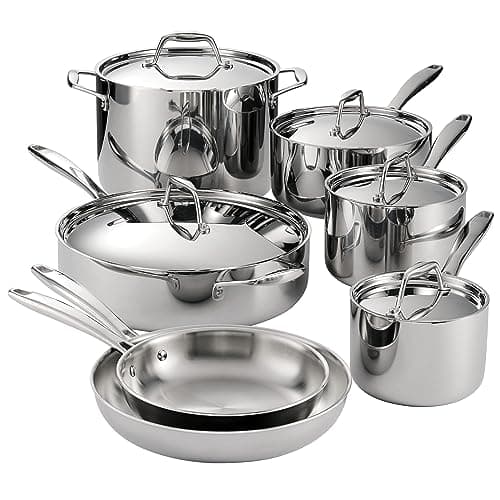
Published specifications for the Tramontina Signature Tri-Ply Clad 12-Piece Set
Construction
Tri-ply: 18/10 stainless, aluminum core, magnetic stainless exterior
Pieces
8 in and 10 in fry pans; 1.5, 2 and 3 qt covered saucepans; 5 qt covered deep saute; 8 qt covered stockpot
Oven maximum
500F on the 80116-249DS listing; other SKUs in the line are listed at 350F
Induction
Yes - magnetic stainless exterior
Dishwasher
Listed dishwasher safe
Handles
Precision cast, riveted
Certification
NSF-certified on the 80116-249DS line
Country of origin
Not asserted - retail listings disagree across SKUs (Brazil and China both appear)
Good
Fully clad, not disc-bottom: the aluminum runs up the sidewalls, so sauces do not scorch in a ring at the base
NSF certification on the flagship SKU is a real, checkable third-party mark rather than a marketing badge
Induction-ready without paying an induction premium
Not good
Retail listings disagree on the oven maximum across SKUs in the same line, which is a documentation problem, not a cooking one
Handles run hot on gas
The 12-piece count includes lids; the useful-item count is seven
The trade-off. Handles are the weak point. They are riveted and sturdy, but they get hot on a gas ring in a way the more expensive clad brands' do not.
Skip this if. You want a set you can leave in the oven above 500F, or you cook mostly eggs and pancakes and would rather spend the money on one good nonstick pan.
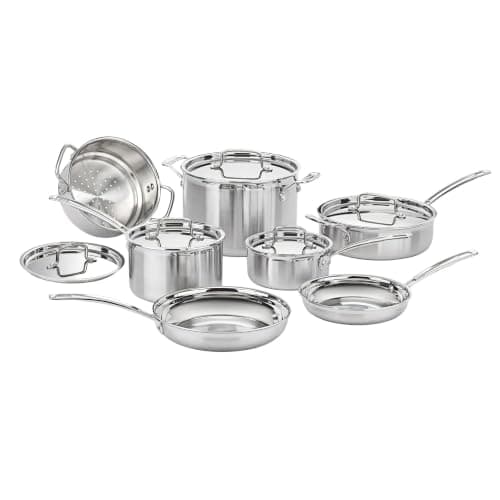
Published specifications for the Cuisinart MultiClad Pro MCP-12N 12-Piece Set
Construction
Tri-ply: 18/10 stainless interior, pure aluminum core, brushed stainless exterior
Pieces
1.5 and 3 qt covered saucepans; 8 in and 10 in skillets; 3.5 qt covered saute; 8 qt covered stockpot; steamer insert
Oven maximum
500F per the Cuisinart use-and-care manual, which the Amazon listing we cite now matches. Major retail listings still advertise 550F; Cuisinart has confirmed the manual figure
Induction
Yes
Dishwasher
Dishwasher safe
Handles
Riveted solid stainless, cool-grip profile
Warranty
Lifetime
Good
Heat runs up the sidewalls, not just across the base
Genuinely dishwasher safe, which the pricier clad brands often are not
Lifetime warranty on a set at this price
Not good
Published oven maximum contradicts the retail listing for the same product
Handle spine is divisive
No 12-inch skillet in the box, which is the pan most people reach for second
The trade-off. The cool-grip handles have a sharp spine that some people find uncomfortable on a full 8-quart stockpot.
Skip this if. You want the higher oven ceiling that major retail listings advertise. The manual says 500F and Cuisinart has confirmed the manual is correct.
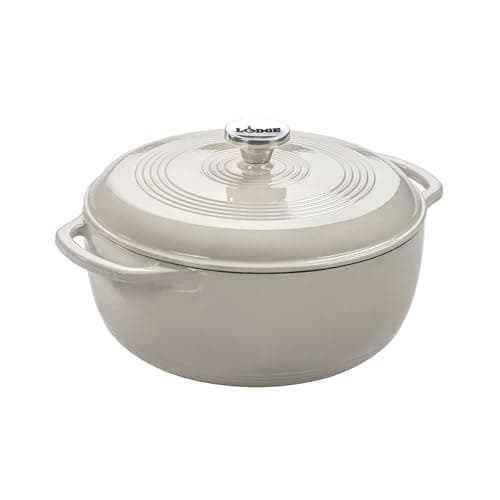
Published specifications for the Lodge Enameled Cast Iron Dutch Oven, 6 qt
Material
Cast iron with porcelain enamel, inside and out
Capacity
6 qt
Induction
Yes - the iron under the enamel is ferrous
Seasoning
None required - enamel is not a seasoning surface
Acid
Safe for tomato and wine, unlike bare iron
Oven maximum
Set by the knob material - check the specific SKU; Lodge publishes a lower ceiling than for bare iron
Good
Non-reactive, so it handles the acidic cooking bare iron cannot
No seasoning to maintain
Considerably cheaper than the French enameled pots it copies
Not good
Chipped enamel is not repairable, unlike bare iron's seasoning
Oven ceiling is lower than bare cast iron because of the knob
Heavy, and the enamel makes it heavier than bare iron of the same capacity
The trade-off. The enamel is a glass layer. Chip it and the pot is not restorable the way bare iron is, and Lodge's enamel chips more readily than the premium brands'.
Skip this if. You already own a large stainless stockpot and rarely braise. This duplicates it for most weeknight cooking.
A fully clad covered pan of 3 to 5 quarts. The Tramontina Signature set includes a 5 qt covered deep saute, the largest on this site, and the Cuisinart MultiClad Pro includes a 3.5 qt. Check your existing set first - most clad sets include this shape.
›What size saute pan do I need?
Three to 3.5 quarts for two people, 4 to 5 quarts for three to five. Base diameter matters more than capacity for searing, and two pans of the same quart rating can have quite different bases depending on wall height.
›Does a saute pan need to be fully clad?
More than a skillet does. A saute pan is mostly wall, and a disc-bottom pan has no aluminum in its walls at all - so a thick braise scorches in a ring where the base disc ends.
›Is a saute pan the same as a braiser?
Not quite, and the naming is inconsistent across the industry. Braisers are usually shallower with curved walls and often enameled cast iron; saute pans are straight-walled and usually clad stainless. Read the photograph rather than the name.
›Should I buy a saute pan or a Dutch oven?
The saute pan if you shallow fry and make pan sauces; the Dutch oven if you braise and bake bread. The Dutch oven holds more and has more thermal mass, at the cost of considerable weight and worse shallow frying.
Sources
Every figure on this page came from one of these. Follow them and check our arithmetic — that is the point.