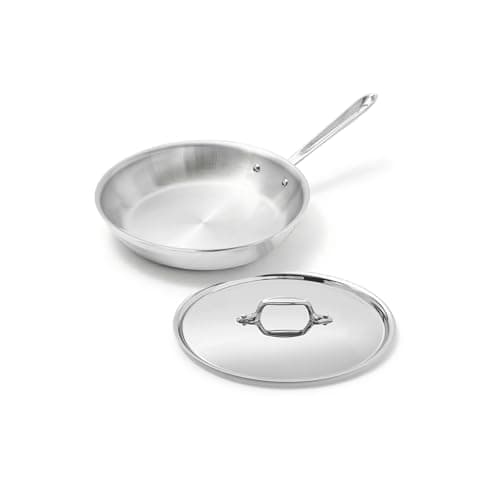
The pan is almost never the limiting part. The handle, the knob or the lid is, and that is why two pans made of the same metal carry ceilings two hundred degrees apart.
Heads up: some links on this page earn us a commission at no extra cost to you. It does not change what we recommend or the order. How we are funded.
The short answer
Cookware
Published oven maximum
All-Clad D3 clad stainless
600F, oven and broiler safe
Lodge bare cast iron
550F
Cuisinart MultiClad Pro
500F in the manual; listings say 550F
Tramontina Signature tri-ply
500F on the flagship SKU; 350F on others
Calphalon Premier hard-anodized
450F
OXO Good Grips Pro
430F
T-fal Professional
400F
Enameled cast iron
Set by the knob material, not the pot
Glass bakeware
No broiler, and no sudden temperature change
The handle sets the number, not the pan
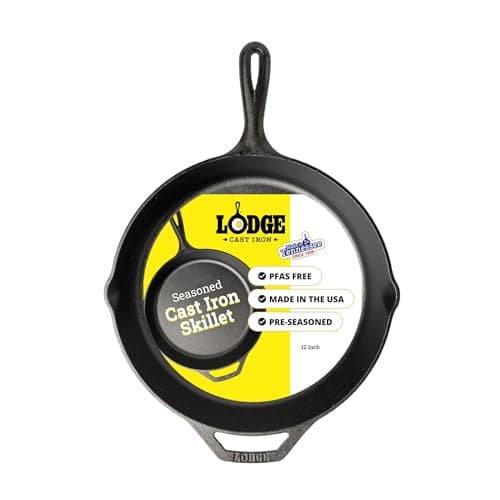
Almost every oven rating you will read is a statement about the least heat-tolerant component, and that is rarely the cooking surface. Bare cast iron has no meaningful ceiling - it was cast at temperatures no domestic oven approaches - and Lodge publishes 550F for its seasoned cookware because that is where the seasoning, not the iron, starts to suffer.
Add a silicone sleeve and the number drops toward 400F. Add a phenolic knob and it drops further. This is why an enameled Dutch oven from any brand carries a ceiling "set by the knob" rather than by the pot: swap the plastic knob for the stainless one the manufacturer sells and the same pot goes hotter.
Bare metal, riveted metal handle: highest ceilings, 500F to 600F.
Stainless handle with a silicone or composite grip: capped by the grip, typically 400F to 450F.
Phenolic or plastic knob on a lid: often the lowest number in the box, and the one nobody reads.
Glass lid: usually rated well below the pan it sits on.
A lid rated lower than its pan is extremely common and almost never printed on the lid. If a manual gives two numbers, the lower one is the real ceiling for the pan as you will actually use it.
Every published ceiling in one place
Cookware
Published maximum
What sets the limit
Broiler
All-Clad D3
600F
Nothing softer than steel anywhere on it
Yes, published
Lodge bare cast iron skillet
550F
The seasoning, not the iron
In practice yes
Lodge carbon steel
550F across the seasoned range
The seasoning
In practice yes
Cuisinart MultiClad Pro
500F (manual)
Cuisinart has confirmed the manual figure over the listing
Not published
Tramontina Signature tri-ply
500F on 80116-249DS; 350F on other SKUs
Documentation, not construction
Not published
Calphalon Premier nonstick
450F
The PTFE coating
No
OXO Good Grips Pro
430F
The stainless-and-silicone handle assembly
No
T-fal Professional
400F
The coating and the handle
No
Enameled cast iron
Knob-dependent - check the SKU
The knob material
No
Glass bakeware
Not a ceiling - a thermal-shock rule
Sudden temperature change
No, explicitly
Every figure here is the manufacturer's own published number, recorded in the product ledger with its source. Where a maker publishes nothing, the row says so rather than estimating.
Where the listing and the manual disagree
Two of these are worth knowing before you trust a retail page. Cuisinart's MultiClad Pro is listed at 550F by major retailers and documented at 500F in the use-and-care manual, and Cuisinart has confirmed the manual is correct. That is a fifty-degree difference on a pan people buy specifically to finish dishes in the oven, and it is set out in full in our Cuisinart review.
Tramontina is stranger. Its flagship 80116-249DS SKU is listed at 500F while other SKUs in the same Signature line are listed at 350F. Nothing about the construction changes between them, so this is a documentation failure rather than a manufacturing one - but you are the person who has to live with it, so buy the SKU whose listing says what you need. More of these traps are catalogued in cookware set buying mistakes.
Broiler safe is a different claim
A broiler is not an oven set higher. It is direct radiant heat from an element a few inches away, and the surface temperature of the pan can run far above the oven's set point. All-Clad is the only brand in the ledger that publishes "oven and broiler safe" explicitly. Everything else is either silent or says no.
Bare cast iron and bare carbon steel handle a broiler in practice - they are heated well past broiler temperatures during seasoning, which is the process described in cast iron seasoning and care. Coated pans do not, and glass explicitly does not.
Nonstick and heat, specifically
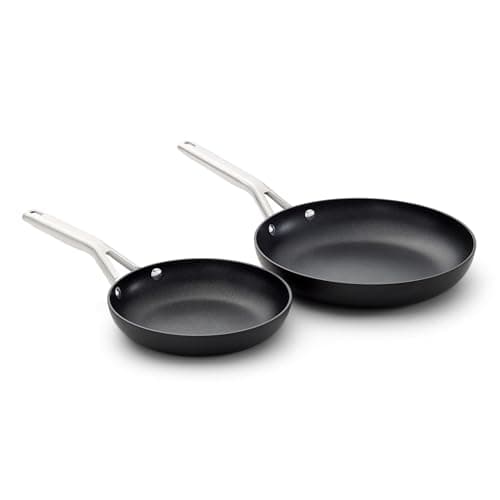
Coated pans carry the lowest ceilings here - 400F to 450F - and the reason is the coating rather than the aluminum under it. The practical risk is not the oven at all, but an empty pan left on a high burner, where the surface climbs much faster than food-loaded cooking ever takes it. The evidence and the actual numbers are in is nonstick cookware safe.
Ceramic coatings produce the most misquoted figure in the category. GreenPan publishes 850F for the Thermolon coating itself, and that number gets repeated as if it were the pan's oven rating. The body ceiling is much lower and varies by line. The distinction is unpicked in PTFE versus ceramic nonstick.
Glass has no ceiling, it has a shock limit
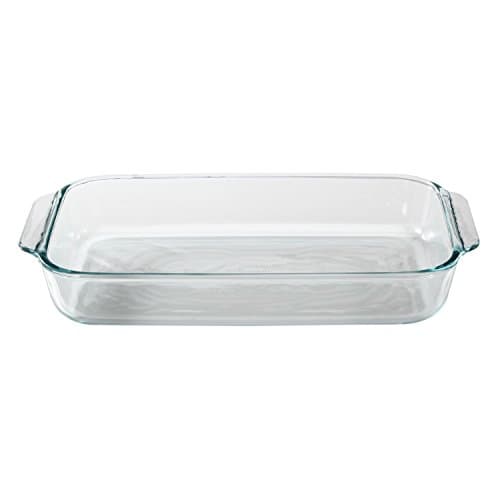
Glass bakeware fails for a completely different reason. It is not the peak temperature that breaks a dish, it is the change: a hot dish set on a wet counter, cold liquid added to a hot dish, or a dish taken from the refrigerator straight into a preheated oven. Pyrex publishes this plainly, and it is a real breakage mechanism rather than a legal disclaimer. The comparison against metal is in glass versus metal bakeware.
What to do with all this
Decide whether you actually finish food in the oven. If you do not, a 400F pan is fine and you can ignore this entire page.
If you do, buy one high-ceiling pan rather than a high-ceiling set.One 600F clad skillet or a cast iron skillet covers every sear-then-roast dish you will cook.
Check the lid, not just the pan. The lid is usually the lowest number in the box.
Check the SKU, not the line. Tramontina and every enameled cast iron brand rate by SKU rather than by range.
Pans grouped by what their published ceiling lets you do
Every number here is the maker's own. Where a maker publishes nothing, the product card says Not published rather than guessing.
All-Clad D3 Stainless 10 in Fry Pan
One good open-stock stainless pan bought instead of a cheap full set
If you are shopping specifically for oven work, high-ceiling clad skillets is the search that filters the category fastest.
What to buy, if you are buying
These are the products this page's reasoning actually points at. Same rules as everywhere else on the site: published specs, a stated trade-off, and a live price only where one exists.
Top pick · Highest published ceilingSpecs read September 3, 2026
All-Clad D3 Stainless 10 in Fry Pan
600F, oven and broiler safe, which is the only pan here you can finish a steak under a broiler without checking anything.
Best for: One good open-stock stainless pan bought instead of a cheap full set
Published specifications for the All-Clad D3 Stainless 10 in Fry Pan
Construction
Fully bonded tri-ply, aluminum core
Oven maximum
600F, oven and broiler safe
Induction
Yes - compatible with any stovetop
Dishwasher
Handwash only (All-Clad published)
Handle
Double-riveted stainless
Weight
3.0 lb (model 4110)
Warranty
Limited lifetime
Made in
Bonded, engineered and assembled in Canonsburg, PA
Good
600F is the highest oven ceiling of any stainless pan on this site
The one pan here whose manufacturing location is published down to the town
Genuinely repairable-adjacent: rivets are the only failure point and the warranty covers them
Not good
Hand wash only
The flared rim makes it a poor pan for anything with liquid
Costs several times what a Tramontina or Cuisinart pan of the same construction costs
The trade-off. Hand wash only. All-Clad publishes that plainly, and it is a real daily cost on a pan you will use every day.
Skip this if. You want a dishwasher-safe pan, or you are buying a whole kitchen on a fixed budget - one D3 skillet costs what a full clad set can cost.
It depends entirely on the least heat-tolerant part. Published ceilings in our ledger run from 400F for T-fal Professional to 600F for All-Clad D3, with bare cast iron at Lodge's published 550F. The handle, knob or lid sets the number far more often than the metal does.
›Can you put a nonstick pan in the oven?
Usually, up to the published ceiling - 400F for T-fal Professional, 430F for OXO Good Grips Pro, 450F for Calphalon Premier. None of them are broiler safe. Check the specific line rather than assuming, because the number varies more within nonstick than within any other category.
›Why do two pans made of the same metal have different oven ratings?
Because the rating describes the whole assembly. A bare riveted stainless handle tolerates far more than a silicone-sleeved one, and a phenolic lid knob is usually rated lower than everything else in the box.
›Is enameled cast iron oven safe?
Yes, but the ceiling is set by the knob rather than the pot. Every brand rates by SKU for this reason, and several sell a stainless replacement knob that raises the number on a pot you already own.
›Can glass bakeware go under the broiler?
No. Pyrex publishes that glass bakeware is not broiler safe. Glass fails from sudden temperature change rather than from peak temperature, and a broiler element applies exactly that.
Sources
Every figure on this page came from one of these. Follow them and check our arithmetic — that is the point.