The handle decides your oven ceiling, whether the pan is safe to grab, and which part of the pan fails first. It is the least examined component in cookware.
Heads up: some links on this page earn us a commission at no extra cost to you. It does not change what we recommend or the order. How we are funded.
The short answer
Riveted stainless is the durable default, and the reason most clad pans publish 500F to 600F.
Phenolic and silicone stay cool on the stove but cap the oven rating near 350F to 450F.
Welded handles leave no rivets inside the pan to clean around, at the cost of a joint you cannot inspect.
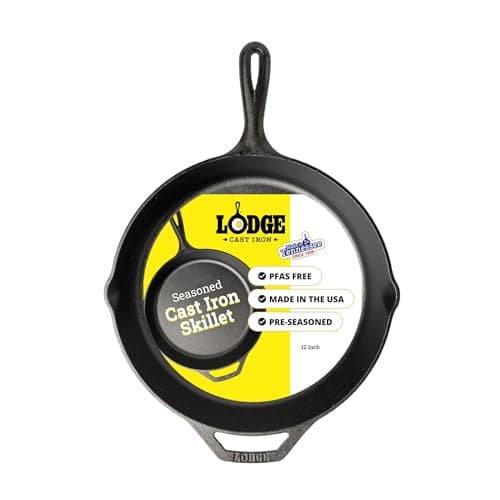
Cast integral handles, as on cast iron, never fail and always get hot.
Wood looks good, cannot go in the oven or the dishwasher, and is effectively a consumable.
Why the handle is the specification that decides things
People choose cookware on the material of the pan and then discover the handle governs most of what they can actually do with it. The oven rating on the box is almost always the handle's rating, not the metal's. Whether you can safely grab the pan mid-sear is the handle. Whether the pan survives twenty years is usually the handle's joint, because a bonded stainless base does not wear out and a rivet can work loose.
It is also the part that varies most between a cheap pan and an expensive one that otherwise look identical on a listing.
Handle materials, and what each costs you
Material
On the stove
Typical oven ceiling
Lifespan
Hollow stainless
Stays usably cool if long enough
500F to 600F
Outlives the pan
Solid stainless
Gets hot - use a towel
600F and up
Outlives the pan
Phenolic (hard plastic)
Stays cool
350F to 450F
Can craze and crack
Silicone over steel
Stays cool
400F to 500F, sleeve dependent
Sleeve is replaceable
Cast integral iron
Gets fully hot
Limited by the pan, not the handle
Permanent
Wood
Stays cool
Not oven safe
Consumable - dries and splits
The pattern: anything that keeps your hand cool on the stove tends to lower what the oven will allow.
That trade is the whole subject. A handle is a thermal bridge, and you are choosing which end of it to optimize. Cast iron takes the honest extreme - the handle is the pan, it is always hot, and it will never fail - cast iron care assumes you own a mitt.
How a stay-cool stainless handle actually works
Stainless steel is a poor conductor of heat compared with aluminum or copper, which is the reason clad pans need an aluminum core at all. A handle exploits that weakness. Make it from stainless, make it hollow so there is less metal to carry heat, make it long so the heat has distance to shed, and give it a shape that sheds heat to the air, and the far end stays cool enough to grip on the stove.
It stops working in the oven, where the whole pan is surrounded by hot air and there is no cool end. Every stay-cool handle is scorching after twenty minutes at 400F. The design solves the stovetop problem only.
The V-shaped or channelled profile you see on clad pans is not styling. It increases surface area for shedding heat and keeps the contact patch on your palm small.
Riveted, welded, or screwed
Riveted
Two or three metal pins pass through the pan wall and are hammered flat on both sides. It is a mechanical joint, not an adhesive or thermal one, and it is the most durable method in normal use. The cost is that rivet heads protrude into the pan interior, where food catches around them. On a coated pan, rivets are also a place the coating is thinner and fails earlier.
Welded
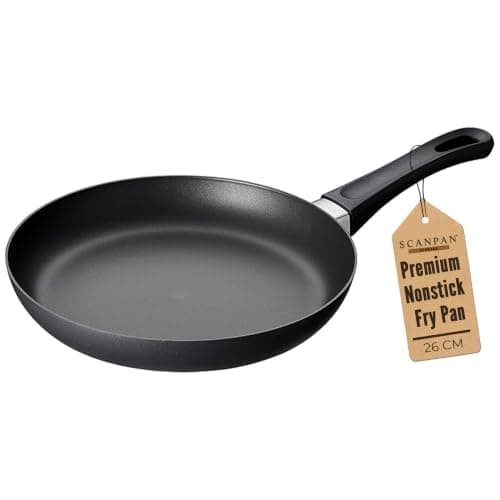
The handle is fused to the outside of the pan wall, leaving the interior completely smooth. Easier to clean, and a real advantage on a coated surface. The catch is that you cannot inspect the joint, and a failed weld is not repairable in the way a loose rivet sometimes is. Scanpan's rivetless construction is the version of this in our ledger - the Scanpan review.
Screwed
Common on inexpensive pans and on wooden handles, where a threaded rod runs into the handle. It is the one joint you can usually tighten yourself, which is just as well, because it is the one most likely to need it.
Helper handles, and when to insist on one
A helper handle is the small loop opposite the main handle. It is the difference between carrying a full pan and dropping it. Insist on one for anything over about ten inches or four quarts, and on anything cast iron, where the pan alone is heavy before you add food. A twelve-inch cast iron skillet full of braise is a two-handed object - what size skillet covers the weights.
On a Dutch oven, both handles are helper handles, which is why the shape is usable at weights no long handle could carry - what size Dutch oven.
The other approach: remove the handle entirely. It solves storage and the oven ceiling, and adds a clamp that wears.
A loose handle, and what to do about it
Screwed handles: tighten the screw. This is routine maintenance, not a defect, and it is worth doing before it wobbles.
Riveted handles: a genuinely loose rivet usually means the pan is finished. Re-peening a rivet at home rarely holds, and a handle that fails while carrying hot food is the worst failure mode in a kitchen.
Welded handles: not repairable. Check the warranty - this is the failure a lifetime warranty is actually for - cookware warranties explained.
The thing that loosens handles fastest is the dishwasher, because repeated thermal cycling works at any joint between two different metals - dishwasher-safe cookware.
What to check on a listing
Handle material, named. If a listing says only "stay-cool handle," it is probably phenolic.
The oven number, and whether it is the pan or the handle. It is the handle.
Rivet count. Three on a large pan; two is normal on a small one.
A helper handle on anything large or heavy.
Handle length relative to the pan. Short handles on wide pans transmit more heat and give worse leverage.
Whether the lid handle is rated lower than the pan handle, which is common and frequently the real ceiling.
These are the products this page's reasoning actually points at. Same rules as everywhere else on the site: published specs, a stated trade-off, and a live price only where one exists.
Top pick · The handle the category copiesSpecs read September 3, 2026
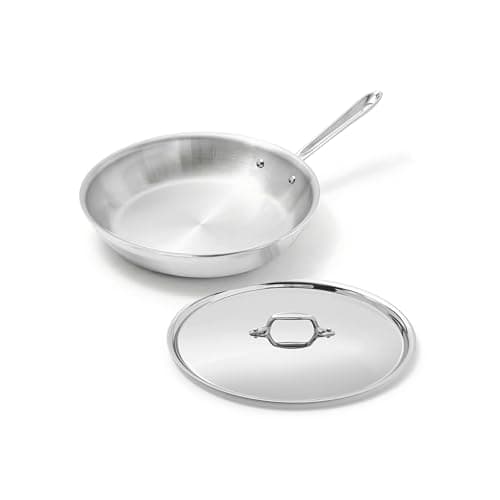
All-Clad D3 Stainless 10 in Fry Pan
A hollow stainless stay-cool handle, riveted, on a pan with a published 600F ceiling - the reference design for the shape.
Best for: One good open-stock stainless pan bought instead of a cheap full set
Published specifications for the All-Clad D3 Stainless 10 in Fry Pan
Construction
Fully bonded tri-ply, aluminum core
Oven maximum
600F, oven and broiler safe
Induction
Yes - compatible with any stovetop
Dishwasher
Handwash only (All-Clad published)
Handle
Double-riveted stainless
Weight
3.0 lb (model 4110)
Warranty
Limited lifetime
Made in
Bonded, engineered and assembled in Canonsburg, PA
Good
600F is the highest oven ceiling of any stainless pan on this site
The one pan here whose manufacturing location is published down to the town
Genuinely repairable-adjacent: rivets are the only failure point and the warranty covers them
Not good
Hand wash only
The flared rim makes it a poor pan for anything with liquid
Costs several times what a Tramontina or Cuisinart pan of the same construction costs
The trade-off. Hand wash only. All-Clad publishes that plainly, and it is a real daily cost on a pan you will use every day.
Skip this if. You want a dishwasher-safe pan, or you are buying a whole kitchen on a fixed budget - one D3 skillet costs what a full clad set can cost.
Published specifications for the Scanpan Classic Fry Pan, 10.25 in
Body
Recycled cast aluminum
Thickness
Not published
Surface
STRATANIUM nonstick; composition not published
Coatings
No PFOA or PFAS statement published on this product page
Diameter
10.25 in
Weight
2.70 lb
Handle
Bakelite, attached with a patented rivetless locking system
Oven maximum
500F
Induction
Not published for the Classic line
Dishwasher
Published dishwasher safe
Metal utensils
Published metal utensil safe
Made in
Denmark
Warranty
Lifetime
Good
Rivetless handle, so nothing inside the pan to clean around
Published metal-utensil safe and dishwasher safe, which is unusual together on a coated pan
Artisan made in Denmark, stated plainly
Not good
The coating composition is not published anywhere on the product page
No induction on the Classic line - that is a separate range
Bakelite handles are a wear part and are not repairable
The trade-off. STRATANIUM is published as metal-utensil safe and its composition is not published at all, so there is no way to check what the surface is.
Skip this if. You cook on induction. The Classic line is published for gas and electric; induction is a separate range.
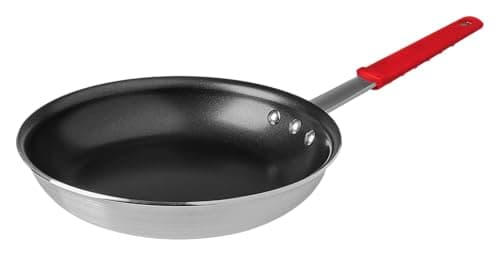
Published specifications for the Tramontina Professional Restaurant Fry Pan, 10 in
Body
Heavy-gauge aluminum
Coating
PTFE nonstick
Induction
No - aluminum body is not ferrous
Coating lifespan
Not published, by this or any nonstick maker
Good
Cheap enough that replacing it every couple of years is a real plan rather than a failure
Heavy gauge for a nonstick pan, so it does not warp on the first hot burner
Silicone handle sleeve that actually stays cool
Not good
Not induction compatible
PTFE, which some buyers will rule out on principle
No published coating lifespan, so the value case is unverifiable by design
The trade-off. It is PTFE. That is fine at normal cooking temperatures, and it is not a pan to preheat empty on high.
Skip this if. You want to avoid PTFE entirely. Buy ceramic instead and accept the shorter release life rather than pretending either one lasts forever.
Partly for hanging, and partly because a hollow handle carries less heat than a solid one. Removing metal from the handle reduces the thermal path between the pan and your hand, which is the same reason stay-cool handles are made from stainless rather than aluminum.
›What is the best material for a cookware handle?
Hollow stainless steel, riveted, for a general-purpose pan. It stays usably cool on the stove, survives any oven temperature the pan can take, and outlasts the cooking surface. Phenolic and silicone are cooler on the stove but cap the oven rating.
›Are riveted or welded handles better?
Riveted is more durable and inspectable; welded leaves a smooth pan interior that is easier to clean and gives a coating no thin spots to fail around. Riveted is the safer default, welded is the better choice on a coated pan.
›Why does my pan handle get hot?
Either it is solid rather than hollow, it is short relative to the pan, or the flame is licking up the side of the pan and heating the handle directly. On a gas burner, a flame wider than the pan base is the usual cause and it is worth turning down.
›Can you replace a cookware handle?
On screwed and detachable handles, yes, and it is routine. On riveted handles, a genuinely loose rivet usually means the pan is finished, because home re-peening rarely holds. Welded handles are not repairable and are what a lifetime warranty exists to cover.
Sources
Every figure on this page came from one of these. Follow them and check our arithmetic — that is the point.