Heads up: some links on this page earn us a commission at no extra cost to you. It does not change what we recommend or the order. How we are funded.
The short answer
Removable-handle cookware is worth buying if cupboard space is your binding constraint, if you finish food in the oven often, or if you cook in an RV or a boat. The handles detach so pans nest, which can cut the space a set occupies by roughly half. The trade is a moving mechanical part on every pan, a weight limit the clamp imposes, and the fact that one handle means one pan at a time on the table. If space is not your problem, fixed handles are simpler and cheaper.
Quick picks
The whole answer, on one screen. Tap a row to jump to the full write-up. Every pick below carries a stated trade-off further down — including the one at the top.
#
Product
Best for
Price
1
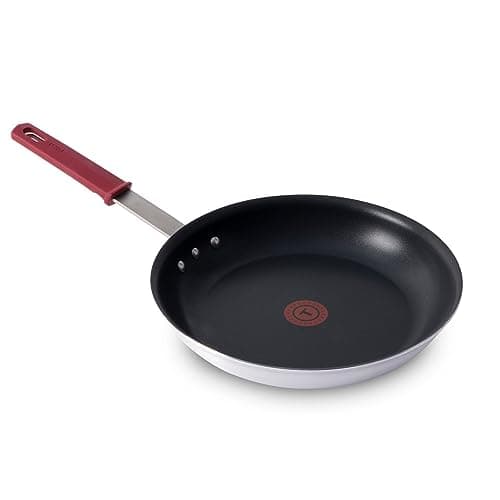
T-fal Professional Total Nonstick Fry Pan, 12 in
T-fal built the detachable-handle system every competitor copies - this is the fixed-handle pan from the same coated line, and the brand whose system to buy into.
Prices last checked September 24, 2026. Prices move constantly — the number on Amazon when you click is the real one.
What we can tell you here
Our audited ledger contains fixed-handle pans rather than a separately audited detachable-handle line, so this page explains what the category does, names the maker that defined it, recommends the audited pans that solve the same problems, and points at a tagged category search for the detachable sets themselves. The method is here.
What the category actually is
A removable-handle set is a group of pans with no handles at all, sold with one or two detachable grips that clamp onto the rim. You clip the handle on to cook, unclip it to put the pan in the oven, and leave it off to stack the pans inside one another. T-fal, which sells the Ingenio system, effectively created the category and remains the line most people mean when they search for it - our T-fal review covers what the brand publishes.
The mechanism is a spring-loaded clamp with two jaws that grip the pan wall. It is not a twist lock and it is not magnetic. Pressing the lever opens the jaws; releasing it closes them onto the rim with enough force to carry the pan and its contents.
The four problems it genuinely solves
Cupboard space
This is the real reason the category exists. Handles are what stop pans nesting, and a handle sticks out four to eight inches from a pan that is otherwise a stackable bowl. Remove them and a set of five pieces occupies roughly the footprint of its largest pan. If you are outfitting a galley kitchen, this is a genuine structural advantage over any amount of clever organizing - cookware for small kitchens covers the rest of the problem.
Oven finishing
Handles are almost always the part that caps a pan's oven rating. A phenolic or silicone handle is rated far lower than the metal it is attached to, which is why coated pans cluster at 400F to 450F while the bodies would take much more. Take the handle off and the ceiling becomes whatever the pan and its coating allow. The maker still publishes a number, and that number is still the one to obey - oven-safe cookware temperatures has the full table.
Oven to table
A handle-less pan is a serving dish. It sits flat in the middle of a table without a projecting lever for someone to catch an elbow on, and it fits in a fridge without wasting a shelf.
RVs, boats and tiny kitchens
Storage that moves has to be dense and it has to not rattle. Nesting pans with the handles in a drawer is the densest cookware packing there is - cookware for camping and RVs covers the rest of that kit.
The mechanical trade, which the marketing skips
Every one of these systems adds a hinge, a spring and two jaws to a product category whose main selling point is usually that it has no moving parts. That is not a reason to avoid it, but it is the thing to think about before buying.
The compromise
What it means in use
The clamp is a wear part
Springs weaken and jaws loosen with cycles. The pans outlive the handle, which is why handles are sold separately.
There is a weight limit
A clamp carries less than a riveted handle. Full stockpots and heavy braises are where people feel it.
One handle, one pan
Serving two dishes at once means a second handle or a second trip.
Rim shape must match
Handles are line-specific. They generally do not fit another maker's pans, which locks you to the line.
A wobble is possible
Any clamp has a little play. Tossing and flipping feel less planted than with a riveted handle.
Cleaning the jaws matters
Grease in the mechanism is what stiffens it. The jaws need washing like any other surface.
None of these is disqualifying. All of them are absent from a riveted pan.
Buy the handle as a consumable, not as a permanent part. If a line does not sell replacement handles on their own, that is a reason to choose a different line.
Almost all of them are coated, which matters
The detachable-handle category is overwhelmingly nonstick, because the same buyer who wants compact storage usually wants easy cleanup. That means you are buying into a coating's replacement cycle as well as a clamp's - two wear parts rather than none. How long nonstick lasts is the honest version of that math, and nonstick coating names decoded explains what the line is actually telling you about the surface.
There is one advantage hiding in this: nesting coated pans is normally the fastest way to wreck them, because the base of one pan grinds against the cooking surface of the next. Sets designed to nest usually account for that. If you nest ordinary coated pans, use pan protectors - how to store pots and pans.
Three ways to get the same result
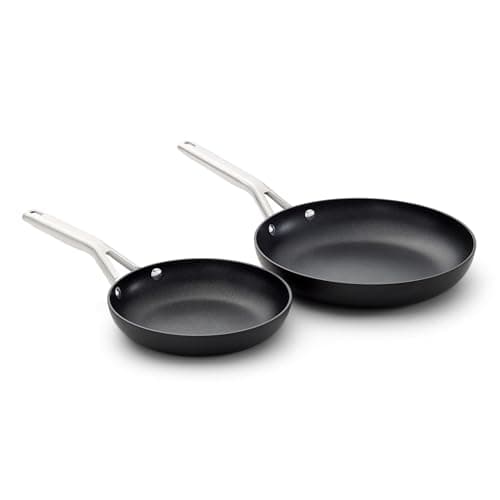
A stackable line. Calphalon Premier is built so pans stack without the coating contacting anything, which is the storage win without the clamp - the Calphalon review.
Fewer, better pans. The most reliable way to fit cookware into a small kitchen is to own less of it. What you actually need makes the case that the number is five, and what piece count you need covers it for sets.
Vertical storage. A rack, a rail or a deep drawer with dividers changes the geometry without changing the pans - cookware storage and organizers.
The riveted joint is the thing a detachable system replaces. It is also the joint least likely to ever need replacing.
What to check before you buy
Are replacement handles sold separately? The single most important question, because the handle fails first.
Each write-up below gives the published specs, what the pan is genuinely good at, what it costs you, and who should skip it. The trade-off line is there on the top pick too — a recommendation with no downside is an advertisement.
Top pick · The maker that defined the categorySpecs read September 3, 2026
T-fal Professional Total Nonstick Fry Pan, 12 in
T-fal built the detachable-handle system every competitor copies - this is the fixed-handle pan from the same coated line, and the brand whose system to buy into.
Best for: Eggs and pancakes on a budget, replaced without regret every couple of years
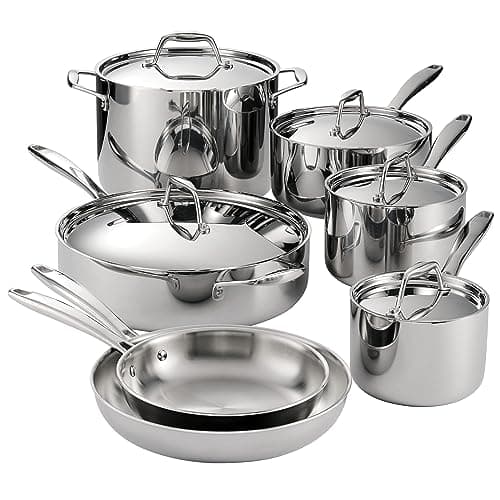
Published specifications for the Tramontina Signature Tri-Ply Clad 12-Piece Set
Construction
Tri-ply: 18/10 stainless, aluminum core, magnetic stainless exterior
Pieces
8 in and 10 in fry pans; 1.5, 2 and 3 qt covered saucepans; 5 qt covered deep saute; 8 qt covered stockpot
Oven maximum
500F on the 80116-249DS listing; other SKUs in the line are listed at 350F
Induction
Yes - magnetic stainless exterior
Dishwasher
Listed dishwasher safe
Handles
Precision cast, riveted
Certification
NSF-certified on the 80116-249DS line
Country of origin
Not asserted - retail listings disagree across SKUs (Brazil and China both appear)
Good
Fully clad, not disc-bottom: the aluminum runs up the sidewalls, so sauces do not scorch in a ring at the base
NSF certification on the flagship SKU is a real, checkable third-party mark rather than a marketing badge
Induction-ready without paying an induction premium
Not good
Retail listings disagree on the oven maximum across SKUs in the same line, which is a documentation problem, not a cooking one
Handles run hot on gas
The 12-piece count includes lids; the useful-item count is seven
The trade-off. Handles are the weak point. They are riveted and sturdy, but they get hot on a gas ring in a way the more expensive clad brands' do not.
Skip this if. You want a set you can leave in the oven above 500F, or you cook mostly eggs and pancakes and would rather spend the money on one good nonstick pan.
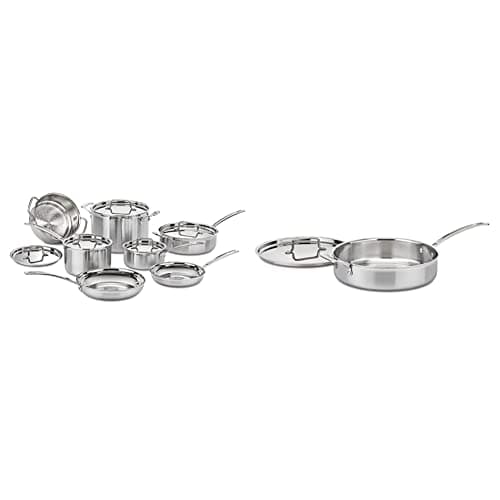
Published specifications for the Cuisinart MultiClad Pro MCP-12N 12-Piece Set
Construction
Tri-ply: 18/10 stainless interior, pure aluminum core, brushed stainless exterior
Pieces
1.5 and 3 qt covered saucepans; 8 in and 10 in skillets; 3.5 qt covered saute; 8 qt covered stockpot; steamer insert
Oven maximum
500F per the Cuisinart use-and-care manual. Amazon listings say 550F; Cuisinart has confirmed the manual figure
Induction
Yes
Dishwasher
Dishwasher safe
Handles
Riveted solid stainless, cool-grip profile
Warranty
Lifetime
Good
Heat runs up the sidewalls, not just across the base
Genuinely dishwasher safe, which the pricier clad brands often are not
Lifetime warranty on a set at this price
Not good
Published oven maximum contradicts the retail listing for the same product
Handle spine is divisive
No 12-inch skillet in the box, which is the pan most people reach for second
The trade-off. The cool-grip handles have a sharp spine that some people find uncomfortable on a full 8-quart stockpot.
Skip this if. You want the higher oven ceiling that the Amazon listing advertises. The manual says 500F and Cuisinart has confirmed the manual is correct.
For small kitchens, RVs and oven finishing it is genuinely useful, because removing the handle lets pans nest and lifts the oven ceiling the handle imposes. The trade is a spring-loaded clamp that wears, a weight limit lower than a riveted handle, and one handle serving one pan at a time.
›Are removable pan handles safe?
They are safe when the clamp is clean and undamaged. The jaws grip the pan rim under spring pressure, so grease in the mechanism and a weakened spring are the two things that cause slips. Treat the handle as a wear part and replace it rather than nursing a loose one.
›Can you put removable handle pans in the oven?
That is one of the main reasons to buy them. With the handle off, the oven ceiling becomes whatever the pan body and its coating allow rather than what the handle material allows. Follow the number the maker publishes for handle-off use.
›Do removable handles fit any pan?
No. Handles are designed for a specific line's rim profile and generally do not fit another maker's pans. That locks you into the line you start with, which is why buying from a maker that sells replacement handles separately matters.
›How much space does removable handle cookware save?
Roughly half the footprint of an equivalent fixed-handle set, because the pans nest inside one another and the handles go in a drawer. Glass lids are the thing most likely to undo the saving, so check whether the lids nest too.
Sources
Every figure on this page came from one of these. Follow them and check our arithmetic — that is the point.