Heads up: some links on this page earn us a commission at no extra cost to you. It does not change what we recommend or the order. How we are funded.
The short answer
For car camping and campfires, cast iron is the right answer: it is indestructible, it does not care about flame or coals, and weight is the vehicle's problem rather than yours. For an RV or a small galley, buy the lightest fully clad stainless you can and one coated pan, because storage volume and induction compatibility matter more than durability. For backpacking, none of this applies - that is a specialist category of titanium and hard-anodized kit we do not cover.
These are two different problems
"Camping cookware" covers two situations with opposite constraints, and most advice fails by mixing them.
Car camping and campfire cooking. The vehicle carries the weight. The heat source is fire, coals or a propane burner, and it is uncontrolled. Durability beats everything.
RVs, vans and small galleys. This is a small kitchen that moves. Storage volume, nesting, weight and stove compatibility matter; a campfire is not involved.
Backpacking is a third case with its own equipment and is outside what this site covers - we write about domestic cookware and will not pretend otherwise.
Campfire and car camping: bare iron
Cast iron is the traditional camp material for reasons that hold up. It has no coating to burn off, no plastic to melt, no rivet to loosen, and it can sit directly in coals at temperatures no domestic stove approaches. Lodge publishes 550F for its seasoned cookware as a cooking guideline; the iron itself is unbothered well beyond that.
It is also the one material where an accident is recoverable. A pan left in a fire and stripped back to bare metal is re-seasoned rather than replaced - the process is in restoring rusty cast iron.
Two practical notes. A long handle is a liability over a fire and a loop handle is better; and a lid turns a skillet into an oven when you put coals on top. What cast iron will and will not take from direct fire is covered in cast iron in the oven and on the grill.
Keep long acidic cooking out of bare iron on a trip as much as at home. A tomato-based camp stew simmering for an hour strips seasoning, which is why an enameled pot is the more versatile single vessel to bring.
RVs and galleys: nesting and the stove
Here the calculation inverts. Cast iron is heavy, it does not nest, and it is a poor fit for a cupboard that moves at speed. What you want is the lightest fully clad stainless you can afford, in pieces that stack.
Constraint
What it rules out
What it points to
Storage volume
Long-handled skillets, non-nesting shapes
Matched-diameter pieces, lids stored separately
Movement in transit
Loose stacks, glass lids, enamel against metal
Cloth or felt between pans, low cupboards
Weight
Cast iron as an everyday pan
Clad stainless and one coated pan
Induction cooktops
Standard aluminum and hard-anodized nonstick
Clad stainless, cast iron, carbon steel
Propane burners
Nothing much - they behave like gas
Anything, but watch pan diameter against burner
Limited water for washing
Bare iron and carbon steel, arguably
Dishwasher-irrelevant clad, or enamel
Induction is the constraint people meet late. Many RV and van conversions use induction hobs, and most coated pans are not compatible.
The induction point deserves emphasis. Calphalon, OXO and T-fal all publish that their standard aluminum and hard-anodized lines are not induction compatible, so a coated pan bought for a van with an induction hob may simply not work. The magnet test in cookware for induction settles it in seconds.
Nesting, and the lid problem
A set that nests is worth more in a moving kitchen than a set that cooks slightly better. Clad stainless nests freely because there is nothing on the surface to protect; coated pans must not be stacked bare, and enamel chips against metal.
Lids are the real volume problem, exactly as they are in a small fixed kitchen. Store them on edge, separately, and a twelve-piece set collapses into one stack - the storage reasoning is in how to store pots and pans and cookware for small kitchens.
Camp Dutch ovens on Amazon covers the fire-specific shape with legs and a rimmed lid, which we have not audited but is the traditional tool for coals.
What to buy, if you are buying
These are the products this page's reasoning actually points at. Same rules as everywhere else on the site: published specs, a stated trade-off, and a live price only where one exists.
Top pick · Best for campfire cookingSpecs read September 3, 2026
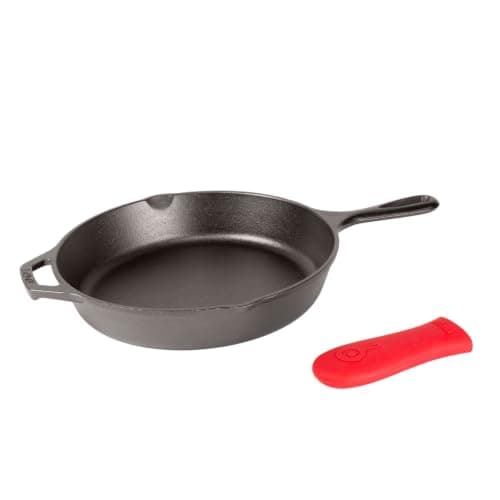
Lodge Seasoned Cast Iron Skillet, 10.25 in (L8SK3)
Bare iron does not care about coals, flame or being dropped, and Lodge publishes 550F for cooking well above what a stove reaches.
Best for: Searing, cornbread, and anyone who wants one pan that cannot be worn out
Published specifications for the Lodge Seasoned Cast Iron Skillet, 10.25 in (L8SK3)
Diameter
10.25 in
Weight
5.66 lb
Oven maximum
550F
Induction
Yes - bare iron is ferrous
Seasoning
Pre-seasoned with soy-based vegetable oil, no synthetic chemicals
Warranty
Lifetime
Made in
USA
Care
Hand wash. Lodge's own instructions permit warm soapy water
Good
Effectively unbreakable and fully restorable - a rusted one can be stripped and re-seasoned
Holds heat better than anything else at the price, which is what a sear needs
Lodge publishes its seasoning method openly, so the maintenance is not a mystery
Not good
Heavy
Heats unevenly on a small burner: cast iron conducts at roughly 50 W/m-K, so it is slow to spread and slow to react
Bare iron is reactive; long tomato braises will taste of it
The trade-off. It weighs 5.66 lb empty. You will feel that every time you move it full, and it is the single most common reason a cast iron skillet ends up in a cupboard.
Skip this if. You have wrist or shoulder trouble, or you cook mostly acidic braises. Carbon steel does most of the same jobs at roughly half the weight.
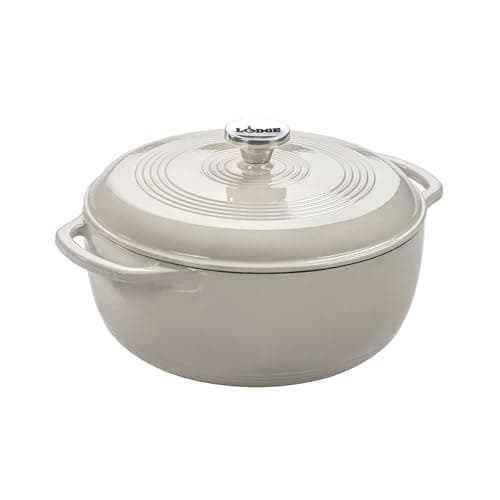
Published specifications for the Lodge Enameled Cast Iron Dutch Oven, 6 qt
Material
Cast iron with porcelain enamel, inside and out
Capacity
6 qt
Induction
Yes - the iron under the enamel is ferrous
Seasoning
None required - enamel is not a seasoning surface
Acid
Safe for tomato and wine, unlike bare iron
Oven maximum
Set by the knob material - check the specific SKU; Lodge publishes a lower ceiling than for bare iron
Good
Non-reactive, so it handles the acidic cooking bare iron cannot
No seasoning to maintain
Considerably cheaper than the French enameled pots it copies
Not good
Chipped enamel is not repairable, unlike bare iron's seasoning
Oven ceiling is lower than bare cast iron because of the knob
Heavy, and the enamel makes it heavier than bare iron of the same capacity
The trade-off. The enamel is a glass layer. Chip it and the pot is not restorable the way bare iron is, and Lodge's enamel chips more readily than the premium brands'.
Skip this if. You already own a large stainless stockpot and rarely braise. This duplicates it for most weeknight cooking.
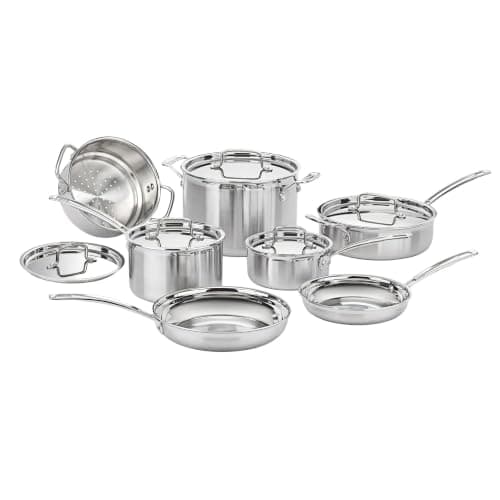
Published specifications for the Cuisinart MultiClad Pro MCP-12N 12-Piece Set
Construction
Tri-ply: 18/10 stainless interior, pure aluminum core, brushed stainless exterior
Pieces
1.5 and 3 qt covered saucepans; 8 in and 10 in skillets; 3.5 qt covered saute; 8 qt covered stockpot; steamer insert
Oven maximum
500F per the Cuisinart use-and-care manual, which the Amazon listing we cite now matches. Major retail listings still advertise 550F; Cuisinart has confirmed the manual figure
Induction
Yes
Dishwasher
Dishwasher safe
Handles
Riveted solid stainless, cool-grip profile
Warranty
Lifetime
Good
Heat runs up the sidewalls, not just across the base
Genuinely dishwasher safe, which the pricier clad brands often are not
Lifetime warranty on a set at this price
Not good
Published oven maximum contradicts the retail listing for the same product
Handle spine is divisive
No 12-inch skillet in the box, which is the pan most people reach for second
The trade-off. The cool-grip handles have a sharp spine that some people find uncomfortable on a full 8-quart stockpot.
Skip this if. You want the higher oven ceiling that major retail listings advertise. The manual says 500F and Cuisinart has confirmed the manual is correct.
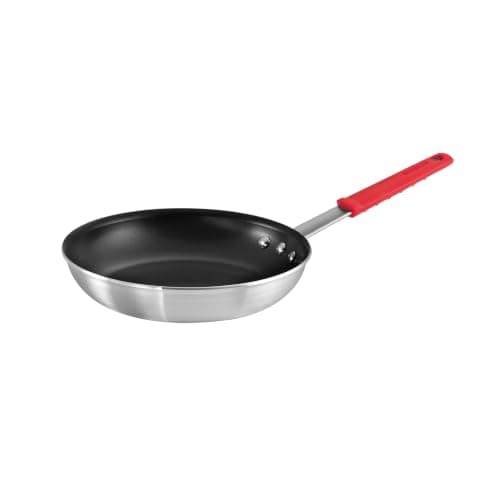
Published specifications for the Tramontina Professional Restaurant Fry Pan, 10 in
Body
Heavy-gauge aluminum
Coating
PTFE nonstick
Induction
No - aluminum body is not ferrous
Coating lifespan
Not published, by this or any nonstick maker
Good
Cheap enough that replacing it every couple of years is a real plan rather than a failure
Heavy gauge for a nonstick pan, so it does not warp on the first hot burner
Silicone handle sleeve that actually stays cool
Not good
Not induction compatible
PTFE, which some buyers will rule out on principle
No published coating lifespan, so the value case is unverifiable by design
The trade-off. It is PTFE. That is fine at normal cooking temperatures, and it is not a pan to preheat empty on high.
Skip this if. You want to avoid PTFE entirely. Buy ceramic instead and accept the shorter release life rather than pretending either one lasts forever.
For car camping and campfires, cast iron - it has no coating to burn off, tolerates coals and flame, and a pan stripped by a fire is re-seasoned rather than replaced. An enameled Dutch oven is the most versatile single vessel to bring.
›What cookware works in an RV?
Light fully clad stainless that nests, plus one coated pan for eggs. Storage volume and stove compatibility matter more than durability, and many RV and van hobs are induction, which most standard coated lines do not work on.
›Can you use nonstick pans over a campfire?
No. Flame and coals reach temperatures far above any published coating ceiling - the coated pans in our ledger publish 400F to 450F. Bare cast iron or carbon steel is the right surface for fire.
›Does cookware need to be induction compatible for a van conversion?
If the hob is induction, yes, and it catches people out. Calphalon, OXO and T-fal publish that their standard aluminum and hard-anodized lines are not compatible. Hold a magnet to the base - if it sticks, the pan works.
›How do you stop pans rattling and chipping in transit?
Nest what nests, put cloth or felt between anything coated or enameled, store lids separately on edge, and keep heavy pieces low. Enamel chips on impact and cannot be repaired, so it is the item to pack most carefully.
Sources
Every figure on this page came from one of these. Follow them and check our arithmetic — that is the point.