Heads up: some links on this page earn us a commission at no extra cost to you. It does not change what we recommend or the order. How we are funded.
The short answer
T-fal publishes an aluminum body under a PTFE coating, a 400F oven ceiling - the lowest on this site - the Thermo-Spot heat indicator that turns solid red at cooking temperature, and dishwasher safety. The standard aluminum line is not induction compatible. The heat indicator is a genuine, useful feature: cooking on an under-heated pan is the most common nonstick mistake, and this is the only pan that tells you. The trade is a thin body that warps on a burner hotter than the pan base is wide.
What this review checks
Published construction, coating type, oven ceiling, induction compatibility, dishwasher guidance, distinctive features, and what the brand declines to state. We have not cooked in any of it. The method is here.
The heat indicator, which is a real feature
This site is generally skeptical of cookware features, because most of them are a name attached to something every pan does. Thermo-Spot is the exception, and it is worth saying so plainly.
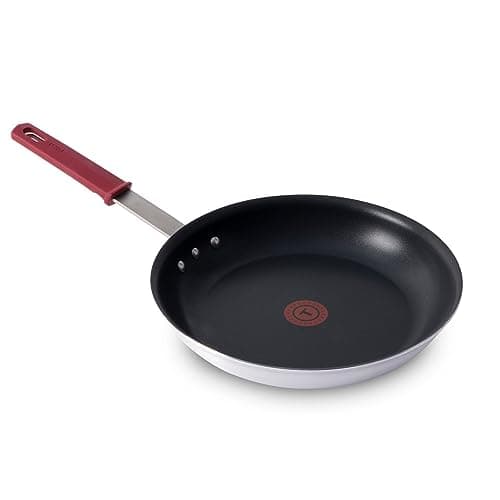
It is a pattern in the center of the pan that changes appearance as the pan heats, turning solid red at cooking temperature. That solves the most common mistake people make with nonstick, which is putting food into a pan that is not hot enough - the cause of most sticking on a coating that is otherwise fine.
It also solves the opposite problem. Because there is a visible signal for "hot enough", there is less reason to preheat on high and overshoot, and overheating is the one genuine risk with PTFE, covered in is nonstick cookware safe. A pan that discourages both mistakes at once, for very little money, is a good design.
What T-fal publishes
Specification
Published figure
Comment
Body
Aluminum
Thin, which is the main trade-off
Coating
PTFE nonstick
Standard chemistry for the category
Heat indicator
Thermo-Spot center pattern, solid red at cooking temperature
The reason to buy this brand
Oven maximum
400F published for the line
The lowest ceiling on this site
Induction
No on the standard aluminum line
Check the specific range
Dishwasher
Dishwasher safe
Published
Coating lifespan
Not published
As with every nonstick maker
Recorded from T-fal's published cookware specifications and care guidance.
The thin body, which is the real limitation
T-fal pans are light. That is pleasant when you are flipping something and it is the source of the brand's main weakness: a thin aluminum base on a burner wider than the pan will warp, and a warped pan spins on a smooth top and never sits flat again.
Two habits avoid it. Match the pan to the burner rather than using a large ring for a small pan, and never run cold water into a hot pan - thermal shock is the fastest route to a domed base. Warping is one of the terminal faults listed in when to replace your cookware, because it cannot be corrected.
If your stove is powerful and your habits are rough, the heavier Tramontina Professional is the budget pan that resists this better.
The 400F ceiling
Four hundred degrees is the lowest published oven ceiling of any pan in our ledger, and it is set by the coating and the handle rather than the aluminum. In practice it rules out finishing a dish in a hot oven and rules out the broiler entirely.
Whether that matters depends entirely on what you cook. For eggs, pancakes and stovetop cooking it is irrelevant. For a sear-then-roast workflow it is disqualifying, and the pan you want is cast iron or clad stainless - the published ceilings are all collected in oven-safe cookware temperatures.
The honest case for buying cheap
There is a coherent argument for T-fal that has nothing to do with the pan being good in absolute terms, and it goes like this. No nonstick maker publishes a coating lifespan. Every nonstick warranty excludes coating wear. So the total cost of owning nonstick is a series of replacements at an interval nobody will tell you in advance.
Under those conditions, spending less per replacement is a rational strategy rather than a compromise, and the pan that costs least while still solving a real problem - the heat indicator - is a good buy. That is the same reasoning behind treating nonstick sets as a consumable purchase in best nonstick cookware sets.
The strategy has one requirement: the rest of your kitchen has to be permanent. A T-fal pan beside a clad stainless set is a sensible kitchen. A kitchen made entirely of T-fal is a kitchen you will replace entirely.
What it gets right
The heat indicator fixes the most common nonstick mistake, and nothing else has it
Cheap enough that replacement is a plan rather than a failure
Light, which matters when you are flipping
Published dishwasher safe
Widely available, so replacing like for like is easy
What it costs you
The thin body warps on high heat or an oversized burner
400F is the lowest oven ceiling on this site
Not induction compatible on the standard aluminum line
No published coating lifespan, as with the whole category
Not a pan to build a whole kitchen from
Who should buy it
Buy T-fal if you want the cheapest pan that solves a real problem, and you accept nonstick as a consumable. The Professional line is the one with the indicator.
Buy Tramontina instead if your burner is powerful and warping worries you.
Buy OXO or Calphalon instead if you cook on a coated pan daily and want a body that lasts as long as the coating.
Do not buy it for induction, or for anything that goes above 400F.
T-fal against the rest of the coated category
The cheapest pan here has the most useful feature. That is not a contradiction - it is what happens when a feature solves a technique problem rather than a materials one.
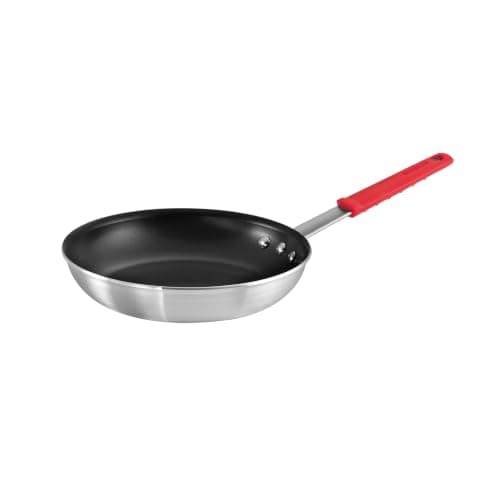
T-fal Professional Total Nonstick Fry Pan, 12 in
Eggs and pancakes on a budget, replaced without regret every couple of years
These are the products this page's reasoning actually points at. Same rules as everywhere else on the site: published specs, a stated trade-off, and a live price only where one exists.
Top pick · The pan to buySpecs read September 3, 2026
T-fal Professional Total Nonstick Fry Pan, 12 in
The heat indicator genuinely fixes the most common nonstick mistake, on a pan cheap enough to replace without regret.
Best for: Eggs and pancakes on a budget, replaced without regret every couple of years
Published specifications for the Tramontina Professional Restaurant Fry Pan, 10 in
Body
Heavy-gauge aluminum
Coating
PTFE nonstick
Induction
No - aluminum body is not ferrous
Coating lifespan
Not published, by this or any nonstick maker
Good
Cheap enough that replacing it every couple of years is a real plan rather than a failure
Heavy gauge for a nonstick pan, so it does not warp on the first hot burner
Silicone handle sleeve that actually stays cool
Not good
Not induction compatible
PTFE, which some buyers will rule out on principle
No published coating lifespan, so the value case is unverifiable by design
The trade-off. It is PTFE. That is fine at normal cooking temperatures, and it is not a pan to preheat empty on high.
Skip this if. You want to avoid PTFE entirely. Buy ceramic instead and accept the shorter release life rather than pretending either one lasts forever.
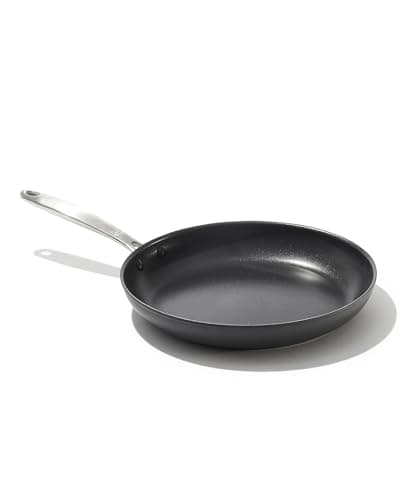
Published specifications for the OXO Good Grips Pro Hard-Anodized Nonstick Fry Pan, 10 in
Body
Hard-anodized aluminum
Coating
Three-layer PTFE nonstick, published PFOA-free
Oven maximum
430F published for the line
Induction
No on the standard hard-anodized line
Dishwasher
Dishwasher safe
Edge
Rolled, for pouring without dripping down the side
Coating lifespan
Not published
Good
The rolled pour edge is a small thing you notice every single time you use it
The hard-anodized body resists the denting that ruins cheap aluminum pans
Handle stays cool and does not rotate the way riveted plastic ones eventually do
Not good
Not induction compatible
Oven ceiling capped by the handle, not the pan
Still a coating, still a consumable, still no published lifespan
The trade-off. The handle that makes it comfortable is a stainless-and-silicone assembly, and that is what caps the oven rating below the body's own limit.
Skip this if. You need induction. The standard hard-anodized body is not ferrous.
For the money, yes. The Thermo-Spot heat indicator solves the most common nonstick mistake, and the pans are cheap enough that replacing them is a plan rather than a failure. The trade-off is a thin body that warps and a 400F oven ceiling.
›What does the T-fal red spot do?
It is a heat indicator in the center of the pan that turns solid red at cooking temperature. Putting food into an under-heated pan is what causes most sticking on a coating that is otherwise fine, and this is the only pan that signals when it is ready.
›How hot can a T-fal pan go?
T-fal publishes 400F for the Professional line, which is the lowest oven ceiling of any pan in our ledger. It is not broiler safe. For sear-then-roast cooking you want cast iron or clad stainless instead.
›Do T-fal pans warp?
The thin aluminum body can, particularly on a burner wider than the pan base or if cold water hits a hot pan. A warped base spins on a smooth top and cannot be corrected. Match the pan to the burner and let it cool before washing.
›Is T-fal induction compatible?
Not on the standard aluminum line - aluminum is not ferrous. Check the specific range before buying and test the base with a magnet if you are unsure.
Sources
Every figure on this page came from one of these. Follow them and check our arithmetic — that is the point.