Heads up: some links on this page earn us a commission at no extra cost to you. It does not change what we recommend or the order. How we are funded.
The short answer
Almost every nonstick coating sold is one of two things: a fluoropolymer, of which PTFE is the common one, or a sol-gel ceramic derived from silicon dioxide. Everything else - titanium, diamond, marble, granite, stone, copper-colored - describes a filler, a reinforcement or an appearance applied to one of those two. Brand names like Teflon and Thermolon identify a manufacturer's version of one chemistry. Work out which of the two you are looking at and the rest of the name is decoration.
There are two chemistries
Every domestic nonstick coating you are likely to meet is one of these.
Fluoropolymer, usually PTFE
Polytetrafluoroethylene: the original nonstick material, applied in layers and cured. Excellent release, published oven ceilings typically 400F to 450F, and it degrades with high heat. It is a PFAS material by definition, which is the source of most of the debate - the FDA and EPA positions are set out in is nonstick cookware safe.
Sol-gel ceramic
A silica-based coating - silicon dioxide, which is sand - sprayed and cured at a lower temperature than PTFE requires. Very good release when new, no fluoropolymer, and release that generally fades faster. GreenPan publishes this composition for Thermolon, and the evidence is in is ceramic cookware safe.
The comparison between the two, including how each fails, is PTFE versus ceramic nonstick. Everything below is a name attached to one of these two.
The glossary
Name you see
What it actually is
What to check
PTFE
The fluoropolymer itself - the honest technical name
Oven ceiling; layer count if published
Teflon
A brand name for PTFE coatings
Same as PTFE
Thermolon
GreenPan's brand for its sol-gel ceramic
Published PFAS-free; body ceiling, not the 850F coating figure
Ceramic
Sol-gel silica coating, not fired pottery
Whether the maker names the composition
Ceramic-titanium
Ceramic coating with titanium in the mix or the base layer
Whether PTFE is also present
Titanium
Usually a reinforcement in a coating, not the surface
Whether PFAS-free is also claimed - it is different
Only the first four rows name a chemistry. Everything else names a filler, a body material, a supplier or an appearance.
PFOA-free is not PFAS-free
This is the single most useful distinction on the page. PFOA was a processing aid used in making fluoropolymer coatings and has not been used in this industry for many years, so "PFOA-free" is true of essentially every pan sold today. It is accurate and it tells you almost nothing.
"PFAS-free" is a much larger claim, because PTFE is itself a PFAS material. A pan cannot be both PTFE and PFAS-free. When a listing says PFAS-free, it is telling you the coating is ceramic - which is a real distinction and worth looking for if that is your reason for buying.
GreenPan publishes PFAS-free, PFOA-free and free of lead and cadmium for Thermolon. That is a specific, checkable set of claims and it is the standard other ceramic brands should be held to - our audit is in the GreenPan review.
Layer counts and what they mean
"Three-layer", "five-layer", "multi-layer" coatings are common claims. More layers generally means a thicker total coating, which plausibly lasts longer - and no maker publishes a lifespan for any layer count, so the claim cannot be checked against an outcome.
What layer counts are useful for is comparing within a brand. OXO publishes three-layer, Calphalon publishes multi-layer, and those are honest descriptions of construction. What they are not is a longevity figure, and the silence on longevity is the subject of how long nonstick lasts.
Feature names that mean something
Not every name in this category is decoration. A few describe something you can verify:
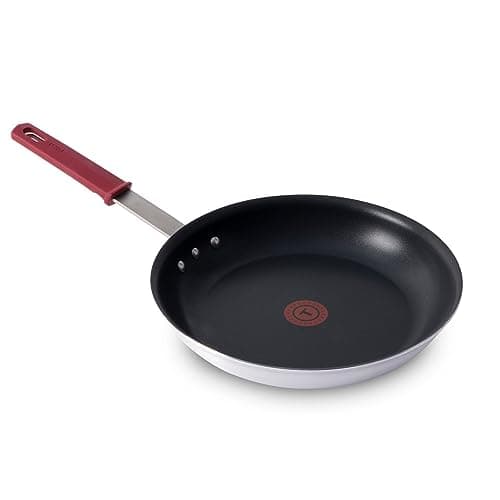
Thermo-Spot - T-fal's heat indicator, which turns solid at cooking temperature. It solves the most common nonstick mistake and it is checkable in use. See our T-fal review.
Metal-utensil safe - Calphalon publishes this for the Premier coating, and almost nobody else does. It is a specific claim about the coating surviving contact.
Induction compatible - verifiable in five seconds with a magnet, and frequently false for standard coated lines.
Dishwasher safe - a published warranty statement, though it says nothing about how release ages.
How to buy in this category
Identify the chemistry. PTFE or ceramic. If the listing will not say, that is information.
Find the published oven ceiling. A number means the pan is documented; silence means it is not.
These are the products this page's reasoning actually points at. Same rules as everywhere else on the site: published specs, a stated trade-off, and a live price only where one exists.
Top pick · Names its coating and its chemistrySpecs read September 3, 2026
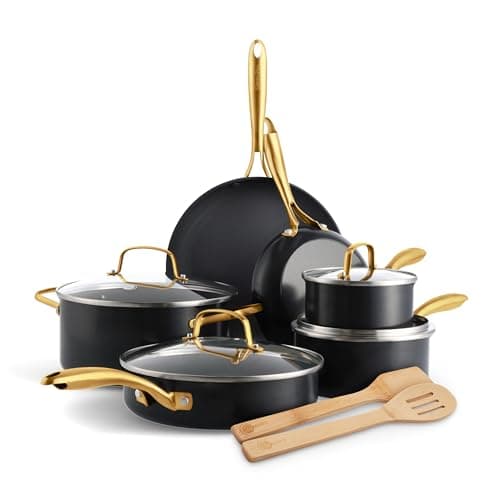
GreenPan Ceramic Nonstick Cookware Set
Thermolon, published as sol-gel ceramic from silicon dioxide and free of PFAS, PFOA, lead and cadmium.
Best for: Someone who wants nonstick without PTFE and has read what that trades away
Published specifications for the GreenPan Ceramic Nonstick Cookware Set
Coating
Thermolon, from sand-derived Silicon Dioxide (SiO2), sprayed
Coating chemistry
PFAS-free, PFOA-free, free of lead and cadmium (GreenPan published)
Coating heat resistance
850F / 450C for the coating itself (GreenPan published)
Body oven maximum
Varies by line and is lower than the coating figure - check the specific line
Coating lifespan
Not published. No ceramic maker publishes one
Good
GreenPan publishes what the coating is made of in plain terms, which most ceramic brands do not
The coating will not release fumes if you overheat it the way PTFE can
Genuinely good release when new
Not good
Release degrades and nobody will tell you how fast
The 850F figure is for the coating, not the pan, and gets quoted as if it were the pan
Ceramic dislikes high heat and dishwashers, which is most of what a set gets used for
The trade-off. Ceramic nonstick loses release with use and no maker publishes a lifespan, GreenPan included. Treat it as a consumable, not a lifetime purchase.
Skip this if. You are buying a set expecting it to last as long as clad stainless. It will not, and the honest move is to buy one ceramic pan alongside a stainless set.
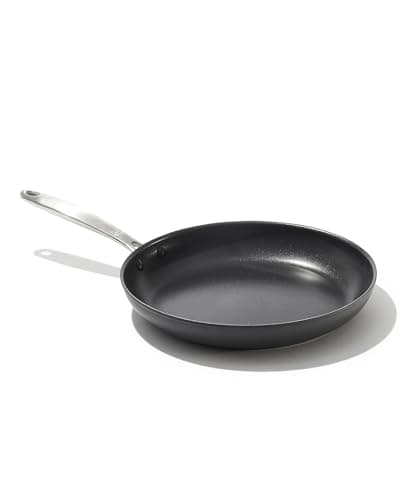
Published specifications for the OXO Good Grips Pro Hard-Anodized Nonstick Fry Pan, 10 in
Body
Hard-anodized aluminum
Coating
Three-layer PTFE nonstick, published PFOA-free
Oven maximum
430F published for the line
Induction
No on the standard hard-anodized line
Dishwasher
Dishwasher safe
Edge
Rolled, for pouring without dripping down the side
Coating lifespan
Not published
Good
The rolled pour edge is a small thing you notice every single time you use it
The hard-anodized body resists the denting that ruins cheap aluminum pans
Handle stays cool and does not rotate the way riveted plastic ones eventually do
Not good
Not induction compatible
Oven ceiling capped by the handle, not the pan
Still a coating, still a consumable, still no published lifespan
The trade-off. The handle that makes it comfortable is a stainless-and-silicone assembly, and that is what caps the oven rating below the body's own limit.
Skip this if. You need induction. The standard hard-anodized body is not ferrous.
›What is the difference between Teflon and ceramic nonstick?
Teflon is a brand name for PTFE, a fluoropolymer coating. Ceramic nonstick is a sol-gel silica coating derived from silicon dioxide. PTFE generally releases well for longer; ceramic contains no fluoropolymer and its release usually fades faster.
›Is PFOA-free the same as PFAS-free?
No, and it is the most important distinction in this category. PFOA was a processing aid phased out years ago, so PFOA-free is true of essentially every pan sold. PTFE is itself a PFAS material, so a pan cannot be both PTFE and PFAS-free.
›What is a titanium or diamond nonstick coating?
Usually a reinforcement particle in a coating rather than the cooking surface itself. No manufacturer publishes a hardness figure or abrasion test result for these, so the claim cannot be checked. Find out the underlying chemistry instead.
›Do more coating layers mean a longer-lasting pan?
Plausibly, and it cannot be verified. More layers means a thicker coating, but no maker publishes a lifespan for any layer count. Layer counts are useful for comparing within a brand, not as a longevity figure.
›What does Thermolon mean?
It is GreenPan's brand name for its sol-gel ceramic coating, which the company publishes as derived from silicon dioxide and free of PFAS, PFOA, lead and cadmium. That level of published detail is unusual in the ceramic category.
Sources
Every figure on this page came from one of these. Follow them and check our arithmetic — that is the point.