The ceramic brand that publishes the most about what its coating actually is - and, like every ceramic brand, publishes nothing about how long it lasts.
Heads up: some links on this page earn us a commission at no extra cost to you. It does not change what we recommend or the order. How we are funded.
The short answer
GreenPan publishes that its Thermolon coating is derived from sand - silicon dioxide - applied by spraying, and that it is free of PFAS, PFOA, lead and cadmium. It publishes 850F heat resistance for the coating itself, which is routinely misquoted as the pan's oven rating; the body ceiling is much lower and varies by line. What it does not publish, like every ceramic maker, is how long the release lasts. Buy it if you want ceramic and want the clearest account of what you are buying - and treat it as a consumable.
What this review checks
Published coating composition and chemistry, heat figures and what they apply to, oven and induction ratings, dishwasher guidance, warranty terms, and what the brand declines to state. We have not cooked in any of it. The method is here.
What Thermolon actually is
GreenPan publishes that Thermolon is a sol-gel ceramic coating derived from silicon dioxide - sand - applied to the pan by spraying, and cured at a lower temperature than a PTFE coating requires. It publishes the coating as free of PFAS, PFOA, lead and cadmium.
That is more than most ceramic brands will say, and it is the reason GreenPan is the ceramic brand we point at. Much of this category markets on the word "ceramic" without describing what the coating is or how it is applied. A checkable claim is worth more than an impressive one, which is the standard applied throughout is ceramic cookware safe.
What GreenPan publishes
Specification
Published figure
Comment
Coating
Thermolon, from sand-derived silicon dioxide, sprayed
Plainly described, which is rare here
Coating chemistry
PFAS-free, PFOA-free, free of lead and cadmium
A checkable claim
Coating heat resistance
850F / 450C for the coating itself
For the coating, not the pan
Body oven maximum
Varies by line and is lower than the coating figure
Check the specific line
Coating lifespan
Not published
No ceramic maker publishes one
Induction
Varies by line
Not a given - check before buying
Recorded from GreenPan's own published material. The blank row is the industry's, not ours.
The 850F figure, and why it is misleading in practice
This number appears everywhere and it is almost always used wrongly. GreenPan publishes 850F as the heat resistance of the Thermolon coating. It is not the oven rating of a pan, and it is not a license to preheat a pan on a high burner.
A pan is a coating plus an aluminum body plus a handle, and the handle is usually the limiting part. The body ceiling varies by line and is far below 850F. So a shopper reading "850F" on a listing and concluding the pan is broiler-capable has been misled by the sequence in which two true facts were presented. Every published cookware ceiling we have is collected in oven-safe cookware temperatures.
The genuine advantage the coating chemistry gives you is different from the one the number implies: an overheated ceramic pan will not release the fumes an overheated PTFE pan can. That is a real safety difference at the extreme, and it does not make the pan oven-safe to 850F.
The missing specification
GreenPan does not publish how long Thermolon keeps releasing. Neither does any other ceramic maker, and neither does any PTFE maker. Across every coated pan in our ledger the row reads "Not published", and that silence is the subject of how long nonstick lasts.
For ceramic it matters more, because the consensus - which is experience rather than published data, and we will label it as such - is that ceramic release fades faster than PTFE. GreenPan is honest enough elsewhere that the omission stands out. The consequence for buyers is simple: buy ceramic as a consumable, not as a lifetime purchase, and do not pay lifetime-purchase prices for it.
Getting the most out of it
Low to medium heat, always. Ceramic dislikes high heat more than PTFE does, and high heat is the fastest way to lose release.
Hand wash. Dishwasher cycles accelerate release loss on any coating.
Silicone or wooden utensils, unless the specific line publishes otherwise.
No aerosol cooking spray, which leaves a residue that behaves like a dead coating - how to clean nonstick pans covers removing it.
Never preheat empty on high, whatever the 850F figure says.
What it gets right
Publishes what the coating is made of in plain terms, which most ceramic brands do not
Published free of PFAS, PFOA, lead and cadmium
Will not release the fumes an overheated PTFE pan can
Genuinely good release when new
The clearest documentation in a category that mostly markets on a word
What it costs you
No published coating lifespan, so the value case cannot be checked
The 850F figure describes the coating and gets quoted as the pan
Release generally fades faster than PTFE
Dislikes high heat and dishwashers, which is much of what a set gets used for
Induction compatibility varies by line rather than being a given
Who should buy it
Buy GreenPan if avoiding PTFE is a decision you have already made and you want the brand that documents its coating. The Valencia set is the way in.
Buy PTFE instead if you have no objection to it - it releases better for longer and a cheap PTFE pan costs less.
Buy one ceramic pan, not a ceramic set, unless you accept replacing the whole box on the same schedule. The case is in mixed-material cookware sets.
Pair it with clad stainless, which is the permanent half of the kitchen.
GreenPan, its coated alternatives, and the permanent kitchen it belongs beside
Every coated pan here is a consumable with no published lifespan. The clad set is the piece that is not.
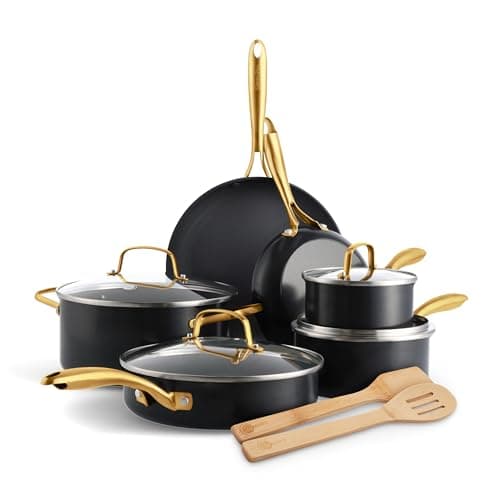
GreenPan Ceramic Nonstick Cookware Set
Someone who wants nonstick without PTFE and has read what that trades away
These are the products this page's reasoning actually points at. Same rules as everywhere else on the site: published specs, a stated trade-off, and a live price only where one exists.
Top pick · The ceramic set to buySpecs read September 3, 2026
GreenPan Ceramic Nonstick Cookware Set
Thermolon with the clearest published composition in the ceramic category, bought on the understanding that release fades.
Best for: Someone who wants nonstick without PTFE and has read what that trades away
Published specifications for the GreenPan Ceramic Nonstick Cookware Set
Coating
Thermolon, from sand-derived Silicon Dioxide (SiO2), sprayed
Coating chemistry
PFAS-free, PFOA-free, free of lead and cadmium (GreenPan published)
Coating heat resistance
850F / 450C for the coating itself (GreenPan published)
Body oven maximum
Varies by line and is lower than the coating figure - check the specific line
Coating lifespan
Not published. No ceramic maker publishes one
Good
GreenPan publishes what the coating is made of in plain terms, which most ceramic brands do not
The coating will not release fumes if you overheat it the way PTFE can
Genuinely good release when new
Not good
Release degrades and nobody will tell you how fast
The 850F figure is for the coating, not the pan, and gets quoted as if it were the pan
Ceramic dislikes high heat and dishwashers, which is most of what a set gets used for
The trade-off. Ceramic nonstick loses release with use and no maker publishes a lifespan, GreenPan included. Treat it as a consumable, not a lifetime purchase.
Skip this if. You are buying a set expecting it to last as long as clad stainless. It will not, and the honest move is to buy one ceramic pan alongside a stainless set.
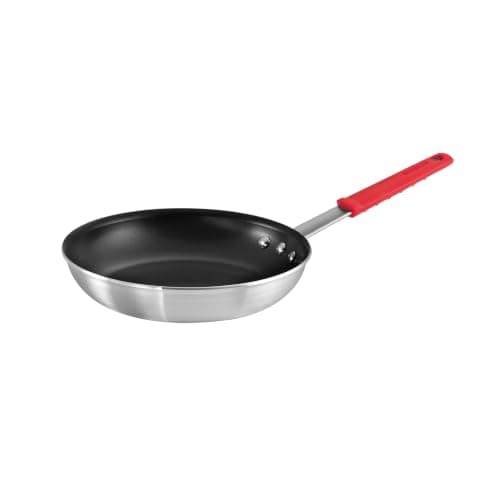
Published specifications for the Tramontina Professional Restaurant Fry Pan, 10 in
Body
Heavy-gauge aluminum
Coating
PTFE nonstick
Induction
No - aluminum body is not ferrous
Coating lifespan
Not published, by this or any nonstick maker
Good
Cheap enough that replacing it every couple of years is a real plan rather than a failure
Heavy gauge for a nonstick pan, so it does not warp on the first hot burner
Silicone handle sleeve that actually stays cool
Not good
Not induction compatible
PTFE, which some buyers will rule out on principle
No published coating lifespan, so the value case is unverifiable by design
The trade-off. It is PTFE. That is fine at normal cooking temperatures, and it is not a pan to preheat empty on high.
Skip this if. You want to avoid PTFE entirely. Buy ceramic instead and accept the shorter release life rather than pretending either one lasts forever.
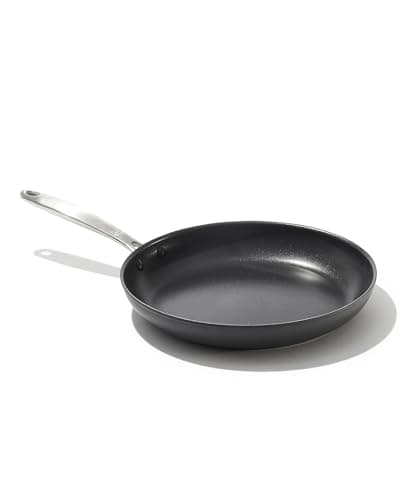
Published specifications for the OXO Good Grips Pro Hard-Anodized Nonstick Fry Pan, 10 in
Body
Hard-anodized aluminum
Coating
Three-layer PTFE nonstick, published PFOA-free
Oven maximum
430F published for the line
Induction
No on the standard hard-anodized line
Dishwasher
Dishwasher safe
Edge
Rolled, for pouring without dripping down the side
Coating lifespan
Not published
Good
The rolled pour edge is a small thing you notice every single time you use it
The hard-anodized body resists the denting that ruins cheap aluminum pans
Handle stays cool and does not rotate the way riveted plastic ones eventually do
Not good
Not induction compatible
Oven ceiling capped by the handle, not the pan
Still a coating, still a consumable, still no published lifespan
The trade-off. The handle that makes it comfortable is a stainless-and-silicone assembly, and that is what caps the oven rating below the body's own limit.
Skip this if. You need induction. The standard hard-anodized body is not ferrous.
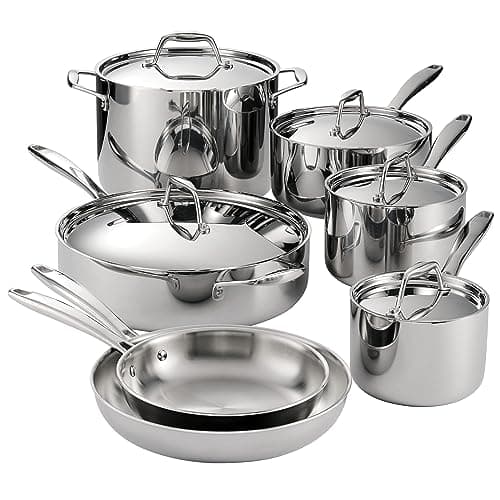
Published specifications for the Tramontina Signature Tri-Ply Clad 12-Piece Set
Construction
Tri-ply: 18/10 stainless, aluminum core, magnetic stainless exterior
Pieces
8 in and 10 in fry pans; 1.5, 2 and 3 qt covered saucepans; 5 qt covered deep saute; 8 qt covered stockpot
Oven maximum
500F on the 80116-249DS listing; other SKUs in the line are listed at 350F
Induction
Yes - magnetic stainless exterior
Dishwasher
Listed dishwasher safe
Handles
Precision cast, riveted
Certification
NSF-certified on the 80116-249DS line
Country of origin
Not asserted - retail listings disagree across SKUs (Brazil and China both appear)
Good
Fully clad, not disc-bottom: the aluminum runs up the sidewalls, so sauces do not scorch in a ring at the base
NSF certification on the flagship SKU is a real, checkable third-party mark rather than a marketing badge
Induction-ready without paying an induction premium
Not good
Retail listings disagree on the oven maximum across SKUs in the same line, which is a documentation problem, not a cooking one
Handles run hot on gas
The 12-piece count includes lids; the useful-item count is seven
The trade-off. Handles are the weak point. They are riveted and sturdy, but they get hot on a gas ring in a way the more expensive clad brands' do not.
Skip this if. You want a set you can leave in the oven above 500F, or you cook mostly eggs and pancakes and would rather spend the money on one good nonstick pan.
GreenPan publishes that Thermolon is a sol-gel ceramic derived from silicon dioxide - sand - applied by spraying, and that it is free of PFAS, PFOA, lead and cadmium. That is a more specific account than most ceramic brands publish.
›Can GreenPan really go to 850F?
The coating is published at 850F. The pan is not. A pan is a coating plus an aluminum body plus a handle, and the body ceiling is far lower and varies by line. The figure gets quoted as an oven rating and it is not one.
›How long does GreenPan ceramic coating last?
GreenPan does not publish a figure, and neither does any other ceramic or PTFE maker. Ceramic release is generally understood to fade faster than PTFE, which is experience rather than published data. Buy it as a consumable.
›Is GreenPan better than PTFE nonstick?
It is different rather than better. Ceramic avoids PTFE entirely and will not release fumes if overheated; PTFE releases better for longer and costs less. If avoiding PTFE is not your reason for buying, PTFE is the more practical purchase.
›Is GreenPan dishwasher safe?
Guidance varies by line, and hand washing is the better routine regardless. Repeated hot alkaline cycles accelerate release loss on every coating, and ceramic tolerates it least well.
Sources
Every figure on this page came from one of these. Follow them and check our arithmetic — that is the point.