Heads up: some links on this page earn us a commission at no extra cost to you. It does not change what we recommend or the order. How we are funded.
The short answer
Let the pan cool first. Cold water into a hot coated pan warps thin aluminum, and a warped pan is finished.
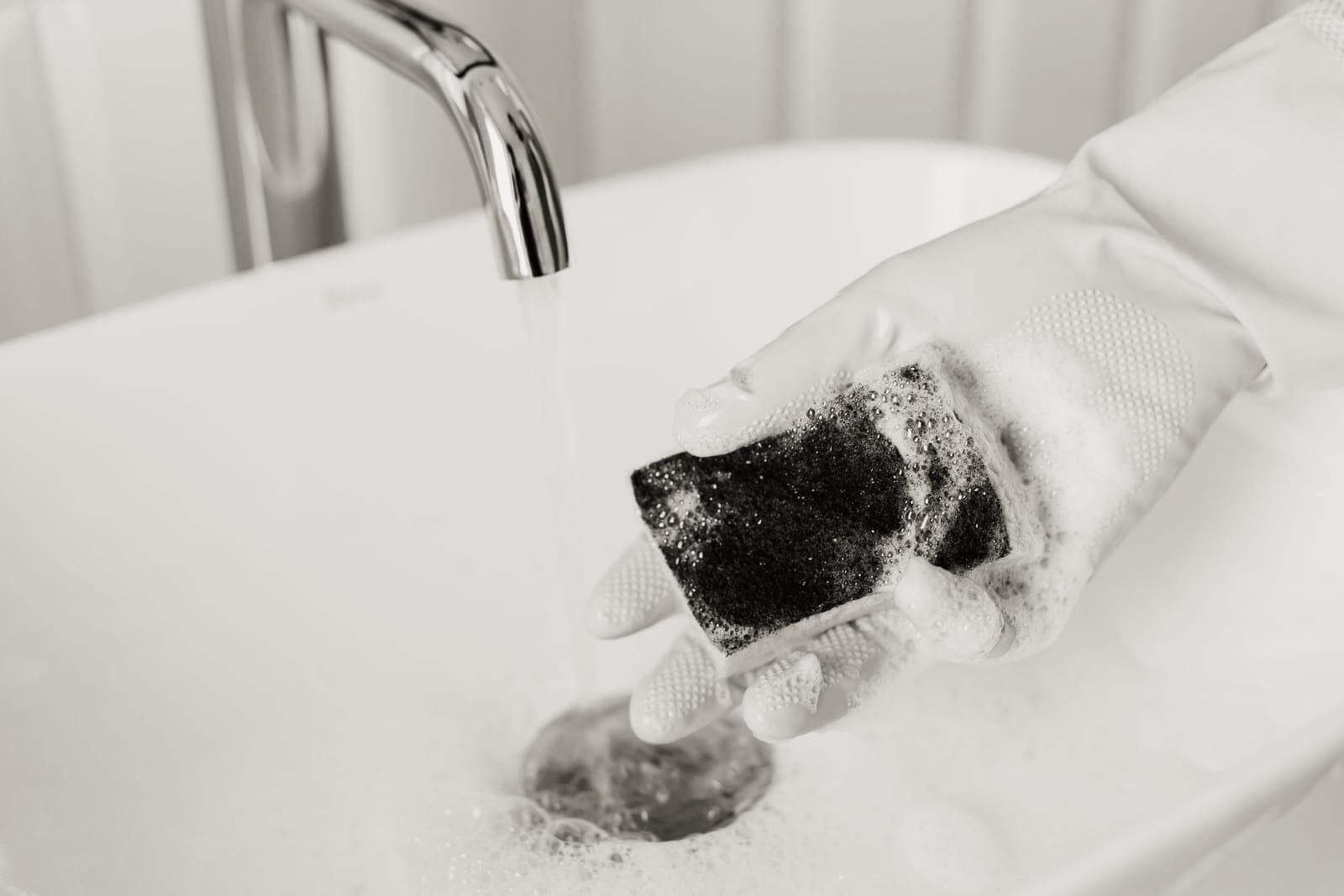
Hot water, dish soap, soft sponge. That is the whole daily routine, and soap is not the enemy here that it is on cast iron.
For burnt-on food, simmer water in the pan for a few minutes and wipe. Never scrape, never scour.
If release has faded but the coating looks fine, strip the invisible oil film with a warm baking soda paste before concluding the pan is dead.
The daily routine
Let it cool. Not to room temperature - just off the boil. Running cold water into a hot thin aluminum pan is the fastest way to warp it, and a warped base that spins on a smooth top is one of the faults that genuinely ends a pan, as listed in when to replace your cookware.
Hot water, a little dish soap, a soft sponge. Soap is fine on nonstick. The no-soap rule people carry over from cast iron does not apply here, because there is no seasoning to strip.
Dry it. Not for rust reasons - aluminum will not rust - but because water spots and mineral film build up on a coated surface over time.
Store it without another pan resting on the coating. This is the storage rule in how to store pots and pans, and it matters more than anything you do at the sink.
Burnt-on food
Nonstick pans do get burnt-on residue, particularly around the edge where sugar and dairy catch. The instinct is to attack it, and that is exactly what destroys the pan.
Fill the pan with an inch of water and bring it to a gentle simmer for three to five minutes.
Turn the heat off and let it sit until it is cool enough to handle.
Wipe with a soft sponge. Most of it will lift without pressure.
For what remains, make a paste of baking soda and warm water, apply with a soft cloth and wipe away.
What not to do: no metal scourer, no steel wool, no scraping with a knife or a metal spatula edge, no oven cleaner, and no abrasive powder. Any of those leaves scratches that food then catches in, which is the beginning of the end for the coating. The equivalent methods for stainless, where you genuinely can be aggressive, are in cleaning burnt stainless.
The invisible film, which is the real story
Here is the most useful thing on this page. A very large share of pans that "stopped being nonstick" have a perfectly good coating underneath a layer of polymerized oil - fat that has been heated repeatedly until it hardened into a thin varnish on the surface.
It is nearly invisible. The pan looks clean, feels slightly tacky when dry, and food sticks to it. Two habits cause it: cooking on higher heat than a coated pan wants, and aerosol cooking spray, whose propellants and emulsifiers leave residue that ordinary washing does not remove.
Symptom
Worn coating
Polymerized oil film
Surface appearance
Dull, sometimes scratched or lifting
Looks fine, often slightly glossy
Feel when dry
Smooth
Faintly tacky or sticky
Where it started
Center, where the spatula works
Edges and the ring outside the food
Responds to a baking soda wash
No
Yes, often completely
Fix
Replace the pan
Clean it properly and carry on
Try the wash before you buy a replacement. It costs ten minutes and it works often enough to be worth doing every time.
How to strip it
Make a thick paste of baking soda and warm water.
Spread it over the whole interior, including the sloped walls where residue collects most.
Leave it fifteen minutes.
Work it gently with a soft sponge - no pressure, no abrasive side.
Rinse thoroughly and dry. Repeat once if the surface still feels tacky.
If release comes back, the coating was never the problem. If it does not, the pan has reached the end that no manufacturer will put a number on - how long nonstick lasts covers that silence.
The dishwasher question
Calphalon, OXO and T-fal all publish their coated lines as dishwasher safe, and that claim is about the coating surviving the cycle rather than the coating lasting. Repeated hot alkaline washes dull release faster than hand washing does. Since nobody publishes a lifespan under either regime, the size of that difference is unmeasurable from published data - but the direction is not in dispute.
Metal scourers, steel wool and scouring powder. They scratch, and scratches are where the coating starts to lift.
Oven cleaner. Strongly caustic, and it attacks the coating and the aluminum under it.
Bleach. No benefit, and it can discolor the surface permanently.
Aerosol cooking spray, which is a cleaning problem before it is a cooking one. Use oil from a bottle or a pump you fill yourself.
Cold water into a hot pan. The warp is permanent.
Ceramic coatings need the same routine, applied a little more carefully. They lose release faster than PTFE and are less tolerant of high heat, so gentle washing is doing more work on a ceramic pan than on a PTFE one - the two failure modes are compared in PTFE versus ceramic nonstick.
The outside of the pan matters too
The base and the outer walls of a nonstick pan are usually uncoated aluminum or hard-anodized aluminum, and they accumulate carbonized grease that no daily wash reaches. That layer holds heat unevenly and makes the pan look far older than it is.
Baking soda paste and a nylon brush handle the exterior, and you can be firmer there than on the cooking surface - though not on an anodized finish, which dulls under abrasion. Avoid the dishwasher on bare and anodized aluminum exteriors for the same reason bare aluminum bakeware discolors in it.
Pans grouped by how much care they need
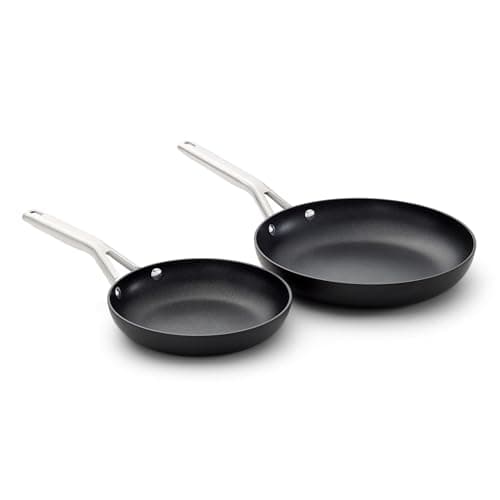
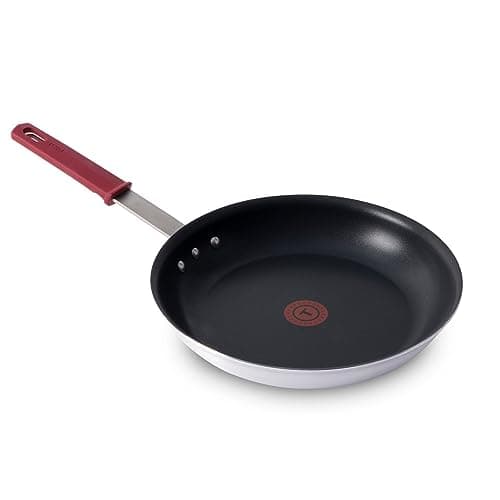
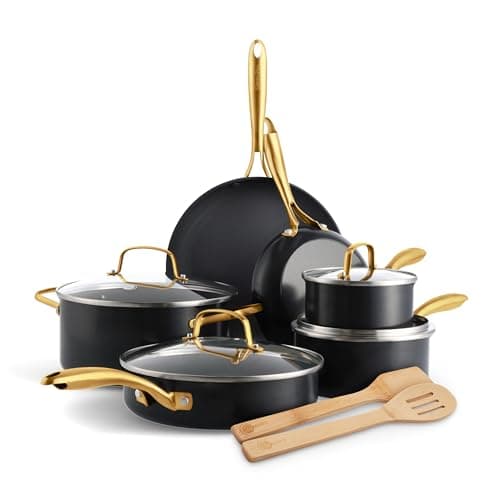
One tolerates the dishwasher and metal utensils by published guidance, one needs the gentlest routine in the category, and all four benefit from the baking soda wash.
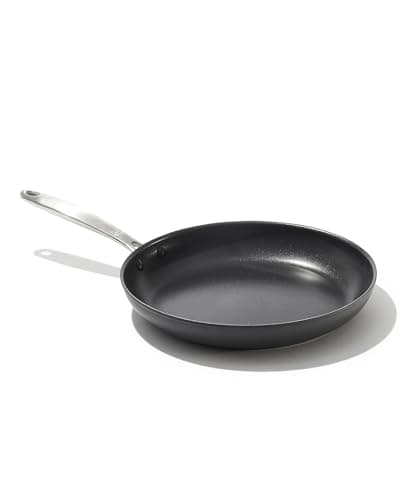
OXO Good Grips Pro Hard-Anodized Nonstick Fry Pan, 10 in
Someone who cooks daily and cares how a pan feels in the hand
These are the products this page's reasoning actually points at. Same rules as everywhere else on the site: published specs, a stated trade-off, and a live price only where one exists.
Top pick · Easiest to clean properlySpecs read September 3, 2026
OXO Good Grips Pro Hard-Anodized Nonstick Fry Pan, 10 in
A rolled edge and a smooth hard-anodized exterior mean fewer places for residue to collect than a riveted, ridged pan.
Best for: Someone who cooks daily and cares how a pan feels in the hand
Published specifications for the OXO Good Grips Pro Hard-Anodized Nonstick Fry Pan, 10 in
Body
Hard-anodized aluminum
Coating
Three-layer PTFE nonstick, published PFOA-free
Oven maximum
430F published for the line
Induction
No on the standard hard-anodized line
Dishwasher
Dishwasher safe
Edge
Rolled, for pouring without dripping down the side
Coating lifespan
Not published
Good
The rolled pour edge is a small thing you notice every single time you use it
The hard-anodized body resists the denting that ruins cheap aluminum pans
Handle stays cool and does not rotate the way riveted plastic ones eventually do
Not good
Not induction compatible
Oven ceiling capped by the handle, not the pan
Still a coating, still a consumable, still no published lifespan
The trade-off. The handle that makes it comfortable is a stainless-and-silicone assembly, and that is what caps the oven rating below the body's own limit.
Skip this if. You need induction. The standard hard-anodized body is not ferrous.
Published specifications for the GreenPan Ceramic Nonstick Cookware Set
Coating
Thermolon, from sand-derived Silicon Dioxide (SiO2), sprayed
Coating chemistry
PFAS-free, PFOA-free, free of lead and cadmium (GreenPan published)
Coating heat resistance
850F / 450C for the coating itself (GreenPan published)
Body oven maximum
Varies by line and is lower than the coating figure - check the specific line
Coating lifespan
Not published. No ceramic maker publishes one
Good
GreenPan publishes what the coating is made of in plain terms, which most ceramic brands do not
The coating will not release fumes if you overheat it the way PTFE can
Genuinely good release when new
Not good
Release degrades and nobody will tell you how fast
The 850F figure is for the coating, not the pan, and gets quoted as if it were the pan
Ceramic dislikes high heat and dishwashers, which is most of what a set gets used for
The trade-off. Ceramic nonstick loses release with use and no maker publishes a lifespan, GreenPan included. Treat it as a consumable, not a lifetime purchase.
Skip this if. You are buying a set expecting it to last as long as clad stainless. It will not, and the honest move is to buy one ceramic pan alongside a stainless set.
Yes. Hot water, a little dish soap and a soft sponge is the correct daily routine. The no-soap rule people carry over from cast iron does not apply, because a nonstick pan has no seasoning to strip.
›How do you get burnt food off a nonstick pan?
Simmer an inch of water in the pan for three to five minutes, let it cool, then wipe with a soft sponge. For what remains, use a baking soda and water paste. Never use metal scourers, scouring powder or oven cleaner.
›Why is my nonstick pan sticky even when clean?
It is almost certainly a film of polymerized oil - fat heated repeatedly until it hardened into a near-invisible varnish. Aerosol cooking spray and high heat are the usual causes. A baking soda paste left on for fifteen minutes usually removes it and restores release.
›Should you put nonstick pans in the dishwasher?
Calphalon, OXO and T-fal all publish their lines as dishwasher safe, so it will not destroy the pan. Repeated hot alkaline cycles do dull release faster than hand washing, and since no maker publishes a lifespan the size of that difference cannot be quantified.
›Can you use baking soda on a nonstick pan?
Yes, as a paste applied with a soft cloth or sponge and no pressure. It is the one mildly abrasive cleaner safe enough for coated surfaces, and it is the standard fix for both burnt-on residue and the invisible oil film that kills release.
Sources
Every figure on this page came from one of these. Follow them and check our arithmetic — that is the point.