Heads up: some links on this page earn us a commission at no extra cost to you. It does not change what we recommend or the order. How we are funded.
The short answer
Most PTFE-coated pans do not need seasoning and never ask for it. Some hybrid and ceramic pans do: HexClad publishes a seasoning step of a teaspoon of oil over medium-low heat for two to three minutes, and its warranty excludes damage from lack of seasoning. The step is worth doing wherever the maker publishes it, because it fills microscopic surface texture and protects exposed metal. It is not cast iron seasoning, it does not build over years, and it washes off.
The short answer, by pan type
Pan type
Seasoning needed?
Why
Standard PTFE nonstick
No
The coating is continuous - there is no exposed metal to protect
Ceramic (sol-gel) nonstick
Sometimes helps
The surface is porous at a microscopic scale and release fades
Hybrid steel-and-coating pans
Yes, where published
Exposed metal in the cooking surface genuinely benefits
Hard-anodized with coating
No
The coating is continuous; the anodizing is underneath it
Bare carbon steel and cast iron
Yes, always
Seasoning is the entire cooking surface
Enameled cast iron
No
Enamel is glass - nothing bonds to it
The pattern: seasoning matters where bare metal is exposed, and does nothing where a continuous coating covers it.
Why hybrid pans ask for it
A hybrid pan puts a raised metal grid over a coated surface, so the cooking surface is part steel and part coating. The steel is there to survive metal utensils; the coating is there to release food. That design means there is genuinely exposed bare metal in contact with your food, and bare metal sticks.
HexClad publishes a specific instruction: a teaspoon of oil over medium-low heat for two to three minutes. More tellingly, its warranty excludes damage arising from a lack of seasoning. That converts the question from a preference into a condition of coverage, which is a strong reason to do it on that pan - the HexClad review covers what else the brand publishes.
A surface that requires seasoning to release food is doing what seasoned carbon steel does, at a much higher price and without the repairability. That is a fair criticism of the hybrid category, and it is worth weighing before buying into it.
Ceramic coatings and the oiling habit
Ceramic nonstick is a silica-based sol-gel coating rather than ceramic the material, and it is microscopically porous. It releases food beautifully when new and fades faster than PTFE does - this is the category's defining characteristic - PTFE versus ceramic nonstick.
A light wipe of oil on a warm ceramic pan does help, by filling surface texture that has opened up with use. It buys time rather than restoring the pan. What it cannot do is reverse the underlying degradation, and no amount of oiling makes a worn ceramic pan new - how long nonstick lasts.
Why this is not cast iron seasoning
The word is doing two very different jobs, and conflating them causes real damage.
What cast iron seasoning is
Oil heated past its smoke point on bare iron polymerizes into a hard, cross-linked film bonded to the metal. It builds in layers over months, survives washing, gets better with use, and can be rebuilt from scratch if ruined. It is a permanent surface - cast iron seasoning and care.
What coated-pan seasoning is
A thin film of oil filling microscopic texture at low temperature. It does not polymerize into anything structural, it comes off in the wash, and it needs redoing periodically. It is conditioning rather than seasoning.
The practical consequence matters: do not season a coated pan the way you season cast iron. Heating a coated pan to an oil's smoke point runs it far past the 400F to 450F most coatings publish, which degrades the coating and, on PTFE, is the temperature region where fume concerns actually live - is nonstick safe. Medium-low, briefly, and stop.
How to do it, where it is called for
Follow the maker's published instruction first. Where one exists it overrides everything here, and on HexClad it is a warranty condition.
Wash and dry the new pan before the first seasoning. Manufacturing residue should not be sealed under oil.
A teaspoon of oil, spread with a paper towel across the whole cooking surface including the sides.
Medium-low heat for two to three minutes. Not until it smokes. Smoke means you have exceeded what the coating tolerates.
Cool, then wipe out the excess. A greasy pan is not a seasoned one.
Repeat occasionally, and after any wash that leaves food sticking more than usual.
Use a neutral oil with a reasonable smoke point. Avoid butter and olive oil for this, since both leave residue at low temperature rather than a clean film.
Where the surface is continuous, oil adds nothing. Where metal is exposed between coated areas, it genuinely helps.
The opposite problem: oil that should not be there
There is a trap here worth stating plainly. A great many people report that their coated pan "needs seasoning" because food has started sticking, when the actual cause is the reverse - a layer of polymerized oil residue has built up on top of the coating and is itself what food is sticking to.
That residue comes from cooking sprays and from heating oil too hot, and it looks like a faint brown haze or feels slightly tacky. Adding more oil makes it worse. The fix is to strip it - a paste of baking soda, or a simmer of water and vinegar - how to clean nonstick pans covers the method.
So before seasoning a pan that has started sticking, work out which of the two problems you have. A pan that was always slightly sticky may want oil. A pan that used to release well and now does not almost certainly wants cleaning instead.
The honest verdict
Standard coated pan: do not bother. There is nothing for the oil to do, and you risk building residue.
Hybrid pan with published instructions: do it, and keep doing it. It may be a warranty condition.
Ceramic pan losing release: worth a try, with realistic expectations.
Any pan that has started sticking: clean it first, season second.
If you find yourself seasoning regularly anyway: a carbon steel pan does this better, permanently, for less money - is carbon steel worth it.
Pans that ask for oil, and pans that do not
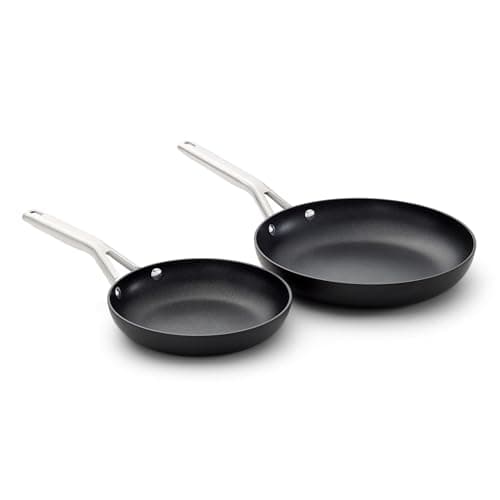
The first two have exposed metal in the cooking surface. The third does not. The fourth is what seasoning was invented for.
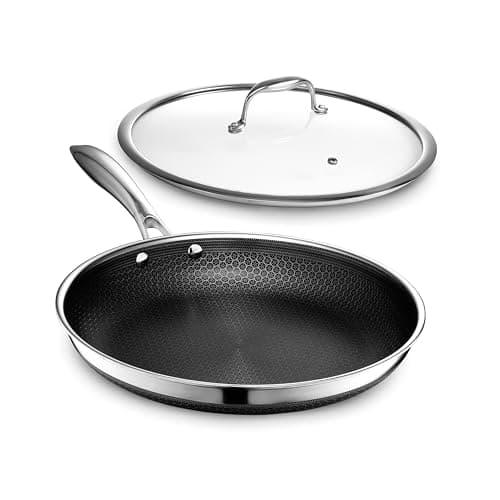
HexClad Hybrid Frying Pan, 12 in
Buyers who want release without giving up metal utensils, and who will follow the seasoning instruction
These are the products this page's reasoning actually points at. Same rules as everywhere else on the site: published specs, a stated trade-off, and a live price only where one exists.
Top pick · The pan that requires itSpecs read September 3, 2026
HexClad Hybrid Frying Pan, 12 in
Publishes a seasoning step - a teaspoon of oil over medium-low heat for two to three minutes - and excludes damage from lack of seasoning in its warranty.
Best for: Buyers who want release without giving up metal utensils, and who will follow the seasoning instruction
Published specifications for the HexClad Hybrid Frying Pan, 12 in
Construction
Tri-ply with an aluminum core
Surface
Laser-etched hexagonal stainless pattern over TerraBond ceramic nonstick
Coatings
Published free from PTFE and PFAS
Flat bottom diameter
11.4 in
Weight
3.4 lb
Handle
Stay-cool stainless steel
Oven maximum
900F published
Induction
Not published on this product page
Dishwasher
Published dishwasher safe
Metal utensils
Published metal utensil safe
Seasoning
Required - published as a teaspoon of oil over medium-low heat for 2 to 3 minutes
Made in
Not published
Warranty
Lifetime against manufacturing defects, excluding excessive heat, sharp utensils and lack of seasoning
Good
Published metal-utensil safe, which almost no coated pan is
Published dishwasher safe
PTFE-free and PFAS-free, stated as a specification
Not good
A 900F oven claim on a coated pan, with no published test method
The warranty excludes damage from excessive heat and from lack of seasoning - both on a pan sold as nonstick
No published country of manufacture and no published induction statement on the product page
The trade-off. It is a coated pan that requires seasoning and publishes a 900F oven rating. Both of those sit oddly against how coatings actually behave.
Skip this if. You want a pan with no wear surface. The hex pattern does not change the fact that the coating between the ridges wears.
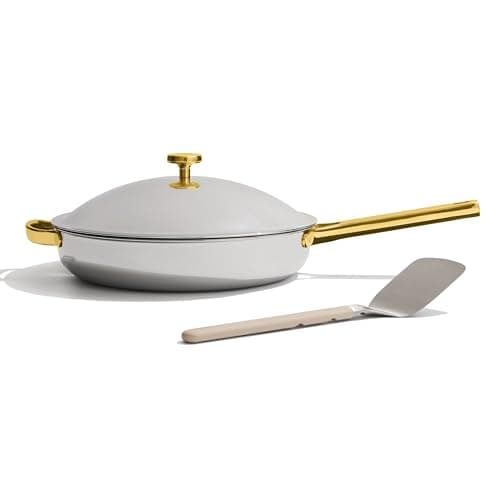
Published specifications for the Our Place Titanium Always Pan Pro
Construction
Published 3 mm fully clad - stainless exterior, aluminum core, titanium interior
Surface
NoCo coating-free nonstick, published as a micro-textured titanium surface that mimics the Lotus Effect
Coatings
Published made without PFAS including PTFE
Oven maximum
1000F published; 750F on the Gold version
Dishwasher
Published completely dishwasher safe
Metal utensils
Published safe
Induction
Published to work on all cooktops
Care
Published recommendation to rub a teaspoon of neutral oil into the interior after cleaning
Warranty
Limited lifetime, published as covering quality and craftsmanship
Made in
Not published
Dimensions and weight
Not published on the product page
Good
No coating at all, so there is no wear surface to fail
Published dishwasher safe and metal-utensil safe, which the ceramic line is not
A 1000F ceiling removes every oven and broiler question
Not good
The coating-free release claim has no published test method
Still recommends oiling the interior after cleaning, which a truly nonstick surface would not need
No published country of manufacture, dimensions or weight
The trade-off. “Coating-free nonstick” is an engineering claim with no published test behind it, and a textured metal surface is not a coating-grade release.
Skip this if. You want the cheap, easy egg pan. This is priced as premium clad cookware, because that is what it is.
Most standard PTFE-coated pans do not, because the coating is continuous and there is no exposed metal for oil to protect. Hybrid pans with metal in the cooking surface do, and HexClad publishes a specific seasoning step while excluding damage from lack of seasoning in its warranty.
›How do you season a HexClad pan?
HexClad publishes a teaspoon of oil over medium-low heat for two to three minutes. Wipe the oil across the whole cooking surface first, do not let it smoke, and wipe out the excess once it cools. The brand's warranty excludes damage arising from lack of seasoning, so it is worth doing.
›Is seasoning a nonstick pan the same as seasoning cast iron?
No, and treating them the same damages coated pans. Cast iron seasoning is oil polymerized past its smoke point into a permanent bonded film. On a coated pan it is a thin oil layer applied at low heat that washes off. Heating a coated pan to an oil's smoke point exceeds what the coating tolerates.
›Can you use oil to fix a nonstick pan that has stopped working?
Sometimes the opposite is needed. Food often sticks because polymerized oil residue has built up on top of the coating, usually from cooking sprays or overheating, and adding more oil makes it worse. If a pan used to release well and now does not, clean it before seasoning it.
›What oil should you use to season a coated pan?
A neutral oil with a reasonably high smoke point, applied thinly. Avoid butter and olive oil, which leave residue at low temperature rather than a clean film. You are filling microscopic surface texture, not building a polymerized layer, so very little oil is needed.
Sources
Every figure on this page came from one of these. Follow them and check our arithmetic — that is the point.