Heads up: some links on this page earn us a commission at no extra cost to you. It does not change what we recommend or the order. How we are funded.
The short answer
"Titanium" on a cookware listing almost never means a titanium pan. Solid titanium cookware exists and is rare and expensive.
"Titanium-infused" or "titanium-reinforced" usually means titanium dioxide or titanium particles added to a coating.
Nobody publishes what the titanium does — no durability figure, no lifespan, no comparison against the same coating without it.
Check the things that are documented instead: body gauge, handle attachment, induction compatibility, oven ceiling.
What is actually being claimed
The word "titanium" appears on cookware listings in several forms, and they describe different things — none of which is usually a titanium pan.
Phrase on the listing
What it usually describes
What it does not mean
"Titanium cookware"
Almost always a coating claim, not a body material
A pan made of titanium
"Titanium-infused nonstick"
Titanium dioxide or particles mixed into a PTFE or ceramic coating
That the coating is titanium
"Titanium-reinforced"
The same, framed as a durability claim
A published durability improvement
"Titanium ceramic"
A sol-gel silica coating with titanium in the mix
A different class of coating
"Hard-anodized with titanium"
An anodized aluminum body plus a titanium-containing coating
A titanium body
Compiled from how the terms are used across cookware listings. None of these is a regulated term.
Solid titanium cookware does exist. It is genuinely rare, genuinely expensive, mostly made for backpacking where weight is everything, and it is a poor cooking material — titanium conducts heat badly and develops severe hot spots. That is not what is on the shelf under this word.
What titanium in a coating might actually do
The plausible claim is hardness. Titanium dioxide is hard, and adding hard particles to a soft polymer film can in principle increase abrasion resistance. That is not nonsense; it is the same idea as adding aggregate to a composite.
The problem is that nobody publishes what it achieves. There is no durability figure, no scratch-resistance standard cited, no published comparison of the same coating with and without titanium, and no lifespan — for the titanium version or the plain one.
On a site that judges products by what their makers document, a claim with no supporting published figure of any kind is a marketing claim. We are not saying it does nothing. We are saying nobody has shown that it does something, and there is a difference between those two statements that most coverage of this topic collapses.
The lifespan silence, applied here
This is where the titanium claim becomes checkable in a useful way. If titanium genuinely extended coating life meaningfully, a manufacturer would have an enormous commercial incentive to publish a figure — because "lasts twice as long" is the single most persuasive thing you could say about a nonstick pan.
Nobody does. Not for titanium-reinforced coatings, not for plain ones, not in PTFE and not in ceramic. The absence is total across the category, which is at least suggestive about how large the difference is.
What to check instead
These are all documented, all comparable, and all matter more than the coating adjective.
Body gauge and construction. Heavy-gauge or hard-anodized aluminum resists warping. A warped pan is a bad pan regardless of what is sprayed on it.
Induction compatibility. Aluminum is not magnetic. Check for a bonded magnetic base or test with a fridge magnet.
Oven ceiling, from the manual. The pan's figure, not the coating's. Coating heat ratings get quoted as if they were pan ratings, which is how the 850F ceramic number ends up on listings for pans with plastic handles.
What the coating actually is. PTFE or sol-gel silica. GreenPan publishes that Thermolon is sand-derived silicon dioxide; that level of specificity is worth more than any adjective.
Is titanium cookware a scam?
No, and it is worth being precise rather than sensational. A titanium-reinforced pan is a normal coated pan and it will work like one. Nobody is selling you an empty box.
What is happening is softer and more common: an unquantified ingredient claim is used to justify a price premium, in a category where the thing you actually want to know — how long will it last — is not published by anyone.
The reasonable response is not outrage; it is to decline to pay extra for the claim. Buy on the specifications that are documented, at a price you would replace without regret, and treat every coated pan as the consumable it is. See the best nonstick pans.
Other coating claims worth reading carefully
"Diamond-infused". The same structure of claim with a different hard particle, and the same absence of published figures.
"Stone" or "granite" coating. A speckled appearance. It is a finish, not a material.
"Ceramic titanium". A sol-gel silica coating with titanium in it. Read is ceramic cookware safe for what the ceramic part means.
"PFOA-free". True of every pan made today. PFOA was a processing aid phased out of US manufacturing years ago, so this is a statement about the whole market rather than about the product.
The general rule for this category: a claim about an ingredient is not a claim about performance, and where a maker publishes a real number — GreenPan's composition and 850F rating, a documented oven ceiling, a stated gauge — that is worth more than any adjective on the box.
What to buy, if you are buying
These are the products this page's reasoning actually points at. Same rules as everywhere else on the site: published specs, a stated trade-off, and a live price only where one exists.
Top pick · A durability claim that is actually publishedSpecs read September 3, 2026
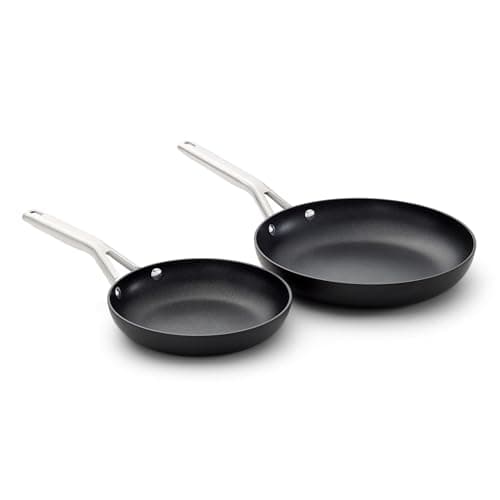
Calphalon Premier Hard-Anodized Nonstick Fry Pan, 10 in
Metal-utensil safe is specific and checkable, which is exactly what the titanium claims on this page are not.
Best for: A nonstick pan in a kitchen where the utensil drawer is not going to be policed
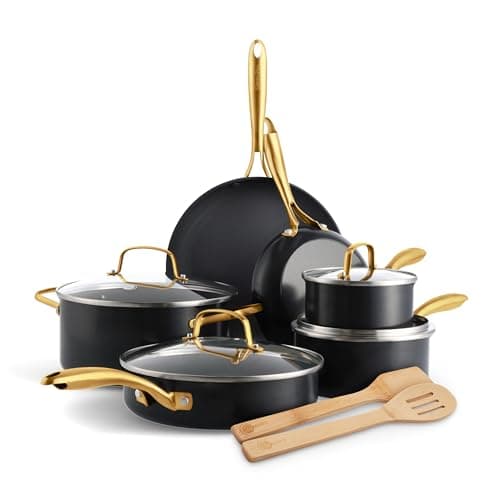
Published specifications for the GreenPan Ceramic Nonstick Cookware Set
Coating
Thermolon, from sand-derived Silicon Dioxide (SiO2), sprayed
Coating chemistry
PFAS-free, PFOA-free, free of lead and cadmium (GreenPan published)
Coating heat resistance
850F / 450C for the coating itself (GreenPan published)
Body oven maximum
Varies by line and is lower than the coating figure - check the specific line
Coating lifespan
Not published. No ceramic maker publishes one
Good
GreenPan publishes what the coating is made of in plain terms, which most ceramic brands do not
The coating will not release fumes if you overheat it the way PTFE can
Genuinely good release when new
Not good
Release degrades and nobody will tell you how fast
The 850F figure is for the coating, not the pan, and gets quoted as if it were the pan
Ceramic dislikes high heat and dishwashers, which is most of what a set gets used for
The trade-off. Ceramic nonstick loses release with use and no maker publishes a lifespan, GreenPan included. Treat it as a consumable, not a lifetime purchase.
Skip this if. You are buying a set expecting it to last as long as clad stainless. It will not, and the honest move is to buy one ceramic pan alongside a stainless set.
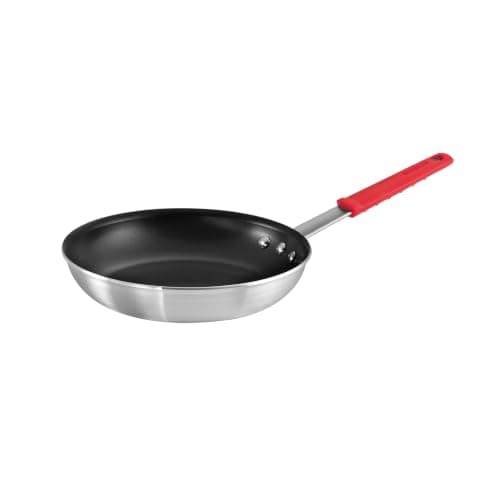
Published specifications for the Tramontina Professional Restaurant Fry Pan, 10 in
Body
Heavy-gauge aluminum
Coating
PTFE nonstick
Induction
No - aluminum body is not ferrous
Coating lifespan
Not published, by this or any nonstick maker
Good
Cheap enough that replacing it every couple of years is a real plan rather than a failure
Heavy gauge for a nonstick pan, so it does not warp on the first hot burner
Silicone handle sleeve that actually stays cool
Not good
Not induction compatible
PTFE, which some buyers will rule out on principle
No published coating lifespan, so the value case is unverifiable by design
The trade-off. It is PTFE. That is fine at normal cooking temperatures, and it is not a pan to preheat empty on high.
Skip this if. You want to avoid PTFE entirely. Buy ceramic instead and accept the shorter release life rather than pretending either one lasts forever.
On almost every listing using the word, it is a coating claim rather than a body material - titanium dioxide or particles added to a PTFE or ceramic coating. Solid titanium cookware exists but is rare, expensive and a poor conductor of heat.
›Does titanium make nonstick coatings last longer?
Nobody publishes a figure showing that it does. There is no durability standard cited, no comparison of the same coating with and without titanium, and no lifespan published for either version. The claim is plausible and unquantified.
›Is titanium cookware a scam?
No. A titanium-reinforced pan is a normal coated pan and works like one. What is happening is an unquantified ingredient claim being used to justify a premium in a category where nobody publishes the number that matters.
›What should I look at instead of titanium claims?
Body gauge, handle attachment, whether the base is flat, induction compatibility, and the pan's oven ceiling from the manual rather than the coating's heat rating. All of those are documented and comparable.
›Does PFOA-free mean anything?
Not as a differentiator. PFOA was a processing aid used to manufacture PTFE and has been phased out of US manufacturing, so every pan sold today is PFOA-free. It is a statement about the market rather than about the product.
Sources
Every figure on this page came from one of these. Follow them and check our arithmetic — that is the point.