Two of the most confident names in the category describe a paint effect. Underneath the speckles is a coating like any other, with the same unpublished lifespan.
Heads up: some links on this page earn us a commission at no extra cost to you. It does not change what we recommend or the order. How we are funded.
The short answer
Marble and granite are appearance descriptions, not materials. A marble-coated or granite-coated pan is an aluminum pan with a nonstick coating that has speckles in it - the coating underneath is usually PTFE, sometimes ceramic, and the maker often does not say which. There is no stone in it in any meaningful sense. Judge these pans exactly as you would any coated pan: on the published coating chemistry, the oven ceiling, the induction compatibility, and the fact that nobody publishes a lifespan.
What the words describe
"Marble coating" and "granite coating" describe how a pan looks. The coating has mineral particles or a speckled pigment in it, producing a mottled stone-like appearance that reads as solid and hard-wearing.
Underneath that appearance is a nonstick coating on an aluminum body, and it belongs to one of the two chemistries this site already covers: a fluoropolymer such as PTFE, or a sol-gel ceramic. Which one it is decides everything that matters, and a great many listings do not say.
This is the same pattern as the titanium claim, examined in titanium cookware claims: a hard-sounding mineral name attached to a coating whose actual composition goes unstated.
What they are not
Not stone. A pan made of marble or granite would be extremely heavy, crack under thermal stress and conduct heat badly. These are aluminum pans.
Not a distinct material category. There is no marble coating industry standard, no published composition, and no agreed definition of the term.
Not automatically PFAS-free. Many marble-coated pans are PTFE, which is a fluoropolymer. If the listing does not say PFAS-free or PTFE-free, do not assume.
Not harder in any published sense. No maker in this category publishes a hardness figure or an abrasion test result.
Not longer-lasting. No coating maker publishes a lifespan at all, which is covered in how long nonstick lasts.
The mineral particles in the coating may be real. What is not established is that they change performance in a way anyone has measured and published. Where a claim cannot be checked, we record that rather than repeating it - the method is here.
How to work out what you are buying
Four questions, and a listing that answers all four is telling you the truth about the pan.
Question
What a good answer looks like
What it tells you
What is the coating chemistry?
PTFE, or sol-gel ceramic named as such
Everything - the two behave and fail differently
Is it PFAS-free or PTFE-free?
A plain published statement, as GreenPan makes
Whether the mineral name is doing marketing work
What is the published oven maximum?
A number, e.g. 400F, 430F, 450F
Whether the coating and handle are documented at all
Is it induction compatible?
Yes or no for that specific line
Whether the pan works on your stove
If a listing leads with the finish name and cannot answer these four, the finish name is the product.
Which chemistry is underneath
If it is PTFE
It behaves like every other PTFE pan: excellent release when new, a published ceiling around 400F to 450F where the maker states one, degrades with high heat, and it is a fluoropolymer. The FDA and EPA positions are set out in is nonstick cookware safe.
If it is ceramic
It behaves like every other sol-gel ceramic pan: very good release when new, no PTFE, and release that generally fades faster. The evidence is in is ceramic cookware safe, and the failure-mode comparison is in PTFE versus ceramic nonstick.
Notice that neither answer has anything to do with marble or granite. Once you know the chemistry, the finish name adds nothing to your decision.
The body underneath
Marble and granite coated pans are usually cast or forged aluminum, frequently thicker than budget stamped pans, and that is a genuine point in their favor - a heavier body resists warping and heats more evenly.
It is also the part of the pan that has nothing to do with the coating name. If a heavy body is what you want, hard-anodized aluminum is the documented version of the same idea, and it is covered in best hard-anodized cookware.
A speckled coating and a plain one age the same way: release fades before anything visible happens, on a schedule no manufacturer publishes.
Should you buy one?
There is nothing wrong with these pans as a class, and some of them are perfectly good. The objection is to buying one on the strength of the name rather than on the specs.
If the listing publishes the coating chemistry, the ceiling and the induction status, judge it against any other coated pan on price and build.
If it publishes only a finish name, buy something that tells you more - the alternatives on this page all do.
If PFAS avoidance is your reason, buy a pan that publishes PFAS-free rather than one that implies it with a mineral name.
Whatever you buy, buy it as a consumable. That is true of every coated pan, marble or otherwise, and it is the reasoning in best nonstick cookware sets.
Stone-derived and mineral coatings - technically true of any sol-gel ceramic, since silicon dioxide is sand.
Copper-colored nonstick, where the color is a pigment in the coating and there is no copper doing anything - copper core versus aluminum core covers where copper does real work.
Scratch-proof claims, which no maker backs with a published test and which sit alongside guidance to use silicone utensils.
Coated pans that publish what they are
Every pan here states its coating chemistry and its oven ceiling. That is the standard a marble or granite listing should be held to.
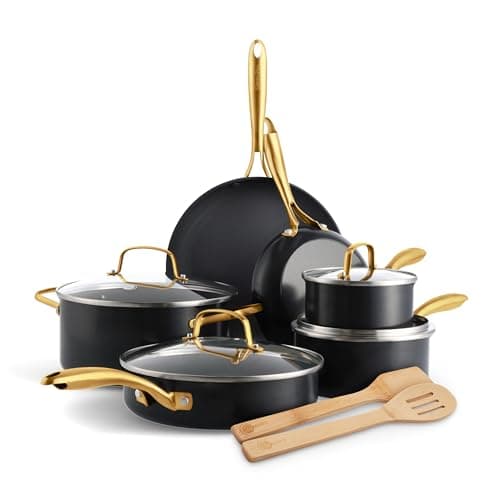
GreenPan Ceramic Nonstick Cookware Set
Someone who wants nonstick without PTFE and has read what that trades away
If you want to see the category, granite-coated pans on Amazon shows how it is priced - read the specifications rather than the finish name.
What to buy, if you are buying
These are the products this page's reasoning actually points at. Same rules as everywhere else on the site: published specs, a stated trade-off, and a live price only where one exists.
Top pick · The transparent alternativeSpecs read September 3, 2026
GreenPan Ceramic Nonstick Cookware Set
GreenPan publishes what Thermolon is made of and that it is PFAS-free, which is exactly the disclosure marble and granite listings avoid.
Best for: Someone who wants nonstick without PTFE and has read what that trades away
Published specifications for the GreenPan Ceramic Nonstick Cookware Set
Coating
Thermolon, from sand-derived Silicon Dioxide (SiO2), sprayed
Coating chemistry
PFAS-free, PFOA-free, free of lead and cadmium (GreenPan published)
Coating heat resistance
850F / 450C for the coating itself (GreenPan published)
Body oven maximum
Varies by line and is lower than the coating figure - check the specific line
Coating lifespan
Not published. No ceramic maker publishes one
Good
GreenPan publishes what the coating is made of in plain terms, which most ceramic brands do not
The coating will not release fumes if you overheat it the way PTFE can
Genuinely good release when new
Not good
Release degrades and nobody will tell you how fast
The 850F figure is for the coating, not the pan, and gets quoted as if it were the pan
Ceramic dislikes high heat and dishwashers, which is most of what a set gets used for
The trade-off. Ceramic nonstick loses release with use and no maker publishes a lifespan, GreenPan included. Treat it as a consumable, not a lifetime purchase.
Skip this if. You are buying a set expecting it to last as long as clad stainless. It will not, and the honest move is to buy one ceramic pan alongside a stainless set.
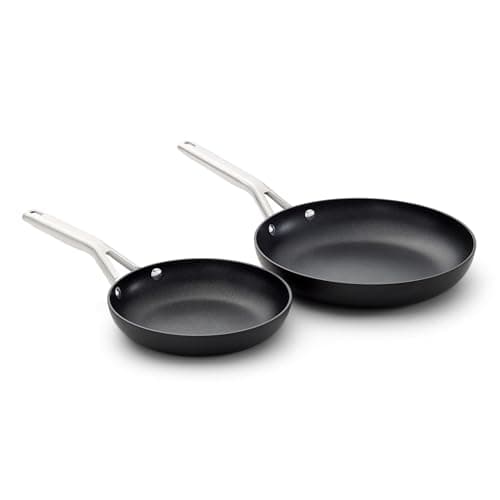
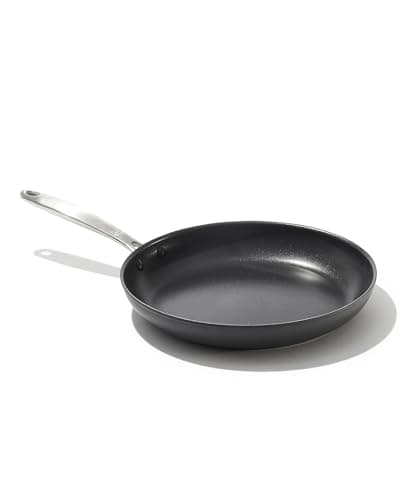
Published specifications for the OXO Good Grips Pro Hard-Anodized Nonstick Fry Pan, 10 in
Body
Hard-anodized aluminum
Coating
Three-layer PTFE nonstick, published PFOA-free
Oven maximum
430F published for the line
Induction
No on the standard hard-anodized line
Dishwasher
Dishwasher safe
Edge
Rolled, for pouring without dripping down the side
Coating lifespan
Not published
Good
The rolled pour edge is a small thing you notice every single time you use it
The hard-anodized body resists the denting that ruins cheap aluminum pans
Handle stays cool and does not rotate the way riveted plastic ones eventually do
Not good
Not induction compatible
Oven ceiling capped by the handle, not the pan
Still a coating, still a consumable, still no published lifespan
The trade-off. The handle that makes it comfortable is a stainless-and-silicone assembly, and that is what caps the oven rating below the body's own limit.
Skip this if. You need induction. The standard hard-anodized body is not ferrous.
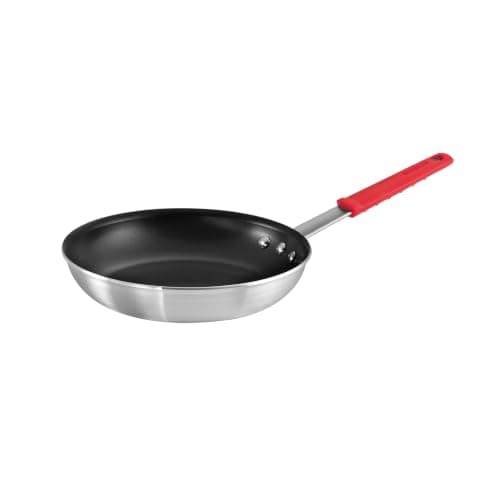
Published specifications for the Tramontina Professional Restaurant Fry Pan, 10 in
Body
Heavy-gauge aluminum
Coating
PTFE nonstick
Induction
No - aluminum body is not ferrous
Coating lifespan
Not published, by this or any nonstick maker
Good
Cheap enough that replacing it every couple of years is a real plan rather than a failure
Heavy gauge for a nonstick pan, so it does not warp on the first hot burner
Silicone handle sleeve that actually stays cool
Not good
Not induction compatible
PTFE, which some buyers will rule out on principle
No published coating lifespan, so the value case is unverifiable by design
The trade-off. It is PTFE. That is fine at normal cooking temperatures, and it is not a pan to preheat empty on high.
Skip this if. You want to avoid PTFE entirely. Buy ceramic instead and accept the shorter release life rather than pretending either one lasts forever.
An aluminum pan with a nonstick coating that has mineral particles or speckled pigment in it, producing a stone-like appearance. The coating underneath is usually PTFE, sometimes ceramic, and many listings do not say which.
›Is granite coated cookware nonstick?
Yes - it is nonstick cookware with a decorative finish. The relevant questions are the same as for any coated pan: what the coating chemistry is, what the published oven ceiling is, and whether it works on induction.
›Is marble coating PFAS-free?
Not necessarily. Many marble-coated pans use PTFE, which is a fluoropolymer. If avoiding PFAS is your reason for buying, look for a pan that publishes PFAS-free or PTFE-free plainly rather than one that implies it with a mineral name.
›Does marble coating last longer than regular nonstick?
There is no published evidence either way, because no manufacturer of any coating publishes a lifespan. Treat marble and granite coated pans as consumables, exactly like every other coated pan.
›Is there actually stone in marble coated pans?
There may be mineral particles in the coating, but the pan is aluminum and the surface is a nonstick coating. A pan made of marble or granite would be extremely heavy, conduct heat badly and crack under thermal stress.
Sources
Every figure on this page came from one of these. Follow them and check our arithmetic — that is the point.