Heads up: some links on this page earn us a commission at no extra cost to you. It does not change what we recommend or the order. How we are funded.
The short answer
Copper conducts at roughly 401 watts per meter-kelvin against aluminum's 237, so a copper core is genuinely better at spreading heat. The catch is thickness: copper-core lines typically use a thin copper layer sandwiched between aluminum layers, and a thin layer of a better conductor does less than a thick layer of a good one. For most home cooking the difference is small and the price difference is not. Buy aluminum-core tri-ply unless you cook delicate sauces professionally.
The numbers, which are not in dispute
Thermal conductivity near room temperature, from the references this site uses throughout:
Metal
Thermal conductivity
Relative to aluminum
Copper
401 W/m-K
About 1.7 times better
Aluminum
237 W/m-K
The baseline
Cast iron (gray)
About 50 W/m-K
About one fifth
Carbon steel
About 45 W/m-K
About one fifth
Stainless type 304
15 to 16 W/m-K
About one fifteenth
This table is the reason every good stainless pan has a core at all. Copper is genuinely the best of the practical options.
So on the physics, copper wins. The question is not whether copper conducts better - it plainly does - but whether the amount of copper in a domestic clad pan is enough for that advantage to reach the food.
Thickness is the variable nobody advertises
A copper-core pan is usually five layers: stainless, aluminum, copper, aluminum, stainless. The copper sits in the middle and is typically thin - often thinner than the aluminum layers around it.
That matters because heat spreading depends on conductivity multiplied by cross-section. A thin layer of copper can move less heat sideways than a thick layer of aluminum, which is why a five-ply copper-core pan does not automatically outperform a well-made tri-ply one.
Almost no maker publishes the copper layer thickness, which puts this claim in the same category as the gauge figures nobody publishes for woks and sheet pans. Where a specification is not published, we record that rather than estimating - the method is here. The related question of whether more plies help at all is in tri-ply versus five-ply.
The genuine copper cookware tradition - solid copper pans lined with tin or stainless, 2 to 3 mm thick - is a different product from a copper-core clad pan, and it is where copper's reputation comes from. It is also expensive, heavy, and requires maintenance that most kitchens will not do.
What a copper core actually changes
Slightly more even heat across the base, which shows most in wide shallow pans and least in tall narrow ones.
Slightly faster response to a change in burner setting, though the stainless layers dominate the lag.
Nothing at all for boiling, braising or searing. Boiling is governed by the water, braising by mass, and searing by stored heat.
A higher price and often a higher weight.
The honest summary is that the advantage is real, small, and concentrated in one type of cooking: delicate sauces where a hot spot scrambles eggs or catches milk solids. If that is not most of what you cook, it is not a specification worth paying for.
Copper disc bottoms are a different thing entirely
A pan with a copper-colored disc bonded to the base is usually a disc-bottom pan, and the copper there is often a thin decorative or partially functional layer. It does not make the pan clad, and the walls still have nothing in them.
The same applies to copper-colored exteriors, which are frequently a finish rather than a material. Read the construction description rather than the color - disc bottom versus fully clad covers how to tell, and it is one of the traps listed in cookware set buying mistakes.
On a five-ply pan the layers are visible at the rim. The copper line, when there is one, is usually the thinnest of them.
If you actually want copper
Solid copper cookware - not copper core - is a genuinely different experience and the reason the material has the reputation it does. It is also:
Expensive, by a large multiple over clad stainless.
Reactive if unlined, so it comes lined with tin or stainless; tin linings wear and need re-tinning.
High maintenance if you want it to stay bright, which is purely cosmetic.
Not induction compatible unless it has a magnetic base added.
We have not audited any solid copper pans and do not have one in the ledger, so we make no recommendation about specific models. If you want to see how the category is priced, lined copper saucepans on Amazon shows the range.
The verdict
Buy aluminum-core tri-ply. It is the construction the whole category is built on and it does everything a home kitchen needs.
Do not pay a premium for a copper core unless the maker publishes the copper thickness and you cook delicate sauces regularly.
Ignore copper-colored discs and exteriors. They are a finish or a disc-bottom pan, not clad construction.
Spend the difference on shape instead. A second clad saucepan or a 12-inch skillet changes more about your cooking than a copper layer will.
Aluminum-core clad, which is what we recommend
Every pan here has an aluminum core. Cuisinart publishes pure aluminum rather than an alloy, which is the one core specification in this category anyone actually states.
All-Clad D3 Stainless 10 in Fry Pan
One good open-stock stainless pan bought instead of a cheap full set
These are the products this page's reasoning actually points at. Same rules as everywhere else on the site: published specs, a stated trade-off, and a live price only where one exists.
Top pick · The aluminum-core referenceSpecs read September 3, 2026
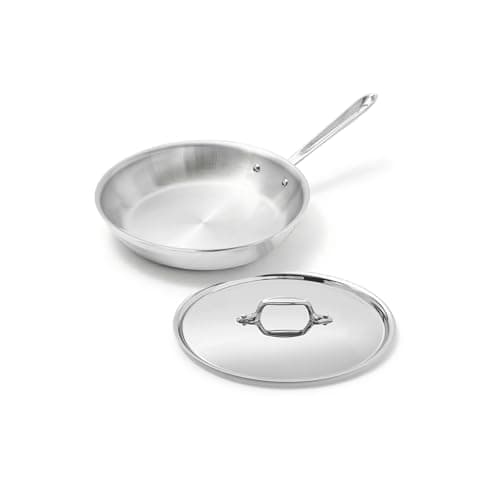
All-Clad D3 Stainless 10 in Fry Pan
Fully bonded tri-ply with an aluminum core, 600F oven and broiler safe, and the pan every clad comparison starts from.
Best for: One good open-stock stainless pan bought instead of a cheap full set
Published specifications for the All-Clad D3 Stainless 10 in Fry Pan
Construction
Fully bonded tri-ply, aluminum core
Oven maximum
600F, oven and broiler safe
Induction
Yes - compatible with any stovetop
Dishwasher
Handwash only (All-Clad published)
Handle
Double-riveted stainless
Weight
3.0 lb (model 4110)
Warranty
Limited lifetime
Made in
Bonded, engineered and assembled in Canonsburg, PA
Good
600F is the highest oven ceiling of any stainless pan on this site
The one pan here whose manufacturing location is published down to the town
Genuinely repairable-adjacent: rivets are the only failure point and the warranty covers them
Not good
Hand wash only
The flared rim makes it a poor pan for anything with liquid
Costs several times what a Tramontina or Cuisinart pan of the same construction costs
The trade-off. Hand wash only. All-Clad publishes that plainly, and it is a real daily cost on a pan you will use every day.
Skip this if. You want a dishwasher-safe pan, or you are buying a whole kitchen on a fixed budget - one D3 skillet costs what a full clad set can cost.
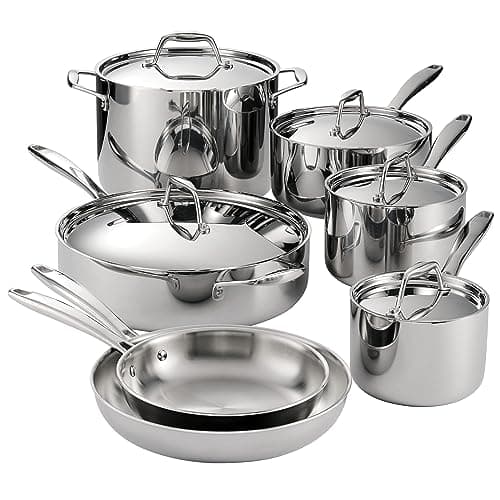
Published specifications for the Tramontina Signature Tri-Ply Clad 12-Piece Set
Construction
Tri-ply: 18/10 stainless, aluminum core, magnetic stainless exterior
Pieces
8 in and 10 in fry pans; 1.5, 2 and 3 qt covered saucepans; 5 qt covered deep saute; 8 qt covered stockpot
Oven maximum
500F on the 80116-249DS listing; other SKUs in the line are listed at 350F
Induction
Yes - magnetic stainless exterior
Dishwasher
Listed dishwasher safe
Handles
Precision cast, riveted
Certification
NSF-certified on the 80116-249DS line
Country of origin
Not asserted - retail listings disagree across SKUs (Brazil and China both appear)
Good
Fully clad, not disc-bottom: the aluminum runs up the sidewalls, so sauces do not scorch in a ring at the base
NSF certification on the flagship SKU is a real, checkable third-party mark rather than a marketing badge
Induction-ready without paying an induction premium
Not good
Retail listings disagree on the oven maximum across SKUs in the same line, which is a documentation problem, not a cooking one
Handles run hot on gas
The 12-piece count includes lids; the useful-item count is seven
The trade-off. Handles are the weak point. They are riveted and sturdy, but they get hot on a gas ring in a way the more expensive clad brands' do not.
Skip this if. You want a set you can leave in the oven above 500F, or you cook mostly eggs and pancakes and would rather spend the money on one good nonstick pan.
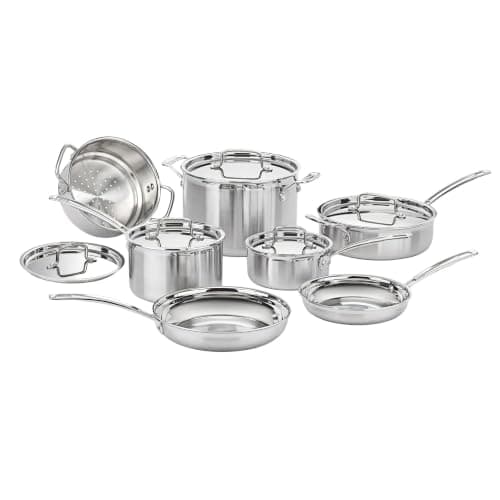
Published specifications for the Cuisinart MultiClad Pro MCP-12N 12-Piece Set
Construction
Tri-ply: 18/10 stainless interior, pure aluminum core, brushed stainless exterior
Pieces
1.5 and 3 qt covered saucepans; 8 in and 10 in skillets; 3.5 qt covered saute; 8 qt covered stockpot; steamer insert
Oven maximum
500F per the Cuisinart use-and-care manual, which the Amazon listing we cite now matches. Major retail listings still advertise 550F; Cuisinart has confirmed the manual figure
Induction
Yes
Dishwasher
Dishwasher safe
Handles
Riveted solid stainless, cool-grip profile
Warranty
Lifetime
Good
Heat runs up the sidewalls, not just across the base
Genuinely dishwasher safe, which the pricier clad brands often are not
Lifetime warranty on a set at this price
Not good
Published oven maximum contradicts the retail listing for the same product
Handle spine is divisive
No 12-inch skillet in the box, which is the pan most people reach for second
The trade-off. The cool-grip handles have a sharp spine that some people find uncomfortable on a full 8-quart stockpot.
Skip this if. You want the higher oven ceiling that major retail listings advertise. The manual says 500F and Cuisinart has confirmed the manual is correct.
›Is copper core cookware better than aluminum core?
Copper conducts about seventy percent better than aluminum, so in principle yes. In practice the copper layer in a clad pan is usually thin, and a thin layer of a better conductor can move less heat sideways than a thick layer of a good one. The difference is small for most home cooking.
›How thick is the copper in a copper core pan?
Almost no manufacturer publishes it, which is the central problem with the claim. Without a thickness figure there is no way to know whether the copper layer is doing meaningful work, so we record it as not published rather than estimating.
›Does a copper bottom make a pan better?
A copper-colored disc bonded to the base is usually a disc-bottom pan, and copper-colored exteriors are often just a finish. Neither makes a pan fully clad, and the walls still have no conductive layer in them.
›When is a copper core worth paying for?
For delicate sauces, where a hot spot scrambles eggs or catches milk solids, and mainly in wide shallow pans. It does nothing for boiling, braising or searing, which are governed by the water, by mass and by stored heat respectively.
›Is solid copper cookware different from copper core?
Completely. Solid copper is 2 to 3 mm of copper lined with tin or stainless, and it is where copper's reputation comes from. It is expensive, needs maintenance, is not induction compatible without a magnetic base, and tin linings eventually need replacing.
Sources
Every figure on this page came from one of these. Follow them and check our arithmetic — that is the point.