Heads up: some links on this page earn us a commission at no extra cost to you. It does not change what we recommend or the order. How we are funded.
The short answer
Buy clad stainless unless you have a specific reason to want copper. Copper conducts heat roughly twenty times better than stainless, which makes it the most responsive cookware material there is - genuinely valuable for sugar work, delicate sauces and anything where you need the pan to react the instant you change the heat. In exchange it costs several times as much, needs polishing to stay bright, must be lined, cannot go on induction, and the lining eventually wears through and needs replacing.
The physics, which are not in dispute
Copper conducts heat far better than any other metal used in cookware - roughly twenty times better than stainless steel, and around twice as well as aluminum. That means heat spreads across a copper pan almost immediately, and it means the pan responds to a change at the burner almost immediately too.
Stainless steel is a poor conductor. This is why no serious stainless pan is solid stainless: it is a thin stainless skin bonded to an aluminum or copper core that does the actual heat spreading. A fully clad pan is, in effect, an aluminum pan with a stainless cooking surface - disc bottom versus fully clad.
So the comparison is not really copper against stainless. It is copper against aluminum, with a stainless surface on both - copper core versus aluminum core covers the version of this argument that happens inside clad pans.
Where copper genuinely wins
Sugar work. Caramel and confectionery have a narrow window between done and burnt, and copper's responsiveness is a real safety margin. This is the strongest case for copper in a home kitchen.
Delicate emulsions and custards. When you pull the heat, the pan actually cools. With a thick clad pan it keeps cooking for a while.
Reductions where you ride the heat constantly.
Unlined copper for egg whites and jam, which are the two traditional unlined uses - both brief and specific.
It looks extraordinary, and that is a legitimate reason to buy something you will look at every day.
Where clad stainless wins
Copper
Clad stainless
Responsiveness
Best available
Good - very good in five-ply
Price
Several times more
Reasonable at every level
Maintenance
Polishing, or accept a dull patina
None
Lining
Wears through; needs relining
Nothing to wear
Induction
No, unless a disc is added
Yes, when the exterior is ferrous
Dishwasher
No
Generally yes
Oven and broiler
Limited by handle and lining
500F to 600F published
Thermal mass for searing
Low - it is thin
Better
Weight
Heavy for its thickness
Moderate
Buy-once lifespan
Decades, with relining
Indefinite, with nothing
The lining is the ownership problem, and it is the thing most buyers do not think about. Copper is reactive and not something to be eating in quantity, so culinary copper is lined - historically with tin, now usually with stainless. Tin is soft, melts at a low temperature and wears through, and relining is a specialist service. A stainless lining lasts far longer but is still a bonded layer that can eventually fail - cooking acidic foods and reactive cookware.
If the lining on a copper pan has worn through to bare copper on the cooking surface, stop using it for food until it is relined. That is not fussiness - it is the reason lining exists.
Thickness is the specification that matters
Thin copper is decorative. A copper pan needs real thickness - around 2 mm and upward - to deliver the evenness people buy copper for. Below that you are paying for the color.
This is where a great deal of copper cookware on the market fails, and where copper-colored stainless and copper-plated aluminum fail completely. A copper exterior bonded to a stainless pan contributes essentially nothing thermally; the aluminum core is doing the work - best copper cookware goes through what to check, and how to read a cookware listing covers how these claims get made.
The induction problem
Copper is not ferrous, so a copper pan will not work on an induction hob unless the maker has bonded a steel disc to the base - which adds thickness and mass exactly where copper's responsiveness is supposed to come from.
If you have induction now, or might have it later, this is close to disqualifying. Clad stainless with a magnetic exterior carries across every hob type - cookware for induction and gas versus induction cookware.
Copper's incompatibility with induction is the practical fact most likely to decide this comparison for a modern kitchen.
The middle ground
If what you want is responsiveness rather than copper specifically, there are two better buys than a copper pan.
Five-ply clad with a thick aluminum core. More responsive than tri-ply, works on induction, no maintenance - tri-ply versus five-ply.
Copper-core clad. A copper layer inside a stainless sandwich: some of copper's conductivity, none of the polishing or lining, and usually induction-capable - copper core versus aluminum core.
And if what you want is searing rather than responsiveness, neither material is the answer - thermal mass is, which means cast iron or carbon steel - best pans for searing steak.
The verdict
Buy clad stainless. It is the right default for essentially every kitchen: no maintenance, no lining, works on induction, survives the dishwasher, lasts indefinitely, and costs a fraction of copper.
Buy copper if you make confectionery, if you want one beautiful pan and know what owning it involves, or if you have inherited good copper - in which case getting it relined is usually worth it. Do not buy thin copper, and do not buy copper-colored anything expecting copper behavior.
The clad pans that make copper hard to justify
Copper cookware itself is recommended as a category via a tagged search - our audited ledger contains clad stainless, which is what we would buy for almost every kitchen.
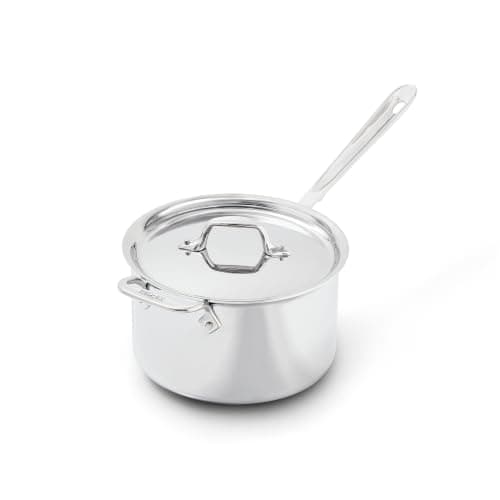
All-Clad D3 Stainless Saucepan, 3 qt
Rice, custards and reductions - anything that scorches in a disc-bottom pan
These are the products this page's reasoning actually points at. Same rules as everywhere else on the site: published specs, a stated trade-off, and a live price only where one exists.
Top pick · The practical answerSpecs read September 3, 2026
All-Clad D3 Stainless Saucepan, 3 qt
Fully clad stainless with an aluminum core gets most of copper's evenness with none of its ownership burden.
Best for: Rice, custards and reductions - anything that scorches in a disc-bottom pan
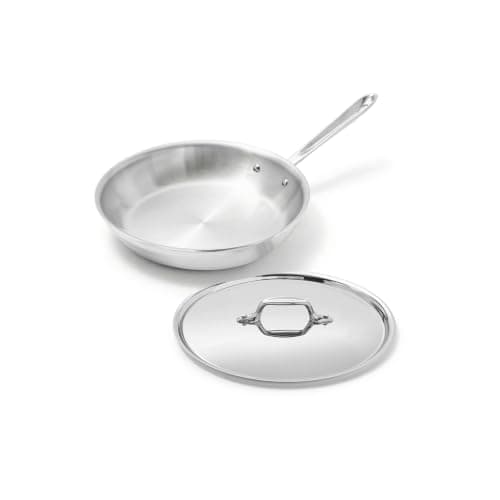
Published specifications for the All-Clad D3 Stainless 10 in Fry Pan
Construction
Fully bonded tri-ply, aluminum core
Oven maximum
600F, oven and broiler safe
Induction
Yes - compatible with any stovetop
Dishwasher
Handwash only (All-Clad published)
Handle
Double-riveted stainless
Weight
3.0 lb (model 4110)
Warranty
Limited lifetime
Made in
Bonded, engineered and assembled in Canonsburg, PA
Good
600F is the highest oven ceiling of any stainless pan on this site
The one pan here whose manufacturing location is published down to the town
Genuinely repairable-adjacent: rivets are the only failure point and the warranty covers them
Not good
Hand wash only
The flared rim makes it a poor pan for anything with liquid
Costs several times what a Tramontina or Cuisinart pan of the same construction costs
The trade-off. Hand wash only. All-Clad publishes that plainly, and it is a real daily cost on a pan you will use every day.
Skip this if. You want a dishwasher-safe pan, or you are buying a whole kitchen on a fixed budget - one D3 skillet costs what a full clad set can cost.
Better at responsiveness, worse at nearly everything else. Copper conducts heat about twenty times better than stainless, which genuinely helps with sugar work and delicate sauces. It also costs several times more, needs polishing and relining, and will not work on induction.
›Is copper cookware worth the money?
For confectionery and delicate emulsions, or if you want one beautiful pan and accept the upkeep, yes. For general cooking, no - a fully clad stainless pan with an aluminum core delivers most of the performance with no polishing, no lining to wear out and induction compatibility.
›Does copper cookware need to be lined?
Yes, for food use. Copper is reactive and not something to be ingesting in quantity, so culinary copper is lined with tin or stainless. If the lining has worn through to bare copper on the cooking surface, stop using the pan for food until it is relined.
›Can you use copper cookware on induction?
Not unless the maker has bonded a magnetic steel disc to the base, because copper is not ferrous. That added disc works against the responsiveness copper is bought for, so copper is a poor choice if you have induction now or might later.
›Is copper-colored cookware the same as copper?
No. A copper exterior bonded onto a stainless pan, or copper plating over aluminum, contributes essentially nothing thermally - the aluminum core is doing the work. Real copper cookware needs genuine thickness, around 2 mm and upward, to behave the way copper is supposed to.
Sources
Every figure on this page came from one of these. Follow them and check our arithmetic — that is the point.