Heads up: some links on this page earn us a commission at no extra cost to you. It does not change what we recommend or the order. How we are funded.
The short answer
Buy a 12-inch cast iron skillet. It holds more heat than anything else at the price, so the surface temperature barely drops when cold meat lands on it, and Lodge publishes 550F so it can go straight into the oven to finish. Carbon steel is the lighter alternative with almost the same behavior. Clad stainless sears well and recovers more slowly. Do not use nonstick: the coating cannot survive searing temperatures, and the published ceilings top out at 450F.
Quick picks
The whole answer, on one screen. Tap a row to jump to the full write-up. Every pick below carries a stated trade-off further down — including the one at the top.
#
Product
Best for
Price
1
Lodge Seasoned Cast Iron Skillet, 12 in (L10SK3)
The most thermal mass per dollar in the category, a 550F published ceiling, and a base wide enough for two steaks without crowding.
Prices last checked October 22, 2026. Prices move constantly — the number on Amazon when you click is the real one.
Searing is a thermal mass problem
A steak straight from the refrigerator is a large, cold, wet object. Drop it into a hot pan and it takes energy out of the surface faster than the burner can put it back. If the pan has little stored energy, its temperature collapses, the moisture coming out of the meat cannot evaporate fast enough, and the steak steams in its own juice instead of browning.
So the useful question is not how hot a pan gets. It is how much heat the pan holds and how little its surface temperature drops when the meat arrives. That favors heavy, thick pans, and it is why cast iron sears superbly despite conducting heat about five times worse than aluminum - the conductivity figures behind that are on cookware materials compared.
Material
Why it sears well or badly
Recovery after the meat lands
Cast iron
Heavy, thick, enormous stored energy
Barely drops. The best in this list
Carbon steel
Thinner than iron but dense and bare
Small drop, fast recovery on gas
Clad stainless
Aluminum core spreads well, less mass
Noticeable drop, slower recovery
Hard-anodized nonstick
Light body plus a coating with a ceiling
Drops hard, and you should not be here anyway
Enameled cast iron
Same mass as iron, glass surface
Excellent, but the enamel dislikes dry high heat
Every row is a consequence of mass and surface, not of brand. A cheap heavy pan out-sears an expensive light one.
How we chose these
We have not cooked in them. This page compares published thickness where a maker states one, published oven ceilings, base diameter and surface type. The method is here, and where a figure is not published the product card says so rather than guessing.
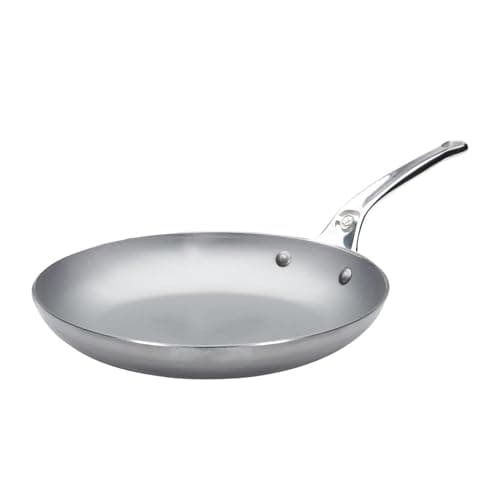
That matters more here than usual, because thickness is the specification most relevant to searing and almost nobody publishes it. de Buyer does - 3 mm at 11 inches - and that single number is why it appears on this page.
Size, and the crowding rule
The most common searing failure has nothing to do with the pan. It is putting two steaks in a 10-inch skillet, where the sloped walls leave a cooking surface nearer eight inches and the meat sits shoulder to shoulder. Steam cannot escape between them and the crust never forms.
One steak: a 10-inch pan is fine.
Two steaks: 12 inches, with a visible gap between them.
More than two: sear in batches, or use the oven to finish.
The rim-versus-surface arithmetic is set out in what size cast iron skillet, and it applies to every sloped pan whatever it is made of.
Oil goes in after the pan is hot, not before. A pan preheated with oil in it smokes the oil long before the metal is ready.
The four things the pan cannot do for you
Dry the meat. Surface water has to boil off before browning starts, and that is energy spent on nothing. Pat it dry.
Preheat properly. Cast iron needs several minutes on medium, not one minute on high - the outside heats long before the middle does.
Use a high smoke point fat. Butter burns at searing temperatures. Add it at the end if you want it.
Leave it alone. The crust releases itself when it is formed. Moving the steak early is how it sticks.
A pan hot enough to sear will smoke. That is normal on bare iron and steel and it is one reason not to attempt this in a coated pan, whose published ceilings run 400F to 450F - the full table of ceilings is here.
Finishing in the oven
For anything thicker than about an inch, sear on the stove and finish in the oven. That makes the pan's oven ceiling a real specification rather than a footnote: Lodge publishes 550F for its seasoned cookware, All-Clad publishes 600F oven and broiler safe, and every coated pan here is out of the running.
It also rules out anything with a silicone handle sleeve or a phenolic knob, since the handle sets the ceiling rather than the metal.
Grill pan or flat pan
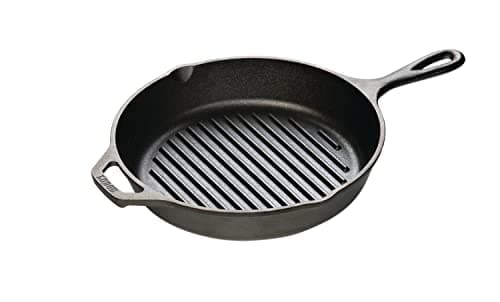
A grill pan gives stripes and lets fat drain away. It also reduces contact area to the tops of the ridges, which means less browning overall - you are trading crust for marks. If you want the look, buy one; if you want the best crust, use a flat pan. The contact-area arithmetic is in best cast iron grill pans and griddles.
Each write-up below gives the published specs, what the pan is genuinely good at, what it costs you, and who should skip it. The trade-off line is there on the top pick too — a recommendation with no downside is an advertisement.
Top pick · Best pan for searingSpecs read September 3, 2026
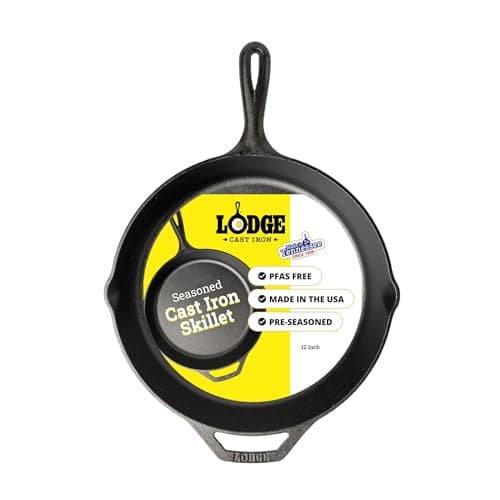
Lodge Seasoned Cast Iron Skillet, 12 in (L10SK3)
The most thermal mass per dollar in the category, a 550F published ceiling, and a base wide enough for two steaks without crowding.
Best for: Cooking for three or more, or anything that needs surface area rather than depth
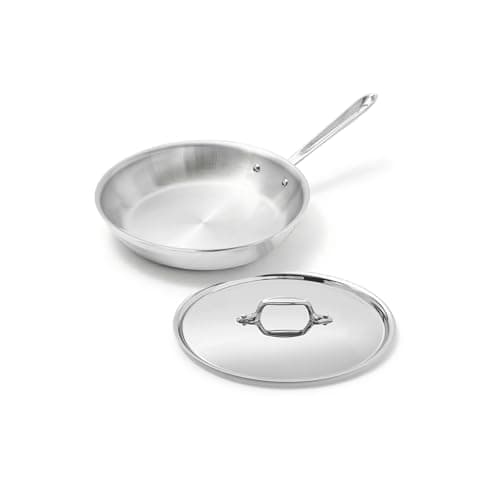
Published specifications for the All-Clad D3 Stainless 10 in Fry Pan
Construction
Fully bonded tri-ply, aluminum core
Oven maximum
600F, oven and broiler safe
Induction
Yes - compatible with any stovetop
Dishwasher
Handwash only (All-Clad published)
Handle
Double-riveted stainless
Weight
3.0 lb (model 4110)
Warranty
Limited lifetime
Made in
Bonded, engineered and assembled in Canonsburg, PA
Good
600F is the highest oven ceiling of any stainless pan on this site
The one pan here whose manufacturing location is published down to the town
Genuinely repairable-adjacent: rivets are the only failure point and the warranty covers them
Not good
Hand wash only
The flared rim makes it a poor pan for anything with liquid
Costs several times what a Tramontina or Cuisinart pan of the same construction costs
The trade-off. Hand wash only. All-Clad publishes that plainly, and it is a real daily cost on a pan you will use every day.
Skip this if. You want a dishwasher-safe pan, or you are buying a whole kitchen on a fixed budget - one D3 skillet costs what a full clad set can cost.
A 12-inch cast iron skillet. It stores more heat than anything else at the price, so its surface temperature barely drops when cold meat lands on it, and Lodge publishes 550F so it can go into the oven to finish a thick cut.
›Can you sear a steak in a nonstick pan?
You should not. Searing needs temperatures above what a coating tolerates - published ceilings across the coated pans here run 400F to 450F - so you are either damaging the coating or not searing properly.
›Why does my steak steam instead of searing?
Almost always crowding or surface moisture. Two steaks in a 10-inch pan sit too close for steam to escape, and a wet surface spends the pan's heat boiling water instead of browning. Pat the meat dry and leave a visible gap.
›Is stainless steel good for searing?
Yes, though it recovers more slowly than cast iron because it stores less heat. Its advantage is the pan sauce afterward: a light interior lets you see the fond, and All-Clad publishes 600F oven and broiler safe.
›Should you use a grill pan for steak?
Only if you want the marks. Ridges reduce contact area to their tops, so a grill pan browns less of the surface than a flat pan does. It is a trade of crust for appearance.
Sources
Every figure on this page came from one of these. Follow them and check our arithmetic — that is the point.