Heads up: some links on this page earn us a commission at no extra cost to you. It does not change what we recommend or the order. How we are funded.
The short answer
Skin-on fillets you want crisp: carbon steel or cast iron, properly preheated. The skin releases when it is crisp and not before.
Delicate white fish, or if you are nervous: a coated pan. It is the one job where nonstick is unambiguously the easy answer.
Whole fish or anything you finish in the oven: clad stainless or cast iron, for the oven ceiling.
Buy a thin, flexible fish spatula. It matters more than the pan for anything you intend to turn over.
Quick picks
The whole answer, on one screen. Tap a row to jump to the full write-up. Every pick below carries a stated trade-off further down — including the one at the top.
#
Product
Best for
Price
1
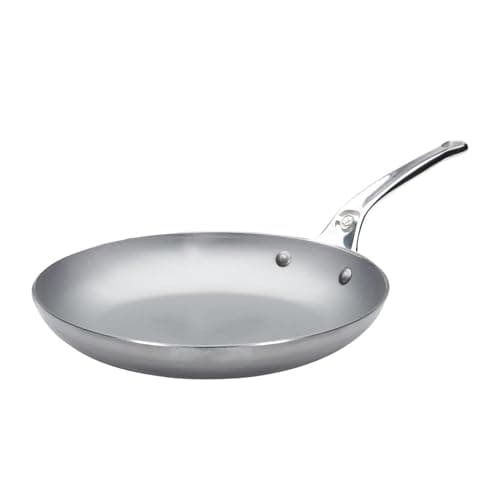
de Buyer MINERAL B PRO Carbon Steel Fry Pan, 11 in
A seasoned carbon steel surface crisps skin and then lets go of it, and 3 mm of published steel holds the heat that crisping needs.
Prices last checked October 22, 2026. Prices move constantly — the number on Amazon when you click is the real one.
Why fish sticks more than anything else
Fish protein bonds to bare metal readily, and fish flesh has almost no structure to survive being pulled off. Meat that sticks can be levered free; a fillet that sticks tears. That is the whole difficulty, and it is why this is the one job where a coating earns its place in a kitchen otherwise built around bare metal.
The second cause is temperature. A pan that is too cool lets the protein bond before a crust forms. The mechanism is identical to the one described in why food sticks to stainless steel, and the water-droplet test there works on any bare pan.
Skin-on fillets: the release tells you when
Skin-on salmon, sea bass or snapper is the case where bare metal beats a coating, because you want the skin to crisp and a coated pan cannot get hot enough for long enough to do it well.
Dry the skin thoroughly. Wet skin steams and never crisps.
Preheat properly, then add a high smoke point oil.
Lay the fillet away from you, skin down, and press it flat for ten seconds so it does not curl.
Leave it. The skin welds itself to the pan and then releases when it is crisp. If it will not move, it is not ready.
Turn once, for less than a minute. Most of the cooking happens on the skin side.
"It releases when it is ready" is not folklore. A crisp crust has dehydrated and contracted away from the metal; a soft one has not. This is the same behavior that makes a seared steak let go on its own.
Delicate fish: use the coating
Skinless cod, haddock, sole and tilapia have nothing to protect them. There is no crust to release, the flesh flakes under a spatula, and a bare pan turns a fillet into scraps. A coated pan is the right tool and nobody should feel bad about it.
Two rules make it work: medium heat, since the coating limits you anyway, and a thin flexible spatula. The published ceilings on coated pans - 400F to 450F across the ledger - are irrelevant here because delicate fish never wants that heat. The cleaning routine that keeps the coating working is in how to clean nonstick pans.
Shape and size
What you are cooking
Pan
Why
Two skin-on fillets
10 to 12 in skillet, sloped
Room to get a spatula under, and space between fillets
Four fillets
12 in, or two pans
Crowding steams fish faster than it steams meat
A whole fish
12 in skillet or a sheet pan in the oven
Length is the constraint; an oval pan is not worth buying
Fish cakes and goujons
Coated 10 in
Repeated turning, delicate structure
Poached or braised fish
Clad saute pan or enameled pot
Liquid, and non-reactive for wine and citrus
A sloped skillet is the right shape for almost all of this - the ramp is what lets a spatula reach under a fillet.
Lemon, wine and why bare iron minds
Fish cookery is full of acid: lemon at the end, wine in the pan, vinegar in the sauce. Brief contact is fine on a well-seasoned pan, but a long acidic braise strips seasoning and can leave a metallic taste - the mechanism is set out in is cast iron cookware safe.
If a dish is fish plus liquid plus acid for more than a few minutes, cook it in clad stainless or enameled cast iron instead. Squeezing lemon over a fillet on the plate is not the problem; simmering it in the pan for twenty minutes is.
The spatula matters more than the pan
A slotted fish spatula - thin, flexible, offset, angled edge - is the single most useful purchase on this page and costs less than any pan. A thick turner cannot get under a fillet without pushing it, and pushing is what breaks fish.
On a coated pan the equivalent tool must be silicone or nylon unless the maker publishes metal-utensil safety, which almost none do - utensils for every cookware surface covers which pan takes which tool. Fish spatulas are cheap and last forever.
Each write-up below gives the published specs, what the pan is genuinely good at, what it costs you, and who should skip it. The trade-off line is there on the top pick too — a recommendation with no downside is an advertisement.
Top pick · Best pan for fishSpecs read September 3, 2026
de Buyer MINERAL B PRO Carbon Steel Fry Pan, 11 in
A seasoned carbon steel surface crisps skin and then lets go of it, and 3 mm of published steel holds the heat that crisping needs.
Best for: Someone who wants cast-iron searing without cast-iron weight
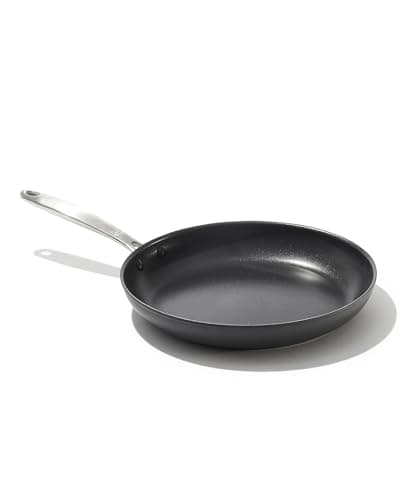
Published specifications for the OXO Good Grips Pro Hard-Anodized Nonstick Fry Pan, 10 in
Body
Hard-anodized aluminum
Coating
Three-layer PTFE nonstick, published PFOA-free
Oven maximum
430F published for the line
Induction
No on the standard hard-anodized line
Dishwasher
Dishwasher safe
Edge
Rolled, for pouring without dripping down the side
Coating lifespan
Not published
Good
The rolled pour edge is a small thing you notice every single time you use it
The hard-anodized body resists the denting that ruins cheap aluminum pans
Handle stays cool and does not rotate the way riveted plastic ones eventually do
Not good
Not induction compatible
Oven ceiling capped by the handle, not the pan
Still a coating, still a consumable, still no published lifespan
The trade-off. The handle that makes it comfortable is a stainless-and-silicone assembly, and that is what caps the oven rating below the body's own limit.
Skip this if. You need induction. The standard hard-anodized body is not ferrous.
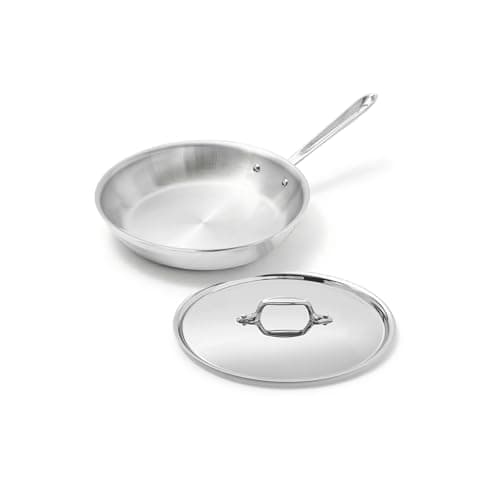
Published specifications for the All-Clad D3 Stainless 10 in Fry Pan
Construction
Fully bonded tri-ply, aluminum core
Oven maximum
600F, oven and broiler safe
Induction
Yes - compatible with any stovetop
Dishwasher
Handwash only (All-Clad published)
Handle
Double-riveted stainless
Weight
3.0 lb (model 4110)
Warranty
Limited lifetime
Made in
Bonded, engineered and assembled in Canonsburg, PA
Good
600F is the highest oven ceiling of any stainless pan on this site
The one pan here whose manufacturing location is published down to the town
Genuinely repairable-adjacent: rivets are the only failure point and the warranty covers them
Not good
Hand wash only
The flared rim makes it a poor pan for anything with liquid
Costs several times what a Tramontina or Cuisinart pan of the same construction costs
The trade-off. Hand wash only. All-Clad publishes that plainly, and it is a real daily cost on a pan you will use every day.
Skip this if. You want a dishwasher-safe pan, or you are buying a whole kitchen on a fixed budget - one D3 skillet costs what a full clad set can cost.
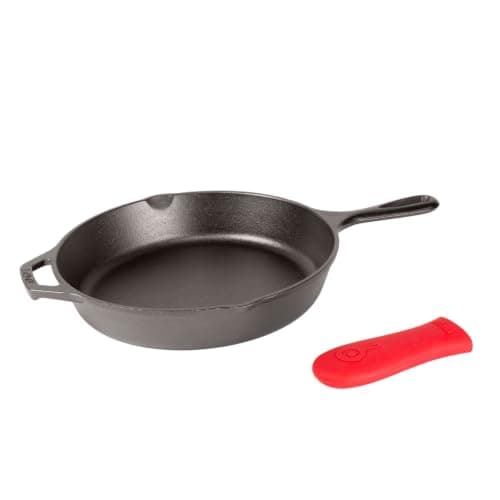
Published specifications for the Lodge Seasoned Cast Iron Skillet, 10.25 in (L8SK3)
Diameter
10.25 in
Weight
5.66 lb
Oven maximum
550F
Induction
Yes - bare iron is ferrous
Seasoning
Pre-seasoned with soy-based vegetable oil, no synthetic chemicals
Warranty
Lifetime
Made in
USA
Care
Hand wash. Lodge's own instructions permit warm soapy water
Good
Effectively unbreakable and fully restorable - a rusted one can be stripped and re-seasoned
Holds heat better than anything else at the price, which is what a sear needs
Lodge publishes its seasoning method openly, so the maintenance is not a mystery
Not good
Heavy
Heats unevenly on a small burner: cast iron conducts at roughly 50 W/m-K, so it is slow to spread and slow to react
Bare iron is reactive; long tomato braises will taste of it
The trade-off. It weighs 5.66 lb empty. You will feel that every time you move it full, and it is the single most common reason a cast iron skillet ends up in a cupboard.
Skip this if. You have wrist or shoulder trouble, or you cook mostly acidic braises. Carbon steel does most of the same jobs at roughly half the weight.
For skin-on fillets you want crisp, a seasoned carbon steel or cast iron skillet - the skin releases once it has crisped. For delicate skinless white fish, a coated pan is genuinely the right tool, because there is no crust to release and the flesh flakes.
›How do you stop fish sticking to the pan?
Dry the surface, preheat the pan properly before the oil goes in, and then leave the fish alone. Skin welds to the metal and releases by itself once it has crisped. If it will not move, it is not ready to move.
›Can you cook fish in a stainless steel pan?
Yes, with a proper preheat and enough fat, and it is the best choice for anything finished in the oven or made into a pan sauce. It is less forgiving than carbon steel or a coating, so it suits skin-on fillets better than delicate ones.
›Does lemon damage a cast iron pan?
A squeeze at the end does not. A long acidic simmer does - acid dissolves iron faster than neutral food and strips seasoning, which can leave a metallic taste. Cook acidic fish braises in clad stainless or enameled cast iron.
›What spatula should you use for fish?
A thin, flexible, slotted fish spatula with an offset and an angled edge. It costs less than any pan on this page and prevents more broken fillets. On coated pans use silicone or nylon unless the maker publishes metal-utensil safety.
Sources
Every figure on this page came from one of these. Follow them and check our arithmetic — that is the point.