Heads up: some links on this page earn us a commission at no extra cost to you. It does not change what we recommend or the order. How we are funded.
The short answer
Surface
Use
Avoid
Bare cast iron
Metal, wood, silicone - anything
Nothing, really
Carbon steel
Metal, wood, silicone
Nothing, though a sharp edge can score seasoning
Clad stainless
Metal, wood, silicone
Nothing; scratches are cosmetic
PTFE nonstick
Silicone, nylon, wood
Metal, unless the maker publishes otherwise
Ceramic nonstick
Silicone, nylon, wood
Metal, and abrasive scrubbers
Enameled cast iron
Silicone, wood
Metal - it chips and scores the glaze
Bare aluminum bakeware
Metal, silicone
Nothing on the pan; a knife on a coating
One question decides every case
Is the cooking surface the metal itself, or is it something applied on top of the metal? If it is the metal - bare iron, carbon steel, clad stainless - then a metal utensil cannot do meaningful damage, because a scratch in stainless heals over instantly with its passive layer and a scratch in seasoning is repaired by cooking.
If the surface is applied - a PTFE or ceramic coating, or porcelain enamel - then a metal utensil is removing something that cannot be replaced. That is the whole rule, and the exceptions to it are published rather than guessed.
Nonstick: silicone, nylon or wood, with one exception
Every coated pan in our ledger except one publishes guidance to use silicone, nylon or wooden tools. The exception is Calphalon, which publishes its Premier coating as metal-utensil safe - a specific, checkable claim, and the reason that pan is worth paying for in a household where the utensil drawer is not going to be policed. It is examined in our Calphalon review.
Two qualifications. Metal-utensil safe means the coating survives contact, not that it lasts forever - no maker publishes a coating lifespan at all, as how long nonstick lasts sets out. And it is a claim about that line, not about the brand.
For everything else coated, the practical damage is not one dramatic gouge. It is hundreds of small scores that give food somewhere to catch, after which release degrades faster. Ceramic is the more fragile of the two coatings and deserves the most care.
Enamel: the one people get wrong
Enameled cast iron feels indestructible and is not. The enamel is glass fused to iron, and while it does not wear out with cooking, it chips on impact and scores under a metal edge. Neither damage can be repaired at home or by the manufacturer, and a chip inside the cooking area means retiring the pot - the thresholds are in when to replace your cookware.
Use silicone or wood in an enameled pot. The place people forget is the whisk: a metal balloon whisk against an enameled base for a few minutes leaves gray streaks, which are metal deposits rather than damage but look alarming. They come off with a gentle cream cleaner, as covered in enameled cast iron care.
Bare metal: use whatever works
On cast iron, carbon steel and clad stainless, a metal utensil is not merely permitted - it is often the better tool. A stiff metal turner gets under a crust that a flexible silicone one deforms around, and scraping fond off a stainless base is exactly what you want before a pan sauce.
The stainless case is worth stating plainly, because people carry the nonstick habit across: a scratch in stainless is cosmetic. The chromium oxide passive layer reforms within moments, which is explained in is stainless steel cookware safe.
The exception on bare seasoned pans is a sharp edge, not a blunt one. A knife used to cut in the pan will score seasoning. A spatula will not, and a metal spatula on cast iron is a traditional pairing for good reason.
A three-tool drawer covers every surface: one flexible silicone turner, one stiff metal turner, one wooden spoon.
The materials, briefly
Utensil material
Heat tolerance
Best for
Watch out for
Silicone
Usually 400F to 600F, check the item
Coated pans, enamel, scraping bowls
Cheap silicone can contain fillers - the pinch test applies
Nylon
Lower, often around 400F
Coated pans
It melts against a hot pan rim; it is the one that fails
Wood
No practical limit in a pan
Everything, especially enamel
Cracks if left soaking or run through a dishwasher
Stainless steel
No practical limit
Bare metal pans, scraping fond
Coatings and enamel
Coated metal
Depends on the coating
Nothing in particular
The coating chips into food
Nylon is the one worth being careful with - it is the lowest-melting material most kitchens own, and it fails against a hot rim rather than in the food.
The filler question on silicone is the same one that applies to silicone bakeware: pinch and twist a flat section, and white streaks suggest fillers. It is set out in is silicone bakeware safe.
The three-tool drawer
One flexible silicone turner for coated pans, eggs and fish. This is the one you will use most.
One stiff metal turner for cast iron, carbon steel and stainless. Thin and slightly flexible beats thick and rigid.
One wooden spoon for enamel and for anything stirred. It is safe on every surface in the kitchen, which no other material is.
Everything beyond that - tongs, a whisk, a ladle, a fish spatula - is a preference rather than a requirement. Silicone utensil sets and metal turners cover the two ends of the drawer.
Storage is part of this
A metal utensil resting inside a coated pan in a cupboard does the same damage a metal utensil in use does, and so does a stacked pan - which is the more common culprit and is covered in how to store pots and pans. Keep tools in a crock or a drawer rather than in the pans.
The four surfaces, one pan each
One publishes metal-utensil safety, one does not, one does not care at all, and one is glass. Those are the only four cases in a kitchen.
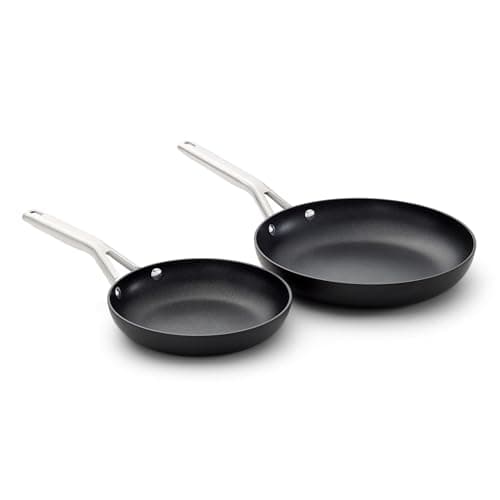
Calphalon Premier Hard-Anodized Nonstick Fry Pan, 10 in
A nonstick pan in a kitchen where the utensil drawer is not going to be policed
These are the products this page's reasoning actually points at. Same rules as everywhere else on the site: published specs, a stated trade-off, and a live price only where one exists.
Top pick · The only coated pan that publishes metal-utensil safetySpecs read September 3, 2026
Calphalon Premier Hard-Anodized Nonstick Fry Pan, 10 in
Calphalon publishes the Premier coating as metal-utensil safe, which is a checkable claim almost nobody else in the category makes.
Best for: A nonstick pan in a kitchen where the utensil drawer is not going to be policed
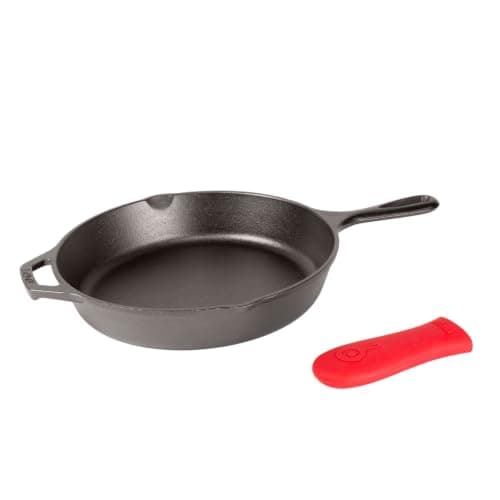
Published specifications for the Lodge Seasoned Cast Iron Skillet, 10.25 in (L8SK3)
Diameter
10.25 in
Weight
5.66 lb
Oven maximum
550F
Induction
Yes - bare iron is ferrous
Seasoning
Pre-seasoned with soy-based vegetable oil, no synthetic chemicals
Warranty
Lifetime
Made in
USA
Care
Hand wash. Lodge's own instructions permit warm soapy water
Good
Effectively unbreakable and fully restorable - a rusted one can be stripped and re-seasoned
Holds heat better than anything else at the price, which is what a sear needs
Lodge publishes its seasoning method openly, so the maintenance is not a mystery
Not good
Heavy
Heats unevenly on a small burner: cast iron conducts at roughly 50 W/m-K, so it is slow to spread and slow to react
Bare iron is reactive; long tomato braises will taste of it
The trade-off. It weighs 5.66 lb empty. You will feel that every time you move it full, and it is the single most common reason a cast iron skillet ends up in a cupboard.
Skip this if. You have wrist or shoulder trouble, or you cook mostly acidic braises. Carbon steel does most of the same jobs at roughly half the weight.
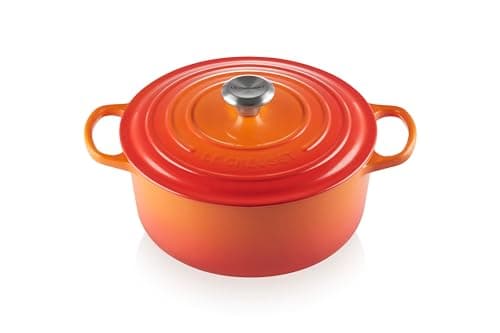
Published specifications for the Le Creuset Signature Round Dutch Oven, 5.5 qt
Material
Cast iron with porcelain enamel inside and out
Capacity
5.5 qt
Interior enamel
Sand-colored, so browning and fond stay visible
Knob
Stainless steel, rated to 500F
Induction
Yes - the iron under the enamel is ferrous
Dishwasher
Dishwasher safe; Le Creuset recommends hand washing
Warranty
Limited lifetime
Made in
France
Good
The pale interior is a genuine cooking advantage: you can see whether the fond is browning or burning
Wide, low-profile handles that a hand in an oven mitt actually fits
The one enameled pot with a real secondhand market, which changes the true cost of ownership
Not good
Costs several times a Lodge enameled pot of the same capacity
The pale interior stains permanently, and Le Creuset says so
Chipped enamel is not repairable on any enameled pot, this one included
The trade-off. You are paying a large multiple of what a Lodge enameled pot costs for a difference in enamel quality, finish and resale value rather than in cooking.
Skip this if. You braise a few times a year. The cooking difference over a Lodge enameled pot is small; the price difference is not.
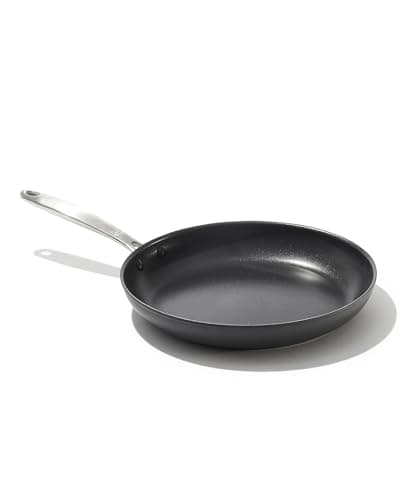
Published specifications for the OXO Good Grips Pro Hard-Anodized Nonstick Fry Pan, 10 in
Body
Hard-anodized aluminum
Coating
Three-layer PTFE nonstick, published PFOA-free
Oven maximum
430F published for the line
Induction
No on the standard hard-anodized line
Dishwasher
Dishwasher safe
Edge
Rolled, for pouring without dripping down the side
Coating lifespan
Not published
Good
The rolled pour edge is a small thing you notice every single time you use it
The hard-anodized body resists the denting that ruins cheap aluminum pans
Handle stays cool and does not rotate the way riveted plastic ones eventually do
Not good
Not induction compatible
Oven ceiling capped by the handle, not the pan
Still a coating, still a consumable, still no published lifespan
The trade-off. The handle that makes it comfortable is a stainless-and-silicone assembly, and that is what caps the oven rating below the body's own limit.
Skip this if. You need induction. The standard hard-anodized body is not ferrous.
Only where the manufacturer publishes it. Calphalon publishes its Premier coating as metal-utensil safe; almost nothing else in the category does. On every other coated pan, use silicone, nylon or wood.
›Are metal utensils safe on cast iron?
Yes, and a stiff metal turner is often the better tool - it gets under a crust that a flexible silicone one deforms around. Seasoning is repaired by cooking, so a scrape is not permanent damage.
›Can you use metal utensils in enameled cast iron?
No. Enamel is glass fused to iron: it chips on impact and scores under a metal edge, and neither can be repaired. Use silicone or wood. Gray streaks left by a metal whisk are metal deposits rather than damage and clean off.
›Do metal utensils scratch stainless steel pans?
They leave cosmetic marks, and nothing more. Stainless is protected by a chromium oxide passive layer that reforms within moments, so a scratched stainless pan is undamaged. Scraping fond with metal is exactly what you want before a pan sauce.
›What utensils do you actually need?
Three cover every surface: one flexible silicone turner for coated pans and delicate food, one stiff metal turner for bare metal, and one wooden spoon, which is the only material safe on everything including enamel.
Sources
Every figure on this page came from one of these. Follow them and check our arithmetic — that is the point.