Heads up: some links on this page earn us a commission at no extra cost to you. It does not change what we recommend or the order. How we are funded.
The short answer
Let it cool before washing. Enamel dislikes thermal shock more than it dislikes anything else.
Hot water, detergent, a soft sponge. Soap is completely fine - there is no seasoning to strip.
For scorched food, simmer water in the pot for ten minutes, then wipe. Never scour, never use metal.
Stains on a pale interior are permanent and normal. Le Creuset publishes this. A cream cleaner lightens them; nothing removes them entirely.
What you are actually caring for
Enamel is powdered glass fused to iron at high temperature. It is chemically inert, non-reactive with acid, and - unlike every nonstick coating - it does not degrade from cooking. There is no lifespan question here and no release to preserve.
It has exactly one failure mode, and it is mechanical: chipping. Everything else on this page is cosmetic. That is a much better position than any coated pan is in, and it means the care routine is about avoiding impact rather than about preserving a surface.
The daily routine
Let the pot cool before it meets water. Enamel is glass and thermal shock is what cracks glass. A hot pot into a cold sink is the one habit worth breaking.
Hot water, dish soap, a soft sponge or a nylon brush. Detergent is completely fine - there is no seasoning here, and the no-soap rule from bare iron does not apply.
Dry it, particularly the rim if the rim is unglazed. Many pots have a bare iron rim and it will rust.
Store the lid ajar or separately. A sealed pot traps moisture against that unglazed rim - how to store pots and pans.
The unglazed rim is the detail people miss. On most enameled pots the rim where the lid sits is bare iron, and it is the only part of the pot that can rust. Dry it, and a wipe of oil on it occasionally does no harm.
Scorched and stuck-on food
Enamel takes far more than a coating does, so you have real options here - just not abrasive ones.
Simmer water in the pot for ten minutes. Most of it lifts on its own.
Add a spoonful of baking soda to that water for anything stubborn, and let it cool before wiping.
Use a nylon brush or a plastic scraper, never steel wool and never a metal scourer.
For a badly burnt base, a paste of baking soda left to sit for an hour will usually finish it.
What not to do: oven cleaner, bleach, abrasive powders and dishwasher cycles with heavy detergent all attack the glaze's finish over time. They will not destroy the pot quickly, and they will dull it.
Stains, and why they are permanent
A pale interior discolors. It goes from cream to beige to brown over months of use, and Le Creuset publishes that this staining is permanent. It is not damage, it does not affect cooking, and no cleaner returns it fully to new.
What helps: a dedicated enamel cream cleaner, or a baking soda paste, applied with a soft cloth and left for a few minutes. Expect to lighten it rather than remove it. A gentle bleach soak is sometimes recommended and we would avoid it - it does little for deep staining and can dull the glaze.
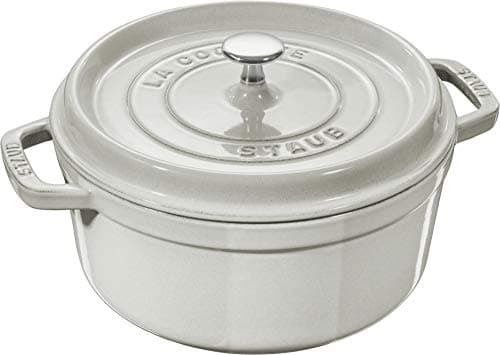
If permanent staining would bother you, that is a buying decision rather than a cleaning one: Staub's black matte interior never shows it, at the cost of hiding the fond - our Staub review covers the trade, and the Le Creuset review covers the other side.
Gray metal marks
Gray or silvery streaks on a pale interior alarm people and are not damage at all. They are metal deposits left by utensils - a metal spoon, a whisk, a knife tip - transferred onto the harder glass surface, in exactly the way a pencil leaves graphite on paper.
They come off with a cream cleaner or a baking soda paste and a soft cloth. The way to stop them recurring is to use silicone or wooden tools, which is the rule set out in utensils for every cookware surface.
Chips: the only real damage
Enamel chips on impact - a knock in a sink, a pot set down hard, a metal utensil striking the rim, or another pan stacked against it. It cannot be repaired at home and no manufacturer repairs it. What matters is where the chip is.
Where
Verdict
Why
Inside the cooking area, dark iron visible
Retire it from cooking
Exposed iron rusts under the glaze edge, and the edge can shed
On the outside
Cosmetic - keep using it
Nothing is in contact with food
On the rim, outer edge
Cosmetic, and very common
The most frequent complaint on budget enameled pots
Crazing - a fine crack network, glaze intact
Normal aging
It is not a chip and it is not a failure
Only the first row ends a pot. The replace-or-keep framework for every material is in when to replace your cookware.
Prevention is entirely about handling: do not stack pans against enamel, do not use metal utensils, set the pot down rather than dropping it, and store it low so it is never lifted above waist height when full.
Heat rules
Do not heat it empty. Dry high heat is hard on enamel and it is the one way to damage a pot through cooking rather than impact.
Medium heat is enough. The mass does the work; cranking the burner gains you very little and risks the glaze.
The knob sets the oven ceiling, not the pot. Check the SKU - Le Creuset publishes a stainless knob rated to 500F on the Signature line, and every published figure is collected in oven-safe cookware temperatures.
No broiler. Direct radiant heat is outside what enameled cookware is rated for.
The dishwasher question
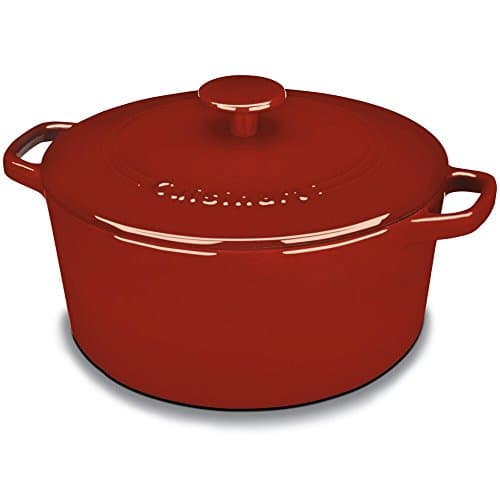
Le Creuset publishes dishwasher safe and then recommends hand washing. Cuisinart recommends hand washing for its enameled range. The enamel itself tolerates the cycle perfectly well; the risk is knocks against other items in a loaded rack, and knocks are the one thing that ends a pot.
Our practical position: hand wash, because it is easier than the alternative and because a 6 qt pot takes up most of a dishwasher anyway. Who publishes what across every material is in what cookware is dishwasher safe.
Four enameled pots, two interior philosophies
Pale interiors stain permanently and let you read the fond. Black matte interiors do neither. That is the whole decision, and no cleaning routine changes it.
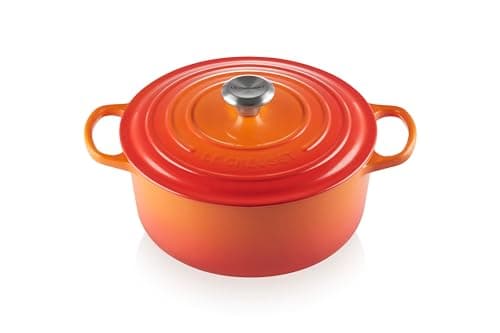
Le Creuset Signature Round Dutch Oven, 5.5 qt
A braising pot bought once, kept for decades and handed on
These are the products this page's reasoning actually points at. Same rules as everywhere else on the site: published specs, a stated trade-off, and a live price only where one exists.
Top pick · The pot this page is mostly aboutSpecs read September 3, 2026
Le Creuset Signature Round Dutch Oven, 5.5 qt
A pale sand-colored interior that lets you read the fond and stains permanently, which Le Creuset publishes plainly.
Best for: A braising pot bought once, kept for decades and handed on
Published specifications for the Le Creuset Signature Round Dutch Oven, 5.5 qt
Material
Cast iron with porcelain enamel inside and out
Capacity
5.5 qt
Interior enamel
Sand-colored, so browning and fond stay visible
Knob
Stainless steel, rated to 500F
Induction
Yes - the iron under the enamel is ferrous
Dishwasher
Dishwasher safe; Le Creuset recommends hand washing
Warranty
Limited lifetime
Made in
France
Good
The pale interior is a genuine cooking advantage: you can see whether the fond is browning or burning
Wide, low-profile handles that a hand in an oven mitt actually fits
The one enameled pot with a real secondhand market, which changes the true cost of ownership
Not good
Costs several times a Lodge enameled pot of the same capacity
The pale interior stains permanently, and Le Creuset says so
Chipped enamel is not repairable on any enameled pot, this one included
The trade-off. You are paying a large multiple of what a Lodge enameled pot costs for a difference in enamel quality, finish and resale value rather than in cooking.
Skip this if. You braise a few times a year. The cooking difference over a Lodge enameled pot is small; the price difference is not.
Published specifications for the Staub Round Cocotte, 5.5 qt
Material
Cast iron with enamel inside and out
Capacity
5.5 qt
Interior enamel
Black matte and textured - does not show staining
Lid
Self-basting spikes on the underside
Knob
Metal; the oven rating is set by the knob, so check the specific SKU
Induction
Yes
Warranty
Limited lifetime
Made in
France
Good
Black matte interior is the practical answer to the staining complaint about pale enamel
Heavier lid than most, which matters more than the spikes do on a long braise
Textured interior takes a hard sear better than a glossy enamel does
Not good
You cannot see the fond, which is a real loss on anything you are building a sauce from
Heavy even by enameled cast iron standards
Priced with Le Creuset, so the same skip-if applies
The trade-off. The black matte interior hides fond as well as it hides stains, so you judge browning by smell and by lifting the food rather than by looking.
Skip this if. You want to watch the fond develop. Buy the sand-colored interior instead and accept that it will discolor.
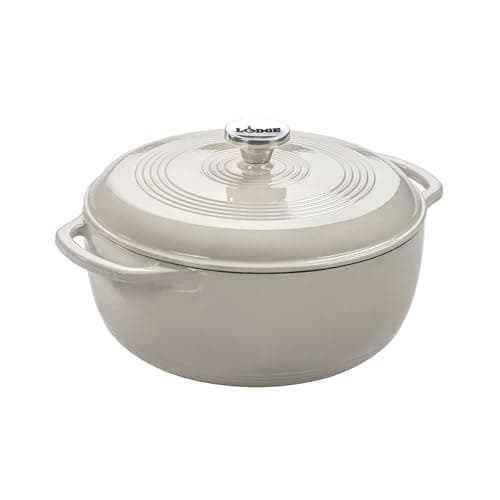
Published specifications for the Lodge Enameled Cast Iron Dutch Oven, 6 qt
Material
Cast iron with porcelain enamel, inside and out
Capacity
6 qt
Induction
Yes - the iron under the enamel is ferrous
Seasoning
None required - enamel is not a seasoning surface
Acid
Safe for tomato and wine, unlike bare iron
Oven maximum
Set by the knob material - check the specific SKU; Lodge publishes a lower ceiling than for bare iron
Good
Non-reactive, so it handles the acidic cooking bare iron cannot
No seasoning to maintain
Considerably cheaper than the French enameled pots it copies
Not good
Chipped enamel is not repairable, unlike bare iron's seasoning
Oven ceiling is lower than bare cast iron because of the knob
Heavy, and the enamel makes it heavier than bare iron of the same capacity
The trade-off. The enamel is a glass layer. Chip it and the pot is not restorable the way bare iron is, and Lodge's enamel chips more readily than the premium brands'.
Skip this if. You already own a large stainless stockpot and rarely braise. This duplicates it for most weeknight cooking.
›How do you clean an enameled cast iron Dutch oven?
Let it cool, then hot water, dish soap and a soft sponge. Soap is completely fine - there is no seasoning to strip. For scorched food, simmer water in the pot for ten minutes, optionally with baking soda, then wipe. Never use steel wool or a metal scourer.
›Why is the inside of my Dutch oven stained brown?
That is normal and permanent on a pale interior, and Le Creuset publishes it as such. A cream cleaner or baking soda paste lightens it; nothing returns it to new. It does not affect cooking. Staub's black matte interior never shows it.
›What are the gray marks inside my enameled pot?
Metal deposits from utensils, transferred onto the harder glass surface in the way a pencil leaves graphite on paper. They are not damage and they come off with a cream cleaner or baking soda paste. Switch to silicone or wooden tools to stop them recurring.
›Can chipped enamel be repaired?
No - not at home and not by the manufacturer. A chip inside the cooking area with dark iron visible means retiring the pot, because the exposed iron rusts and the chip edge can shed. Chips on the outside or the rim are cosmetic.
›Can enameled cast iron go in the dishwasher?
Le Creuset publishes dishwasher safe and still recommends hand washing. The enamel tolerates the cycle; the risk is knocks against other items in a loaded rack, and impact is the only thing that genuinely ends an enameled pot.
Sources
Every figure on this page came from one of these. Follow them and check our arithmetic — that is the point.