Two materials that are bad at the same thing for different reasons, and good at opposite things because of it.
Where we stand
We do not make or sell stainless cookware or cast iron. Both link to the same retailer, both pay us the same commission rate, and we earn exactly the same whichever one you buy — or nothing at all if you buy neither, which is sometimes the right answer. Most of the comparison pages that rank for this question are published by companies that sell one of the two. How we are funded.
The physics, which decides everything else
Both materials are poor conductors, and that is the surprising part. Cast iron conducts at around 50 W/m-K; type 304 stainless at 15 to 16. Aluminum, for scale, is 237.
They solve the problem differently. Clad stainless cheats: it wraps an aluminum core in stainless so the aluminum does the spreading while the steel does the durable, non-reactive food contact. Cast iron does not cheat — it just carries so much mass that it stores an enormous amount of energy and does not care that heat moves through it slowly.
That single difference produces everything below. Clad stainless is even and responsive. Cast iron is uneven and unshakeable. Neither is better; they are answers to different questions. The full material argument is in cookware materials compared.
Searing: cast iron, clearly
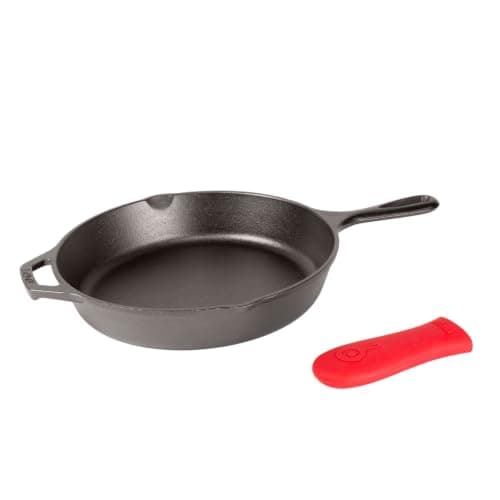
When cold food hits a hot pan, the pan's temperature drops. How far it drops is a function of stored energy, which is mass times temperature. A Lodge 10.25-inch skillet at 5.66 lb barely notices a steak. A 3 lb clad pan at the same temperature drops enough that the surface stops browning and starts steaming.
That is the entire case for cast iron and it is a strong one. There is nothing at the price that sears better, and there is not much at any price that does.
Sauces and anything acidic: stainless, without argument
Bare iron is reactive. Simmer tomato, wine, lemon or vinegar in it for any length of time and the food picks up a metallic taste, while the acid strips the seasoning you have been building. This is not a small effect and it is not a matter of technique.
Stainless is indifferent to all of it. You can reduce wine for an hour and the sauce tastes like wine. For a first kitchen that difference alone makes stainless the spine and cast iron the addition rather than the other way round.
Weight, which decides more purchases than performance does
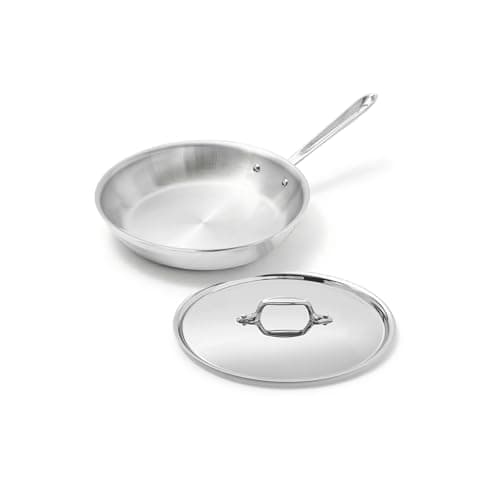
Lodge publishes 5.66 lb for the 10.25-inch skillet. Empty. All-Clad publishes 3.0 lb for the 10-inch D3. Full of food, that gap is the difference between a one-handed lift and a two-handed one.
This is the single most common reason a cast iron pan ends up at the back of a cupboard, and it is worth taking seriously rather than treating as a character flaw. If weight is a problem for you, carbon steel does most of what cast iron does at roughly half the mass — de Buyer publishes 4.6 lb for an 11-inch pan, in a larger size.
What it gets right
- Clad stainless: no maintenance, no reactivity, dishwasher-tolerant on most brands, effectively permanent
- Clad stainless: responds when you change the heat, which cast iron does not
- Cast iron: unmatched searing at any price, and restorable from rust forever
- Cast iron: the cheapest cookware here with a genuine lifetime warranty
What it costs you
- Clad stainless: sticks without a proper preheat, and always will
- Clad stainless: costs several times what cast iron does for the same diameter
- Cast iron: 5.66 lb empty, and that is the 10-inch
- Cast iron: reactive with acid, slow to respond, and needs a cool-down before washing
Maintenance: not as lopsided as people say
Cast iron's reputation for being demanding is mostly folklore, and Lodge's own instructions contradict the loudest piece of it: "Use warm, soapy water to wash your pan, then dry completely." Soap is fine. Seasoning is polymerized oil bonded to the metal, not a film of grease that detergent dissolves.
What genuinely damages cast iron is water left sitting, and long acidic cooking. Dry it properly and it is close to maintenance-free. Re-seasoning, when it is needed, is an hour in a 450 to 500F oven with a layer of oil too thin to drip — Lodge publishes the method. Full detail in seasoning and caring for cast iron.
Stainless asks nothing except a preheat. Burnt-on food comes off with deglazing or an oxalic acid cleaner and the pan is unharmed — see how to clean a burnt stainless pan.
Which should you buy
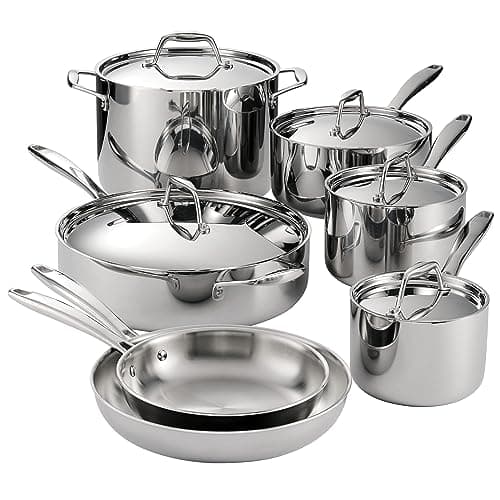
If you can only buy one: clad stainless. It does more jobs adequately, it handles the acidic cooking cast iron cannot, and it asks nothing of you. Cast iron is better at one thing; stainless is acceptable at everything.
If you can buy both, and you should eventually: a clad set as the spine of the kitchen, plus one cast iron skillet for searing. Cast iron is cheap enough that this is not really a budget decision — a Lodge skillet costs a fraction of a single clad pan.
If cast iron's weight rules it out: carbon steel instead. Same searing behavior, roughly half the mass, and the same reactivity caveat. See cast iron versus carbon steel.
The one answer this page will not give is "buy both, from us, in a bundle". Plenty of first kitchens are complete with a clad set and nothing else, and adding cast iron because an article said so is how cupboards fill up with pans nobody reaches for.
Where to go for the specific products
The stainless picks are in the best stainless steel cookware and the cast iron picks are in the best cast iron skillets. We do not duplicate the roundups here, because a comparison page that turns into two roundups is a comparison page that has stopped answering the question.