Heads up: some links on this page earn us a commission at no extra cost to you. It does not change what we recommend or the order. How we are funded.
The short answer
Buy fully clad stainless with a magnetic exterior and a flat base, and your pans work on both. Induction only heats ferrous metal, so it rules out plain aluminum and copper unless a steel disc is bonded on, and it rewards a perfectly flat base. Gas accepts any material, including round-bottomed woks, but wastes heat around the sides of small pans and heats in a ring. Cast iron and carbon steel are excellent on both. The costly mistake is buying aluminum or copper now and moving to induction later.
How the two heat a pan
Gas
A flame heats the base and wraps some way up the sides. Heat arrives fast, changes instantly when you turn the knob, and reaches parts of the pan other than the base - which is why woks work on gas and nowhere else.
Its weaknesses are efficiency and evenness. A great deal of the energy goes around the pan rather than into it, and the flame is a ring, so the base has a hot circle and cooler middle and edges - cookware for gas stoves.
Induction
A coil creates a magnetic field that induces electrical currents inside the pan itself. The pan is the heating element; the hob surface only gets hot because the pan warms it. That makes it fast, efficient and extremely responsive.
The catch is that it only works with ferrous metal, and only where the pan makes flat contact within the coil's area - cookware for induction.
What each stove does to your material choice
Material
Gas
Induction
Clad stainless, ferrous exterior
Excellent
Excellent
Cast iron
Excellent
Excellent - strongly ferrous
Carbon steel
Excellent
Excellent
Enameled cast iron
Excellent
Excellent
Disc-bottom stainless
Good
Good, if the disc is magnetic
Plain aluminum
Good
Will not work at all
Hard-anodized aluminum
Good
Only with a bonded steel base
Copper
Excellent
Only with a bonded steel base
Round-bottomed wok
The only stove it works on
Almost no contact - no
Glass and stoneware on the hob
No
No
The magnet test settles any individual pan in a second: if a refrigerator magnet grips the base firmly, induction will heat it. A weak pull means a thin ferrous layer and slow, uneven heating.
"Induction ready" is a claim worth verifying rather than trusting, because some lines apply it to pans with a thin sprayed-on ferrous layer that works poorly. A strong magnetic grip is the real test - how to read a cookware listing.
What each stove does to your shape choice
This gets less attention than material and matters just as much.
Induction needs flat. Heat is induced where the pan meets the field, so a domed or warped base heats in a ring and can trigger error codes on some hobs. Flatness is the specification - why pans warp.
Induction needs the base to match the coil. A pan much smaller than the zone may not be detected; a pan much larger has cold outer regions, because the field does not extend past the coil.
Gas forgives shape entirely. Curved, round-bottomed, warped - a flame finds it. This is the one real advantage gas has left.
Gas punishes small pans on big burners, because the flame licks up the sides and cooks the handle - cookware handles explained.
What changes about how you cook
Induction boils water dramatically faster. The most obvious daily difference, and the one people notice first.
Induction responds faster than gas, which surprises people who assume flame is the responsive option. Power stops the instant you turn it down, though a thick pan still coasts on stored heat.
Thermal mass matters more on induction. Because heat is generated in the base rather than around the pan, a thin pan on high can develop a genuinely hot spot. Clad or heavy bases spread it.
Charring and flame work are gas only. Blackening peppers directly on the burner, or toasting chiles in flame, has no induction equivalent.
Induction kitchens stay cooler, because the waste heat is not going into the room.
Some induction hobs hum or make pans sing, particularly lighter clad pans. Heavier pans do it less.
Induction shares the smooth-surface rules with radiant glass tops: lift rather than drag, and keep grit out from under the pan.
If you are switching
Test everything with a magnet before you assume you need new cookware. What typically carries over and what typically does not:
Carries over: all cast iron, all carbon steel, clad stainless with a magnetic exterior, most disc-bottom stainless, enameled cast iron.
Does not: plain and hard-anodized aluminum pans without a bonded base, most coated aluminum lines, copper, round-bottomed woks.
Marginal: anything warped. It may have worked on gas and will disappoint on induction.
Interface discs - a steel plate between hob and pan - exist and work poorly. They are slow, they waste most of induction's efficiency, and they add a warping component. Fine as a stopgap for one beloved pan, not a strategy.
Check the base diameter against typical induction zones, not the rim diameter.
That is also, almost exactly, the specification list for a smooth radiant cooktop - best cookware for glass top stoves - so one purchase covers all three surfaces.
Cookware that does not care which stove you own
Every pick here is ferrous and flat-based, which is the combination that works on gas, radiant glass and induction alike.
These are the products this page's reasoning actually points at. Same rules as everywhere else on the site: published specs, a stated trade-off, and a live price only where one exists.
Top pick · Works on both, whole setSpecs read September 3, 2026
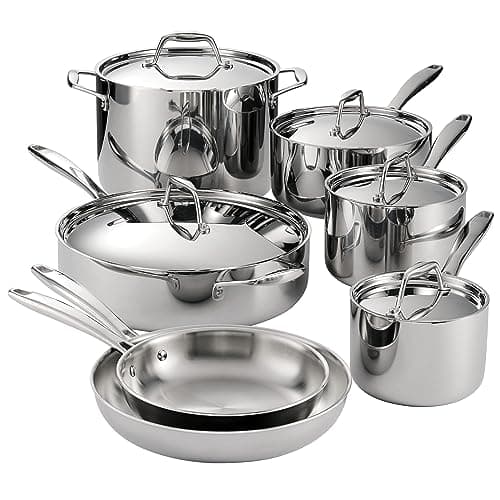
Tramontina Signature Tri-Ply Clad 12-Piece Set
Fully clad with a ferrous exterior and flat machined bases - the specification that survives a stove replacement.
Best for: A first kitchen that should not need replacing
Published specifications for the Tramontina Signature Tri-Ply Clad 12-Piece Set
Construction
Tri-ply: 18/10 stainless, aluminum core, magnetic stainless exterior
Pieces
8 in and 10 in fry pans; 1.5, 2 and 3 qt covered saucepans; 5 qt covered deep saute; 8 qt covered stockpot
Oven maximum
500F on the 80116-249DS listing; other SKUs in the line are listed at 350F
Induction
Yes - magnetic stainless exterior
Dishwasher
Listed dishwasher safe
Handles
Precision cast, riveted
Certification
NSF-certified on the 80116-249DS line
Country of origin
Not asserted - retail listings disagree across SKUs (Brazil and China both appear)
Good
Fully clad, not disc-bottom: the aluminum runs up the sidewalls, so sauces do not scorch in a ring at the base
NSF certification on the flagship SKU is a real, checkable third-party mark rather than a marketing badge
Induction-ready without paying an induction premium
Not good
Retail listings disagree on the oven maximum across SKUs in the same line, which is a documentation problem, not a cooking one
Handles run hot on gas
The 12-piece count includes lids; the useful-item count is seven
The trade-off. Handles are the weak point. They are riveted and sturdy, but they get hot on a gas ring in a way the more expensive clad brands' do not.
Skip this if. You want a set you can leave in the oven above 500F, or you cook mostly eggs and pancakes and would rather spend the money on one good nonstick pan.
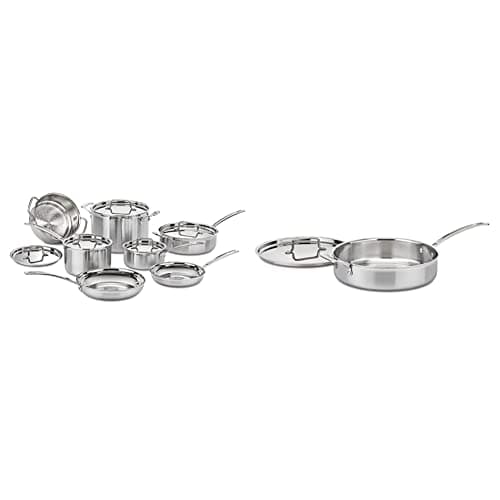
Published specifications for the Cuisinart MultiClad Pro MCP-12N 12-Piece Set
Construction
Tri-ply: 18/10 stainless interior, pure aluminum core, brushed stainless exterior
Pieces
1.5 and 3 qt covered saucepans; 8 in and 10 in skillets; 3.5 qt covered saute; 8 qt covered stockpot; steamer insert
Oven maximum
500F per the Cuisinart use-and-care manual. Amazon listings say 550F; Cuisinart has confirmed the manual figure
Induction
Yes
Dishwasher
Dishwasher safe
Handles
Riveted solid stainless, cool-grip profile
Warranty
Lifetime
Good
Heat runs up the sidewalls, not just across the base
Genuinely dishwasher safe, which the pricier clad brands often are not
Lifetime warranty on a set at this price
Not good
Published oven maximum contradicts the retail listing for the same product
Handle spine is divisive
No 12-inch skillet in the box, which is the pan most people reach for second
The trade-off. The cool-grip handles have a sharp spine that some people find uncomfortable on a full 8-quart stockpot.
Skip this if. You want the higher oven ceiling that the Amazon listing advertises. The manual says 500F and Cuisinart has confirmed the manual is correct.
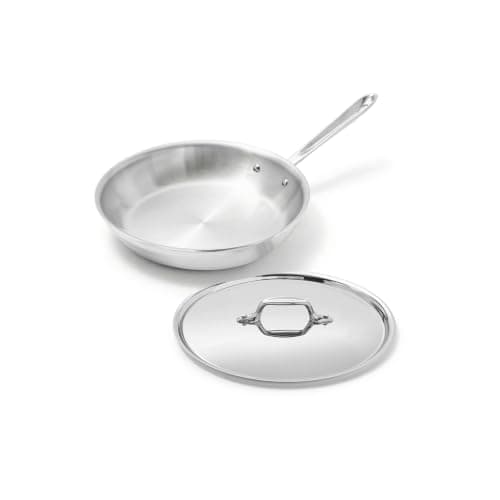
Published specifications for the All-Clad D3 Stainless 10 in Fry Pan
Construction
Fully bonded tri-ply, aluminum core
Oven maximum
600F, oven and broiler safe
Induction
Yes - compatible with any stovetop
Dishwasher
Handwash only (All-Clad published)
Handle
Double-riveted stainless
Weight
3.0 lb (model 4110)
Warranty
Limited lifetime
Made in
Bonded, engineered and assembled in Canonsburg, PA
Good
600F is the highest oven ceiling of any stainless pan on this site
The one pan here whose manufacturing location is published down to the town
Genuinely repairable-adjacent: rivets are the only failure point and the warranty covers them
Not good
Hand wash only
The flared rim makes it a poor pan for anything with liquid
Costs several times what a Tramontina or Cuisinart pan of the same construction costs
The trade-off. Hand wash only. All-Clad publishes that plainly, and it is a real daily cost on a pan you will use every day.
Skip this if. You want a dishwasher-safe pan, or you are buying a whole kitchen on a fixed budget - one D3 skillet costs what a full clad set can cost.
You need ferrous cookware - the pan has to be magnetic, because induction generates heat inside the metal itself. Cast iron, carbon steel and clad stainless with a magnetic exterior all work. Plain aluminum and copper do not, unless a steel disc has been bonded to the base.
›Can you use the same pans on gas and induction?
Yes, if they are ferrous and flat-based. Cast iron, carbon steel, enameled cast iron and clad stainless with a magnetic exterior work well on both. Round-bottomed woks and plain aluminum pans work on gas only, so those are the pieces that get orphaned by a switch.
›Is gas or induction better for cooking?
Induction is faster, more efficient, more responsive and keeps the kitchen cooler; gas accepts any pan shape and allows direct flame work like charring peppers. For cookware purposes induction is pickier about the pan and gas is pickier about nothing, which is gas's remaining advantage.
›How do you tell if a pan will work on induction?
Hold a refrigerator magnet against the base. A firm grip means it will heat well; a weak pull means a thin ferrous layer that heats slowly and unevenly. This is more reliable than an induction ready label, which some lines apply to pans with only a sprayed-on ferrous coating.
›Do induction interface discs work?
Poorly. A steel plate between the hob and the pan does let a non-magnetic pan heat up, but it is slow, wastes most of induction's efficiency, and adds another component that can warp. It is a reasonable stopgap for one pan you refuse to replace, not a strategy.
Sources
Every figure on this page came from one of these. Follow them and check our arithmetic — that is the point.