Metal expands when hot. Warping happens when one part of a pan expands faster than the rest - which is almost always something you did a moment earlier.
Heads up: some links on this page earn us a commission at no extra cost to you. It does not change what we recommend or the order. How we are funded.
The short answer
Pans warp when part of the metal expands or contracts much faster than the rest. The two common causes are cold water hitting a hot pan and an empty pan preheated hard on a burner much smaller than its base. Thin pans warp most, disc-bottom pans can separate at the joint, and fully clad pans resist best because the layers are bonded across the whole surface. A mild warp on a thick pan often relaxes; a pronounced one is permanent.
What is physically happening
Metal expands when heated and contracts when cooled. In a pan, that is fine as long as it happens uniformly. Warping occurs when it does not: one region expands while an adjacent region does not, the metal cannot accommodate the difference, and it buckles into a new shape that relieves the stress.
Once it has buckled, the stress is gone, and so is the flatness. The pan is not damaged in any other sense - it is simply a different shape now.
The two things that actually cause it
Cold water into a hot pan
The overwhelming cause. Water at room temperature hitting metal at 400F cools the contact area almost instantly while the rest of the pan stays hot. The temperature difference across a few inches of metal can be hundreds of degrees, and thin metal has no strength to resist it.
Deglazing is not this. Deglazing adds a small amount of liquid to a pan that has come off high heat, into a pan with food and fat still in it, and the liquid is usually not refrigerator-cold. The dangerous version is carrying a smoking-hot empty pan to the sink and running the tap into it.
Empty preheating on a small burner
An empty pan has nothing to absorb the heat, so the base gets extremely hot very quickly. If the burner is much smaller than the pan, the center reaches high temperature while the outer base stays comparatively cool, and the pan domes upward in the middle or dishes downward around the ring.
Food and liquid buffer this, because they absorb heat and spread it. A pan preheated with a film of oil is much safer than one preheated bare.
A pan that has domed slightly in the middle will spin on a glass cooktop and let oil run to the edges. On an induction hob it can also lose contact and heat erratically, which is usually the first sign people notice.
Which pans are vulnerable
Construction
Warp risk
Failure mode
Thin single-ply stainless
Very high
Buckles easily; almost never recovers
Thin coated aluminum
High
Aluminum is soft and moves readily
Disc-bottom stainless
Moderate
The disc can separate or bow away from the pan
Fully clad tri-ply and five-ply
Low
Bonded layers resist, but extreme shock still works
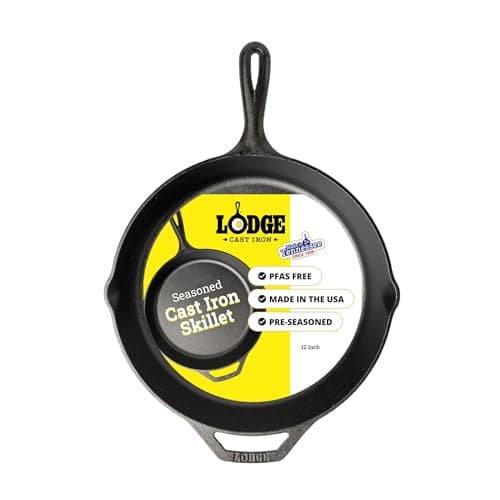
Bare cast iron
Very low
Cracks rather than warps, which is rare
Carbon steel
Moderate
Thin steel can oil-can; often relaxes back
Aluminized steel sheet pans
High
The familiar bang as a sheet pan pops in the oven
Disc-bottom pans deserve a note. The disc is attached to the pan body rather than bonded through it, so thermal stress concentrates at that joint. A separated disc shows as a pan that rocks, sometimes with a visible gap or a rattle - disc bottom versus fully clad covers why the construction differs.
Sheet pans are the other special case. The loud bang from an oven is a thin sheet relieving thermal stress, and it is normal rather than a defect. Heavier-gauge pans do it less - sheet pan materials.
Preventing it
Let a pan cool before it meets water. Five minutes off the heat is enough. This one habit prevents most warping that happens in home kitchens.
Match the burner to the pan base, not the pan to the burner. A six-inch burner under a twelve-inch pan creates exactly the gradient that warps it - cookware for gas stoves.
Do not preheat empty on high. Medium, with oil, and let it come up over a couple of minutes. Stainless in particular does not need a bare rip-hot preheat - why food sticks to stainless steel.
Keep pans out of the dishwasher where the maker allows a choice. Repeated heat cycling stresses joints and rivets - dishwasher-safe cookware.
Never put a hot pan under the broiler and then into the sink. The two extremes in sequence are what finishes pans.
Buy thicker. Mass resists gradients, which is most of what you pay for in a good pan - are expensive pans worth it.
Thermal cycling works at joints as well as at surfaces. A loose rivet and a warped base often arrive together, and for the same reason.
Can you fix a warped pan?
Sometimes, and it depends on the severity and the construction.
A slight dome that appears when hot and disappears when cool is not really a warp. It is normal thermal expansion. Leave it alone.
A mild warp on thick clad occasionally relaxes with normal use as further heat cycles redistribute the stress. It is worth waiting before writing the pan off.
Carbon steel that oil-cans often settles with continued use, and this is one of the reasons carbon steel is more forgiving than its thinness suggests - carbon steel problems and fixes.
Hammering it flat is not a home repair for clad cookware. You will delaminate the layers and turn a cosmetic problem into a structural one.
A separated disc bottom is finished. There is no home repair, and the gap will collect water.
A pronounced warp on a thin pan is permanent. If it spins on the cooktop and pools oil at the edge, it has stopped being useful - when to replace your cookware.
Is warping covered by the warranty?
Usually not, because most manufacturers classify it as misuse rather than as a defect, and the thermal shock explanation is on their side. The exception is a pan that warps in normal use at moderate heat, or a disc bottom that separates - that is a manufacturing failure and worth claiming. Read what the warranty excludes rather than what it promises - cookware warranties explained.
Constructions that stay flat
Full cladding and thickness are the two specifications that resist warping. Cast iron sidesteps the problem entirely at the cost of weight.
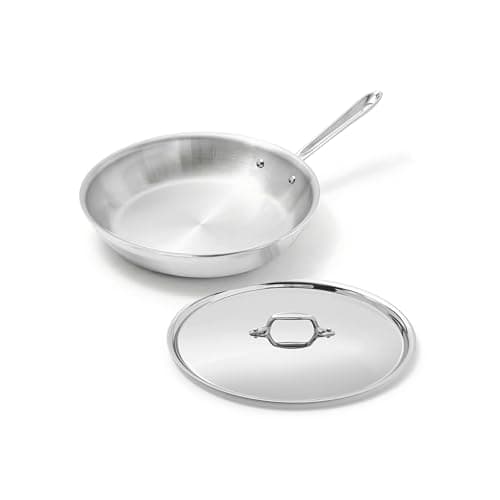
All-Clad D3 Stainless 10 in Fry Pan
One good open-stock stainless pan bought instead of a cheap full set
These are the products this page's reasoning actually points at. Same rules as everywhere else on the site: published specs, a stated trade-off, and a live price only where one exists.
Top pick · Most warp resistantSpecs read September 3, 2026
All-Clad D3 Stainless 10 in Fry Pan
Fully clad across the entire pan, so there is no disc joint to separate and no thin single-ply base to flex.
Best for: One good open-stock stainless pan bought instead of a cheap full set
Published specifications for the All-Clad D3 Stainless 10 in Fry Pan
Construction
Fully bonded tri-ply, aluminum core
Oven maximum
600F, oven and broiler safe
Induction
Yes - compatible with any stovetop
Dishwasher
Handwash only (All-Clad published)
Handle
Double-riveted stainless
Weight
3.0 lb (model 4110)
Warranty
Limited lifetime
Made in
Bonded, engineered and assembled in Canonsburg, PA
Good
600F is the highest oven ceiling of any stainless pan on this site
The one pan here whose manufacturing location is published down to the town
Genuinely repairable-adjacent: rivets are the only failure point and the warranty covers them
Not good
Hand wash only
The flared rim makes it a poor pan for anything with liquid
Costs several times what a Tramontina or Cuisinart pan of the same construction costs
The trade-off. Hand wash only. All-Clad publishes that plainly, and it is a real daily cost on a pan you will use every day.
Skip this if. You want a dishwasher-safe pan, or you are buying a whole kitchen on a fixed budget - one D3 skillet costs what a full clad set can cost.
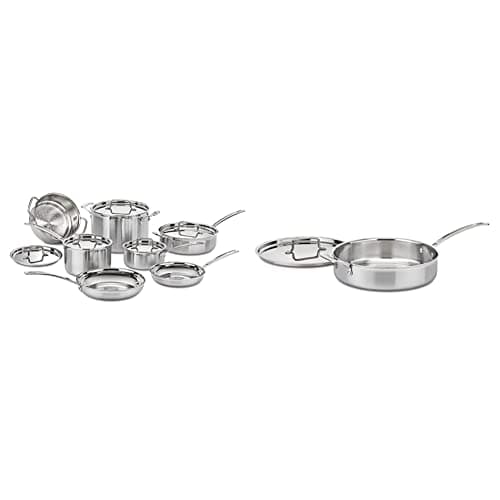
Published specifications for the Cuisinart MultiClad Pro MCP-12N 12-Piece Set
Construction
Tri-ply: 18/10 stainless interior, pure aluminum core, brushed stainless exterior
Pieces
1.5 and 3 qt covered saucepans; 8 in and 10 in skillets; 3.5 qt covered saute; 8 qt covered stockpot; steamer insert
Oven maximum
500F per the Cuisinart use-and-care manual. Amazon listings say 550F; Cuisinart has confirmed the manual figure
Induction
Yes
Dishwasher
Dishwasher safe
Handles
Riveted solid stainless, cool-grip profile
Warranty
Lifetime
Good
Heat runs up the sidewalls, not just across the base
Genuinely dishwasher safe, which the pricier clad brands often are not
Lifetime warranty on a set at this price
Not good
Published oven maximum contradicts the retail listing for the same product
Handle spine is divisive
No 12-inch skillet in the box, which is the pan most people reach for second
The trade-off. The cool-grip handles have a sharp spine that some people find uncomfortable on a full 8-quart stockpot.
Skip this if. You want the higher oven ceiling that the Amazon listing advertises. The manual says 500F and Cuisinart has confirmed the manual is correct.
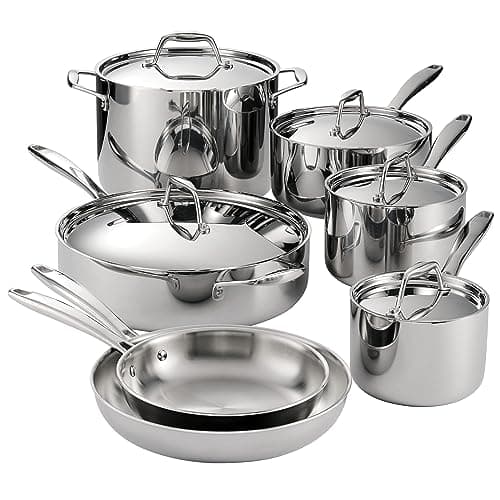
Published specifications for the Tramontina Signature Tri-Ply Clad 12-Piece Set
Construction
Tri-ply: 18/10 stainless, aluminum core, magnetic stainless exterior
Pieces
8 in and 10 in fry pans; 1.5, 2 and 3 qt covered saucepans; 5 qt covered deep saute; 8 qt covered stockpot
Oven maximum
500F on the 80116-249DS listing; other SKUs in the line are listed at 350F
Induction
Yes - magnetic stainless exterior
Dishwasher
Listed dishwasher safe
Handles
Precision cast, riveted
Certification
NSF-certified on the 80116-249DS line
Country of origin
Not asserted - retail listings disagree across SKUs (Brazil and China both appear)
Good
Fully clad, not disc-bottom: the aluminum runs up the sidewalls, so sauces do not scorch in a ring at the base
NSF certification on the flagship SKU is a real, checkable third-party mark rather than a marketing badge
Induction-ready without paying an induction premium
Not good
Retail listings disagree on the oven maximum across SKUs in the same line, which is a documentation problem, not a cooking one
Handles run hot on gas
The 12-piece count includes lids; the useful-item count is seven
The trade-off. Handles are the weak point. They are riveted and sturdy, but they get hot on a gas ring in a way the more expensive clad brands' do not.
Skip this if. You want a set you can leave in the oven above 500F, or you cook mostly eggs and pancakes and would rather spend the money on one good nonstick pan.
Almost certainly thermal shock. Either cold water hit it while it was still hot, or it was preheated empty on a burner much smaller than its base. Both create a large temperature difference across a short distance, and the metal buckles to relieve the stress.
›Can you fix a warped pan?
Mild warping on thick clad cookware sometimes relaxes with continued use, and carbon steel frequently settles on its own. A pronounced warp on a thin pan is permanent, and a separated disc bottom cannot be repaired. Do not hammer clad cookware flat - it delaminates the layers.
›Does running cold water on a hot pan ruin it?
It is the single most common cause of warping. The contact area cools instantly while the rest of the pan stays hot, creating a temperature difference of hundreds of degrees across a few inches of metal. Let a pan cool for five minutes before it meets water.
›Do expensive pans warp?
Less, because thickness and full cladding both resist thermal gradients, but they are not immune. Extreme shock will warp anything short of cast iron. What you are buying with a thicker pan is a wider margin before the metal gives, not an absolute guarantee.
›Why does my sheet pan bang in the oven?
It is a thin sheet of metal relieving thermal stress as it expands unevenly, and it is normal rather than a defect. Heavier gauge pans do it less. It is the same mechanism as warping, just resolved with a noise instead of a permanent bend.
Sources
Every figure on this page came from one of these. Follow them and check our arithmetic — that is the point.