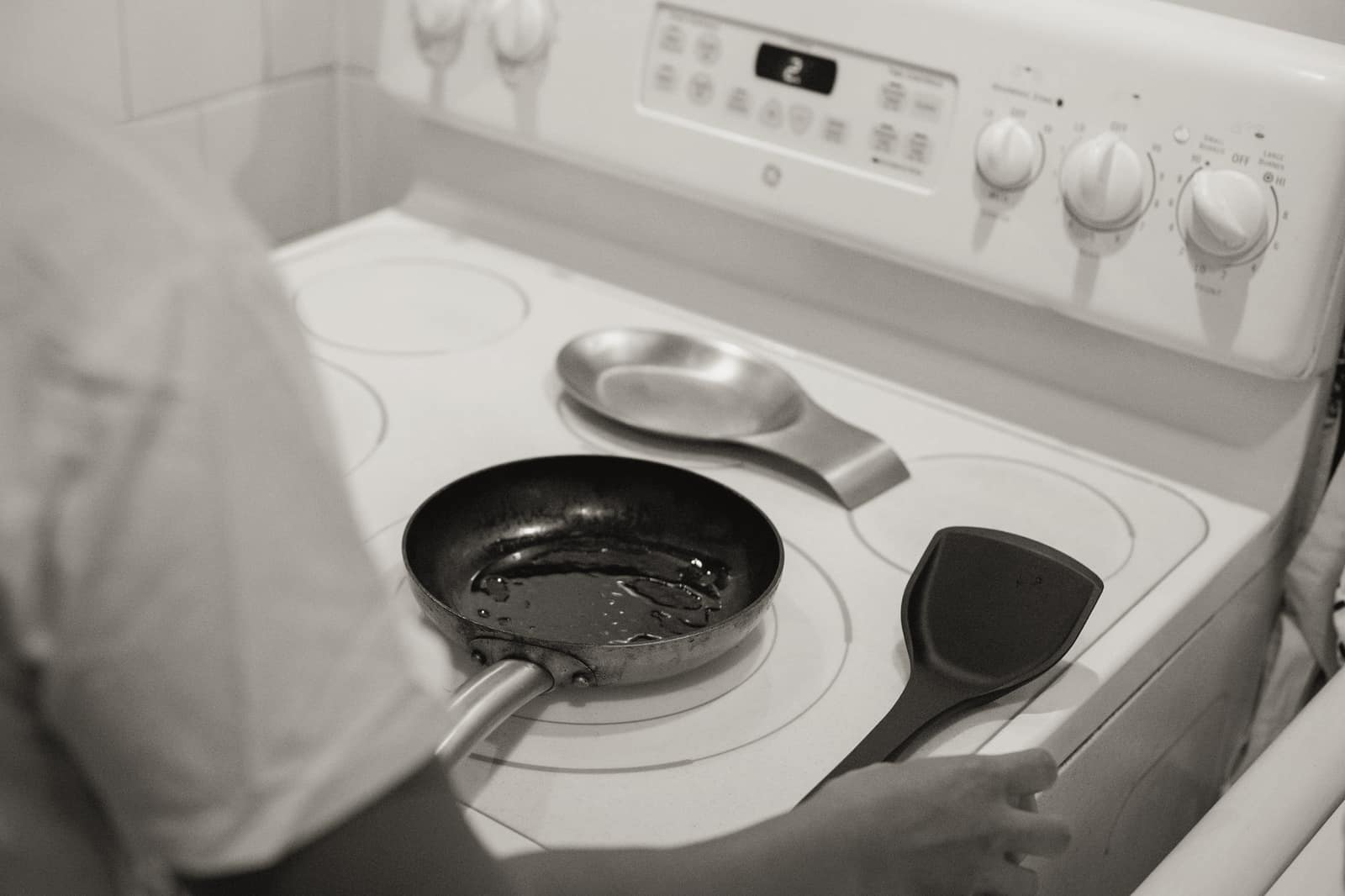
Electric is the most common stove in America and the least written about. The rules are different from gas, and flatness matters more than anything on the box.
Heads up: some links on this page earn us a commission at no extra cost to you. It does not change what we recommend or the order. How we are funded.
The short answer
Flat base, always. Electric elements transfer heat by contact. A base that rocks or bows loses most of it.
Heavy over thin. Electric elements change temperature slowly, so the pan has to do the buffering that a gas flame does for you.
On a glass top, watch the drag. Bare cast iron does not scratch ceramic glass by existing; it scratches it when you slide it, or when grit is trapped underneath.
Match the base to the element. A pan wider than the element browns in a ring; a pan narrower than it wastes the outer edge as room heat.
Two stoves get called "electric" and they behave differently
A coil range has exposed spiral elements that glow. A smooth top - sometimes called radiant, ceramic or glass top - has the same kind of resistive element hidden under a sheet of ceramic glass, which the element heats and which then heats your pan. Induction is a third thing entirely and is covered in cookware for induction.
Both coil and radiant share the trait that matters: heat moves by direct contact, and the element takes a long time to change temperature. A gas flame responds the instant you turn the knob. An electric element carries on doing what it was doing for another thirty seconds, and everything about pan choice follows from that one fact.
Flatness is the specification nobody prints
On gas, hot air wraps around the bottom of a pan and up the sides, so a base that bows slightly still cooks. On electric, the only heat that reaches the food is the heat that crosses the contact patch. A pan with a base that bows by a millimeter has a contact patch the size of a coin, and it will boil water at roughly half the speed of a flat one.
Nobody publishes a flatness figure. The usable proxy is a pan that is rated for induction, because an induction-compatible base has to be ground flat and magnetically even to work at all. Every clad pan on this site is induction-rated for that reason. The other proxy is thickness: a thin pan warps the first time it meets a hot element, and a thick one does not.
The kitchen test is a straightedge or a ruler across the base in two directions. If light shows under the middle, the pan is bowed. If light shows at the edges, it is domed, which is worse - a domed pan spins.
Thermal mass replaces the responsiveness you do not have
The complaint about electric cooking is that it lags. You cannot drop the heat under a pan of caramelizing onions the way you can on gas. That is true, and the answer is not a better stove - it is a heavier pan.
A heavy pan buffers the swing. When the element cycles off, a cast iron skillet barely notices; a thin aluminum pan drops thirty degrees. When the element overshoots, the same mass absorbs it instead of passing it to the food. On an electric range, mass does the job the flame knob does on gas.
Pan
On a coil element
On a smooth top
Cast iron
Ideal - mass covers the lag entirely
Excellent, but lift it, never slide it
Clad stainless
Ideal - flat, heavy enough, non-reactive
Ideal
Carbon steel
Good if it is 3 mm; thin pans warp on a coil
Good, and lighter to lift than iron
Thin aluminum nonstick
Poor - warps, and the lag shows
Fine for eggs, poor for anything else
Disc-bottom stainless
Fine, if the disc is genuinely flat
Fine
The ranking is about contact area and thermal mass. Nothing here is about brand.
The glass top question: does cast iron scratch it?
It can, and the mechanism is worth understanding because the usual advice - just never use iron - throws away the best pan for the stove.
Ceramic glass is harder than cast iron. Iron sitting on it does nothing. What scratches it is a rough, sandy casting dragged sideways, or a grain of salt or grit caught between the pan and the glass and then dragged. The damage is abrasion, not weight. A dropped pan is a different problem: that cracks rather than scratches, and no cookware choice prevents it.
Lift pans on and off. Never slide, ever, on any smooth top.
Wipe the glass before you put a pan down. Grit is the actual culprit.
Prefer a smoother casting. The Victoria 12-inch skillet has a noticeably less pebbled factory surface than the category norm, which is a real advantage here.
If you want iron on glass but not the weight, a smaller 8-inch skillet is far easier to lift cleanly with one hand.
An induction-rated base is a usable proxy for a flat base, because a pan has to be flat and magnetically even to work on induction at all.
Match the pan to the element, not to the recipe
Electric elements come in fixed diameters, usually around six and eight inches on a coil range, with a couple of sizes plus a bridge or dual-ring zone on a smooth top. Heat leaves the element in a circle that size and no wider.
Put a 12-inch skillet on a six-inch element and you get a browned center and pale edges, which is the single most common complaint about electric cooking and is entirely a matching problem. Put an 8-inch pan on a large element and the exposed ring heats the room, the pan handle and eventually the cabinet above it.
Measure your elements before you buy anything. They are rarely what the manual implies.
Buy the pan that matches your biggest element for searing, and one that matches a small element for sauces.
Use the oven for anything wider. A large roast on a stovetop element is going to cook unevenly no matter which pan you own.
What genuinely does not work
Warped thin nonstick
A thin coated aluminum pan that has warped is worse on electric than anywhere else, because the contact patch collapses to a point. If a pan spins when you nudge it, it is finished. The relevant reading is how long nonstick actually lasts.
Round-bottom woks
A round-bottom wok makes almost no contact with a flat element and is the one shape that genuinely cannot work here. If you want to stir fry on electric, buy a flat-bottom wok - the Joyce Chen flat-bottom 14-inch is the standard answer, and the full wok roundup is here.
Rim-heavy sheet pans on the stovetop
Sheet pans belong in the oven. People do use them across two coils to griddle, and it warps them permanently. Use a proper two-burner cast iron griddle if that is the goal.
The electric-range shortlist
Every one of these has a flat, induction-rated base, which is the closest thing to a published flatness specification the category offers.
Start with one clad skillet and one clad saucepan, because those two cover most of what an electric range is asked to do and both benefit most from a flat base. Add cast iron third, once you know you will lift rather than slide it. Add nonstick last and treat it as a consumable.
These are the products this page's reasoning actually points at. Same rules as everywhere else on the site: published specs, a stated trade-off, and a live price only where one exists.
Top pick · Best set for an electric rangeSpecs read September 3, 2026
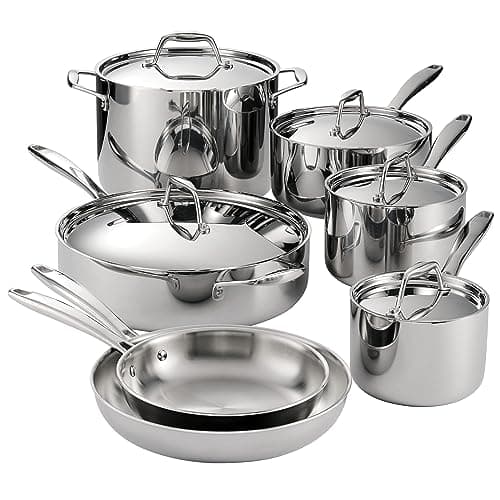
Tramontina Signature Tri-Ply Clad 12-Piece Set
Fully clad, flat-bottomed and induction-rated, which on an electric top means the base is ground flat and stays that way.
Best for: A first kitchen that should not need replacing
Published specifications for the Tramontina Signature Tri-Ply Clad 12-Piece Set
Construction
Tri-ply: 18/10 stainless, aluminum core, magnetic stainless exterior
Pieces
8 in and 10 in fry pans; 1.5, 2 and 3 qt covered saucepans; 5 qt covered deep saute; 8 qt covered stockpot
Oven maximum
500F on the 80116-249DS listing; other SKUs in the line are listed at 350F
Induction
Yes - magnetic stainless exterior
Dishwasher
Listed dishwasher safe
Handles
Precision cast, riveted
Certification
NSF-certified on the 80116-249DS line
Country of origin
Not asserted - retail listings disagree across SKUs (Brazil and China both appear)
Good
Fully clad, not disc-bottom: the aluminum runs up the sidewalls, so sauces do not scorch in a ring at the base
NSF certification on the flagship SKU is a real, checkable third-party mark rather than a marketing badge
Induction-ready without paying an induction premium
Not good
Retail listings disagree on the oven maximum across SKUs in the same line, which is a documentation problem, not a cooking one
Handles run hot on gas
The 12-piece count includes lids; the useful-item count is seven
The trade-off. Handles are the weak point. They are riveted and sturdy, but they get hot on a gas ring in a way the more expensive clad brands' do not.
Skip this if. You want a set you can leave in the oven above 500F, or you cook mostly eggs and pancakes and would rather spend the money on one good nonstick pan.
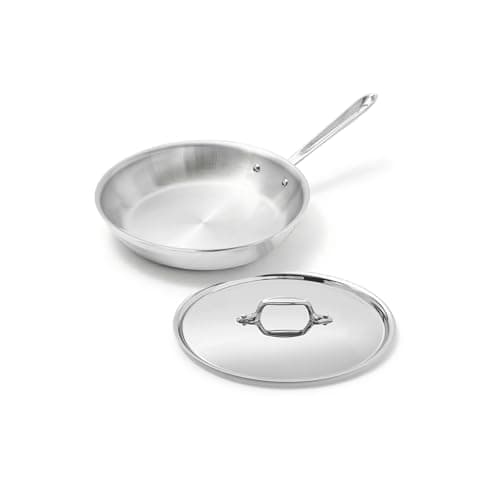
Published specifications for the All-Clad D3 Stainless 10 in Fry Pan
Construction
Fully bonded tri-ply, aluminum core
Oven maximum
600F, oven and broiler safe
Induction
Yes - compatible with any stovetop
Dishwasher
Handwash only (All-Clad published)
Handle
Double-riveted stainless
Weight
3.0 lb (model 4110)
Warranty
Limited lifetime
Made in
Bonded, engineered and assembled in Canonsburg, PA
Good
600F is the highest oven ceiling of any stainless pan on this site
The one pan here whose manufacturing location is published down to the town
Genuinely repairable-adjacent: rivets are the only failure point and the warranty covers them
Not good
Hand wash only
The flared rim makes it a poor pan for anything with liquid
Costs several times what a Tramontina or Cuisinart pan of the same construction costs
The trade-off. Hand wash only. All-Clad publishes that plainly, and it is a real daily cost on a pan you will use every day.
Skip this if. You want a dishwasher-safe pan, or you are buying a whole kitchen on a fixed budget - one D3 skillet costs what a full clad set can cost.
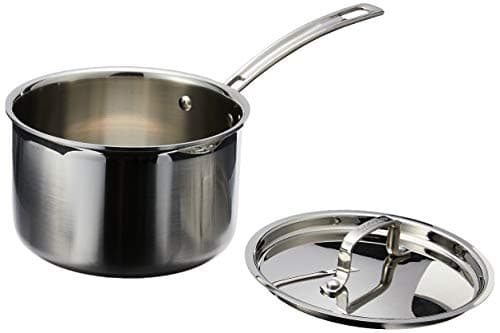
Published specifications for the Cuisinart MultiClad Pro Saucepan, 3 qt
Construction
Tri-ply: 18/10 stainless interior, pure aluminum core, brushed stainless exterior
Capacity
3 qt with lid
Oven maximum
500F per the Cuisinart use-and-care manual; retail listings say 550F
Induction
Yes
Dishwasher
Dishwasher safe
Handle
Riveted solid stainless, cool-grip profile
Warranty
Lifetime
Good
Genuinely dishwasher-safe clad stainless, which the premium brands are not
Fully clad rather than disc-bottom at an open-stock price
Lifetime warranty
Not good
Published oven maximum contradicts the retail listing for the same pan
The handle spine is divisive on larger pieces
No published country of manufacture
The trade-off. The oven ceiling is 500F per Cuisinart's manual, not the 550F some retail listings advertise. That is a documentation problem the buyer inherits.
Skip this if. You want the higher oven ceiling or the published US factory. That is All-Clad, and you pay for it.
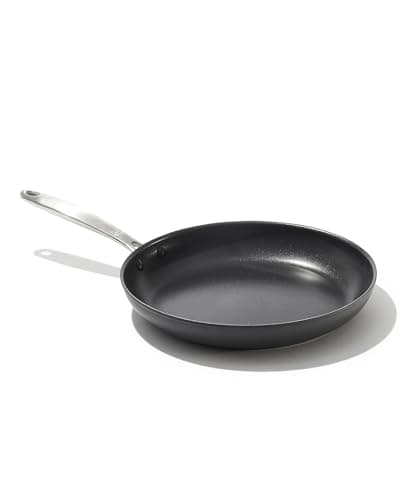
Published specifications for the OXO Good Grips Pro Hard-Anodized Nonstick Fry Pan, 10 in
Body
Hard-anodized aluminum
Coating
Three-layer PTFE nonstick, published PFOA-free
Oven maximum
430F published for the line
Induction
No on the standard hard-anodized line
Dishwasher
Dishwasher safe
Edge
Rolled, for pouring without dripping down the side
Coating lifespan
Not published
Good
The rolled pour edge is a small thing you notice every single time you use it
The hard-anodized body resists the denting that ruins cheap aluminum pans
Handle stays cool and does not rotate the way riveted plastic ones eventually do
Not good
Not induction compatible
Oven ceiling capped by the handle, not the pan
Still a coating, still a consumable, still no published lifespan
The trade-off. The handle that makes it comfortable is a stainless-and-silicone assembly, and that is what caps the oven rating below the body's own limit.
Skip this if. You need induction. The standard hard-anodized body is not ferrous.
Flat, heavy pans. Fully clad stainless and cast iron both work well because they make full contact with the element and have enough mass to smooth out the slow temperature swings an electric element produces. Thin aluminum pans warp and lose contact.
›Does cast iron scratch a glass top stove?
Only if you slide it, or if grit is trapped underneath. Ceramic glass is harder than iron, so a pan sitting still does no damage. Lift pans on and off, wipe the glass before setting a pan down, and prefer a smoother casting.
›Why does my food cook unevenly on an electric stove?
Usually because the pan is wider than the element. Heat leaves an electric element in a circle its own diameter, so a 12-inch skillet on a 6-inch coil browns in the center and stays pale at the edge. Measure your elements and match the pan.
›Can you use a wok on an electric stove?
Only a flat-bottom one. A round-bottom wok makes almost no contact with a flat element, so it never gets hot enough to stir fry properly. Flat-bottom carbon steel woks are made specifically for Western stovetops.
›Is a coil stove or a glass top better for cookware?
A coil range is more forgiving because you cannot scratch it and it tolerates rough castings. A glass top heats more evenly and cleans more easily but adds a scratch risk that comes from dragging pans rather than from their weight.
Sources
Every figure on this page came from one of these. Follow them and check our arithmetic — that is the point.