Heads up: some links on this page earn us a commission at no extra cost to you. It does not change what we recommend or the order. How we are funded.
The short answer
Most standard coated lines do not work on induction, and their makers say so: Calphalon and OXO publish that their standard hard-anodized ranges are not compatible, and T-fal publishes the same for its standard aluminum line. Induction-specific coated ranges exist and are worth seeking out - Calphalon sells one - but verify with a magnet rather than with a listing. If you want one pan for eggs on induction, a seasoned carbon steel skillet is the alternative that always works.
Why coated pans fail on induction
An induction hob generates a magnetic field that induces currents in the pan itself. The pan therefore has to be ferromagnetic. Aluminum is not, and neither is anodized aluminum, and the overwhelming majority of coated cookware is one of those two with a coating on top.
The coating is irrelevant to the physics. What matters is the body, and the body is the part the listing spends least time on. The stove-side detail is in cookware for induction.
What the makers publish
Line
Body
Induction
Source
Calphalon Premier hard-anodized
Hard-anodized aluminum
No - separate induction range exists
Calphalon published
OXO Good Grips Pro
Hard-anodized aluminum
No on the standard line
OXO published
T-fal Professional
Aluminum
No on the standard aluminum line
T-fal published
Tramontina Professional
Heavy-gauge aluminum
No - aluminum body is not ferrous
Tramontina published
GreenPan Valencia
Aluminum, ceramic coated
Varies by line
GreenPan published
Every coated pan in our ledger is in this table, and not one of the standard lines is induction compatible. That is the honest state of the category.
We are not going to recommend a coated pan for induction that we have not audited. What we can say is that induction-specific coated ranges do exist - they add a magnetic stainless layer bonded to the base - and that Calphalon publishes one alongside its standard range.
How to verify, in five seconds
Hold a fridge magnet against the base of the pan.
If it grabs firmly, the pan works.
If it slides off or holds weakly, it does not - whatever the listing says.
Do this in the shop, or on arrival before you use the pan. "Induction ready" is a marketing phrase with no agreed definition, and it appears on sets where some pieces work and others do not - the partial-compatibility trap described in best cookware sets for induction.
A second, quieter failure: most induction hobs have a minimum base diameter they will detect, often around four to five inches. A small coated pan can be magnetic and still not register, which people reasonably mistake for a faulty pan.
If you do buy an induction coated pan
Two things change about how it behaves, and both are worth knowing.
Heat arrives faster and more locally. Induction generates heat in the magnetic layer, so a coated pan can reach coating-damaging temperatures faster than on gas. Use lower settings than you are used to - the published ceilings, 400F to 450F, are not far away.
Base flatness matters more. A warped coated pan couples badly and heats in a ring. Thin aluminum warps readily, which makes the thermal-shock rule - never cold water into a hot pan - more important on induction than elsewhere.
The alternatives, which are better than they sound
Induction is the stove type where the case for bare metal is strongest, because bare metal is exactly what induction wants.
Carbon steel
Strongly ferrous, light enough to move easily, and a seasoned surface releases eggs cleanly once it is mature. It also tolerates the whole heat range an induction hob can produce, which no coating does. Start with best carbon steel pans, and the honest comparison against a coating is carbon steel versus nonstick.
Cast iron
Couples superbly, costs little and is the cheapest guaranteed-compatible pan you can buy. Heavy, and the smooth-top handling rules apply - cast iron on glass top stoves covers lifting rather than sliding, which matters on induction glass too.
Clad stainless for everything else
Every piece works, and there is no coating to fail. A clad set plus one bare skillet is a complete induction kitchen, and the sets are in best cookware sets for induction.
What to do
Build the kitchen from clad stainless:a fully clad set, magnetic on every piece.
For eggs, try bare metal first:carbon steel or cast iron, both of which always work.
If you want a coated pan, buy from a line published as induction compatible and magnet-test it on arrival.
If you want ceramic specifically,check the GreenPan line rather than the brand, because compatibility varies within it.
What actually works on an induction hob
Three of these are guaranteed by their material. The fourth varies by line, which is why the magnet test is the last word on any listing.
de Buyer MINERAL B PRO Carbon Steel Fry Pan, 11 in
Someone who wants cast-iron searing without cast-iron weight
These are the products this page's reasoning actually points at. Same rules as everywhere else on the site: published specs, a stated trade-off, and a live price only where one exists.
Top pick · The pan that always works on inductionSpecs read September 3, 2026
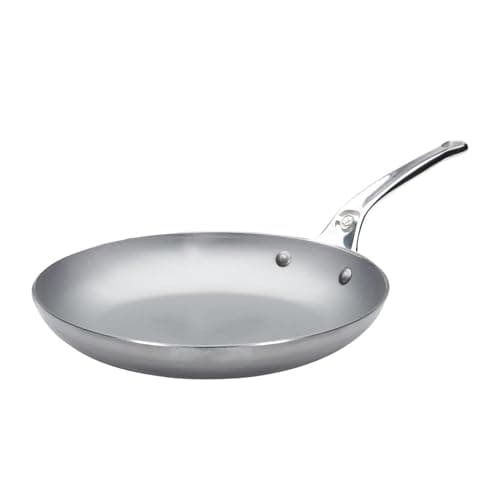
de Buyer MINERAL B PRO Carbon Steel Fry Pan, 11 in
Bare carbon steel is strongly ferrous, and a seasoned surface releases eggs well enough that a coating becomes optional.
Best for: Someone who wants cast-iron searing without cast-iron weight
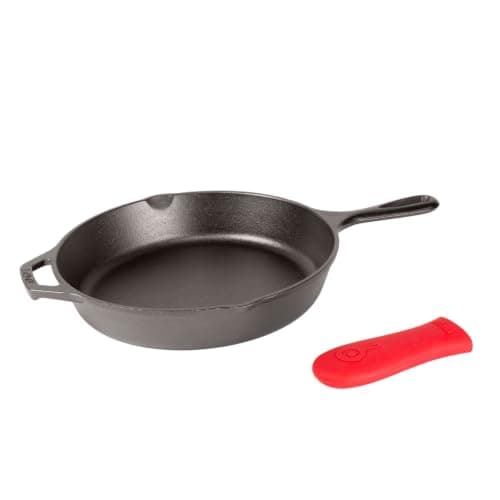
Published specifications for the Lodge Seasoned Cast Iron Skillet, 10.25 in (L8SK3)
Diameter
10.25 in
Weight
5.66 lb
Oven maximum
550F
Induction
Yes - bare iron is ferrous
Seasoning
Pre-seasoned with soy-based vegetable oil, no synthetic chemicals
Warranty
Lifetime
Made in
USA
Care
Hand wash. Lodge's own instructions permit warm soapy water
Good
Effectively unbreakable and fully restorable - a rusted one can be stripped and re-seasoned
Holds heat better than anything else at the price, which is what a sear needs
Lodge publishes its seasoning method openly, so the maintenance is not a mystery
Not good
Heavy
Heats unevenly on a small burner: cast iron conducts at roughly 50 W/m-K, so it is slow to spread and slow to react
Bare iron is reactive; long tomato braises will taste of it
The trade-off. It weighs 5.66 lb empty. You will feel that every time you move it full, and it is the single most common reason a cast iron skillet ends up in a cupboard.
Skip this if. You have wrist or shoulder trouble, or you cook mostly acidic braises. Carbon steel does most of the same jobs at roughly half the weight.
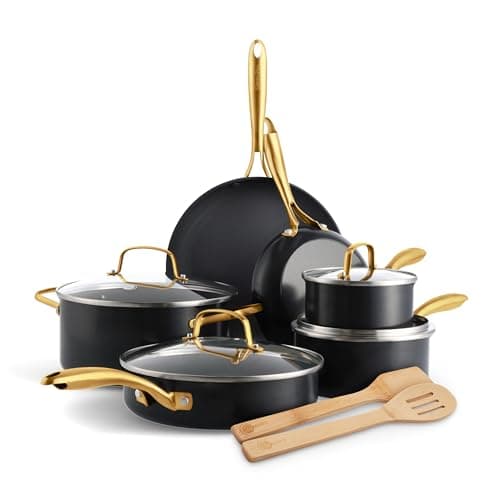
Published specifications for the GreenPan Ceramic Nonstick Cookware Set
Coating
Thermolon, from sand-derived Silicon Dioxide (SiO2), sprayed
Coating chemistry
PFAS-free, PFOA-free, free of lead and cadmium (GreenPan published)
Coating heat resistance
850F / 450C for the coating itself (GreenPan published)
Body oven maximum
Varies by line and is lower than the coating figure - check the specific line
Coating lifespan
Not published. No ceramic maker publishes one
Good
GreenPan publishes what the coating is made of in plain terms, which most ceramic brands do not
The coating will not release fumes if you overheat it the way PTFE can
Genuinely good release when new
Not good
Release degrades and nobody will tell you how fast
The 850F figure is for the coating, not the pan, and gets quoted as if it were the pan
Ceramic dislikes high heat and dishwashers, which is most of what a set gets used for
The trade-off. Ceramic nonstick loses release with use and no maker publishes a lifespan, GreenPan included. Treat it as a consumable, not a lifetime purchase.
Skip this if. You are buying a set expecting it to last as long as clad stainless. It will not, and the honest move is to buy one ceramic pan alongside a stainless set.
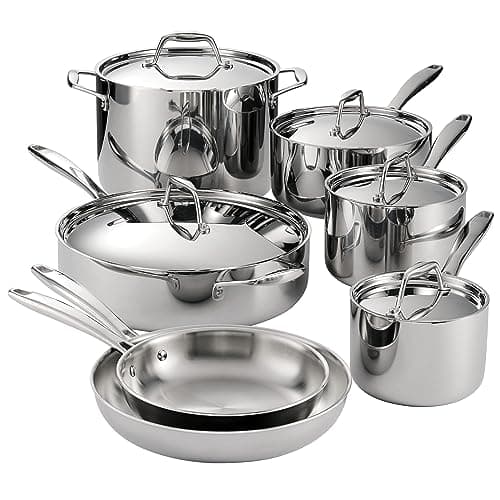
Published specifications for the Tramontina Signature Tri-Ply Clad 12-Piece Set
Construction
Tri-ply: 18/10 stainless, aluminum core, magnetic stainless exterior
Pieces
8 in and 10 in fry pans; 1.5, 2 and 3 qt covered saucepans; 5 qt covered deep saute; 8 qt covered stockpot
Oven maximum
500F on the 80116-249DS listing; other SKUs in the line are listed at 350F
Induction
Yes - magnetic stainless exterior
Dishwasher
Listed dishwasher safe
Handles
Precision cast, riveted
Certification
NSF-certified on the 80116-249DS line
Country of origin
Not asserted - retail listings disagree across SKUs (Brazil and China both appear)
Good
Fully clad, not disc-bottom: the aluminum runs up the sidewalls, so sauces do not scorch in a ring at the base
NSF certification on the flagship SKU is a real, checkable third-party mark rather than a marketing badge
Induction-ready without paying an induction premium
Not good
Retail listings disagree on the oven maximum across SKUs in the same line, which is a documentation problem, not a cooking one
Handles run hot on gas
The 12-piece count includes lids; the useful-item count is seven
The trade-off. Handles are the weak point. They are riveted and sturdy, but they get hot on a gas ring in a way the more expensive clad brands' do not.
Skip this if. You want a set you can leave in the oven above 500F, or you cook mostly eggs and pancakes and would rather spend the money on one good nonstick pan.
Most standard lines do not, and their makers publish it - Calphalon and OXO for their hard-anodized ranges, T-fal for its standard aluminum line. Induction-specific coated ranges exist with a magnetic layer bonded to the base.
›How do you check if a nonstick pan is induction compatible?
Hold a fridge magnet against the base. If it grabs firmly the pan works; if it slides or holds weakly it does not, whatever the listing claims. Induction ready is a marketing phrase with no agreed definition.
›Why does my induction hob not recognize my nonstick pan?
Either the base is not ferromagnetic, which is the usual reason, or the pan is smaller than the hob's minimum detectable diameter - often around four to five inches. Both are common with small coated pans.
›What can you use instead of nonstick on induction?
Carbon steel or cast iron. Both are strongly ferrous, both tolerate any heat an induction hob produces, and a well-seasoned surface releases eggs cleanly. Clad stainless covers everything else and works on every piece.
›Do nonstick pans overheat faster on induction?
They can. Induction generates heat in the pan's magnetic layer, so it arrives faster and more locally than on gas, and published coating ceilings of 400F to 450F are not far away. Use lower settings than you are used to.
Sources
Every figure on this page came from one of these. Follow them and check our arithmetic — that is the point.