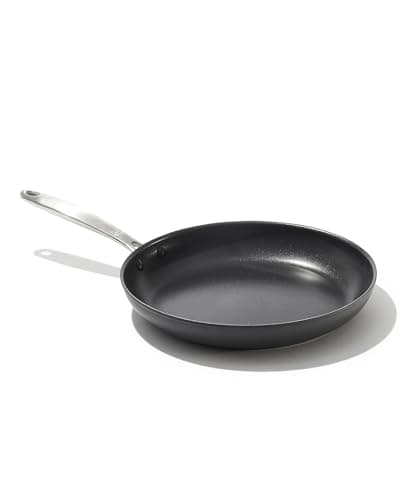
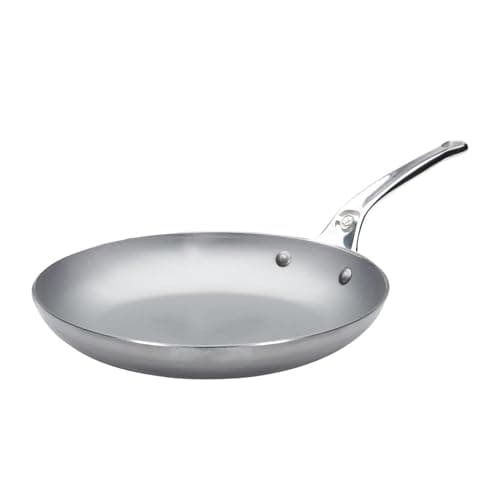
The honest comparison is not which one releases better on day one. It is which one you will still be using in five years, and what each asks of you to get there.
Heads up: some links on this page earn us a commission at no extra cost to you. It does not change what we recommend or the order. How we are funded.
The short answer
Buy nonstick if you want eggs to release from day one with no effort, and accept that you are buying a consumable no maker will put a lifespan on. Buy carbon steel if you are willing to season a pan and cook in it regularly, in exchange for a surface that repairs indefinitely, tolerates any heat you can produce, and sears far better than any coating. Most kitchens should own one of each: a cheap nonstick pan for eggs on a bad morning, and a carbon steel pan for everything that needs heat.
Two pans bought for the same job
Nearly everyone who compares these is asking one question: what do I fry eggs in? That is worth saying out loud, because it explains why the comparison feels closer than the materials suggest. In every other respect these two pans are almost opposites.
A nonstick pan is thin aluminum with a manufactured polymer sprayed or rolled onto it. A carbon steel pan is a sheet of steel, typically 2 to 3 mm thick, with no coating at all - the release surface is seasoning you create by heating oil until it polymerizes, exactly as on cast iron.
The comparison, line by line
Carbon steel
Nonstick
Release when new
Poor until seasoned - it takes weeks of cooking
Excellent from the first use
Release at year five
Better than year one, if used regularly
Not published by any maker
Repairable
Completely - strip and re-season
No. A coating cannot be reapplied
Heat ceiling
Whatever your stove produces; Lodge publishes 550F for its seasoned range
400F to 450F published across the coated pans here
Searing
Excellent - this is what it is for
Poor. The coating cannot take the heat searing needs
Metal utensils
Yes
Only where the maker publishes it - Calphalon Premier does
Dishwasher
Never
Usually published safe, though it shortens release life
Acidic food
Avoid long contact - it strips seasoning
Fine
Induction
Yes - steel is ferrous
Usually not on standard aluminum and hard-anodized lines
Weight
Heavy for its size; 3 mm at 11 in is a real pan
Light
Effort
Seasoning, drying, oiling. A relationship
None
Every published figure here is the manufacturer's own, recorded in the product ledger. The two blank-by-design cells are the coating lifespans, which no maker states.
The one asymmetry that decides it
There is a single fact that reframes this entire comparison, and it is an absence rather than a number: no nonstick manufacturer publishes a coating lifespan. Not T-fal, not Calphalon, not OXO, not GreenPan on the ceramic side. It is examined in full in how long nonstick lasts.
That means the cost-per-year of a nonstick pan is unknowable by design, and every warranty in the category excludes coating wear anyway - Calphalon states the exclusion in plain words. What that wording means is covered in cookware warranties explained.
Carbon steel has the opposite property. Its surface degrades and is rebuilt, indefinitely, by a process the manufacturer publishes. de Buyer prints its first-use and seasoning instructions; Lodge publishes its seasoning method for the whole seasoned range. A twenty year old carbon steel pan is a normal object; a twenty year old nonstick pan is not.
This is not an argument that nonstick is bad. It is an argument that nonstick is a consumable, and it should be bought like one - cheaply, and with replacement planned. That is the reasoning behind our nonstick pick on this page.
Eggs, specifically
On day one, nonstick wins and it is not close. A new coated pan releases a fried egg with no fat and no technique. A new carbon steel pan will glue that egg to itself, because bare steel is bare steel.
At month six the picture changes. A carbon steel pan that has been used several times a week - fried, seared, wiped, oiled - develops a dark slick patina that releases eggs with a little butter and the right heat. It will never be as forgiving as new PTFE, and it does not need to be, because it also does everything else.
The honest summary is that carbon steel rewards frequency. A pan used four times a week gets better; a pan used twice a month never arrives. If your cooking is occasional, the coated pan is genuinely the better purchase and there is no virtue in pretending otherwise.
The surface on the left of this comparison is one you build. That is the whole cost and the whole benefit.
Heat is where the gap is widest
The coated pans in our ledger publish oven ceilings of 400F (T-fal Professional), 430F (OXO Good Grips Pro) and 450F (Calphalon Premier), and none of them are broiler safe. Those numbers are set by the coating, not the aluminum.
Carbon steel has no coating to protect. Lodge publishes 550F across its seasoned cookware, and the practical limit on a bare pan is the seasoning rather than the steel - which is to say, higher than a domestic stove reaches. That is why a hard sear, a smoking-hot stir fry or a pan taken straight from the burner into a hot oven is carbon steel territory and not nonstick territory. The published ceilings for everything are collected in oven-safe cookware temperatures.
What carbon steel actually asks of you
Strip the factory coating on arrival. New bare pans ship with an anti-rust film that must be scrubbed off - de Buyer publishes this step.
If any of those five sound like a chore rather than a routine, that is a real answer and it points at nonstick. Whether the material suits you at all is the question in is carbon steel worth it.
What goes wrong with each
Carbon steel
Sticky, uneven or blotchy seasoning, usually from oil applied too thickly.
Rust, from a pan put away damp.
Warping, because thin steel moves - more readily than cast iron.
You cook occasionally and mostly eggs:a cheap nonstick skillet, replaced when it stops releasing.
You want both, which is the right answer: carbon steel for heat, one coated pan for mornings. Roughly the cost of one mid-range coated pan.
You cook eggs daily and want the nicest coated pan:the OXO Good Grips Pro, with the same caveat about lifespan.
Both sides of this comparison
Two bare steel pans with published thickness, and two coated pans with no published lifespan. Owning one from each column is a completely reasonable kitchen.
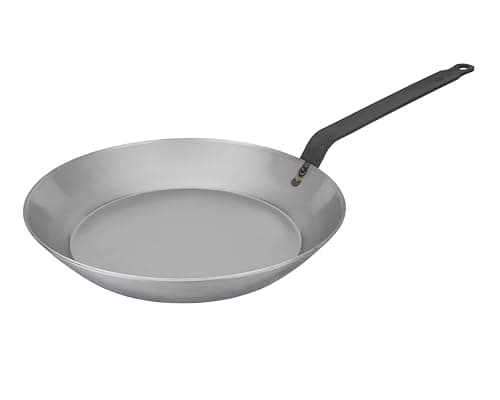
de Buyer MINERAL B PRO Carbon Steel Fry Pan, 11 in
Someone who wants cast-iron searing without cast-iron weight
We do not make or sell carbon steel pans or nonstick pans. Both link to the same retailer, both pay us the same commission rate, and we earn exactly the same whichever one you buy — or nothing at all if you buy neither, which is sometimes the right answer. Most of the comparison pages that rank for this question are published by companies that sell one of the two. How we are funded.
What to buy, if you are buying
These are the products this page's reasoning actually points at. Same rules as everywhere else on the site: published specs, a stated trade-off, and a live price only where one exists.
Top pick · The carbon steel to buySpecs read September 3, 2026
de Buyer MINERAL B PRO Carbon Steel Fry Pan, 11 in
3 mm of French steel with a published thickness, which is the specification the rest of this category refuses to state.
Best for: Someone who wants cast-iron searing without cast-iron weight
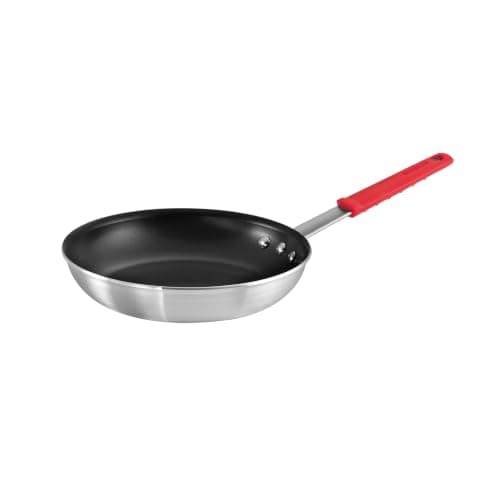
Published specifications for the Tramontina Professional Restaurant Fry Pan, 10 in
Body
Heavy-gauge aluminum
Coating
PTFE nonstick
Induction
No - aluminum body is not ferrous
Coating lifespan
Not published, by this or any nonstick maker
Good
Cheap enough that replacing it every couple of years is a real plan rather than a failure
Heavy gauge for a nonstick pan, so it does not warp on the first hot burner
Silicone handle sleeve that actually stays cool
Not good
Not induction compatible
PTFE, which some buyers will rule out on principle
No published coating lifespan, so the value case is unverifiable by design
The trade-off. It is PTFE. That is fine at normal cooking temperatures, and it is not a pan to preheat empty on high.
Skip this if. You want to avoid PTFE entirely. Buy ceramic instead and accept the shorter release life rather than pretending either one lasts forever.
Published specifications for the OXO Good Grips Pro Hard-Anodized Nonstick Fry Pan, 10 in
Body
Hard-anodized aluminum
Coating
Three-layer PTFE nonstick, published PFOA-free
Oven maximum
430F published for the line
Induction
No on the standard hard-anodized line
Dishwasher
Dishwasher safe
Edge
Rolled, for pouring without dripping down the side
Coating lifespan
Not published
Good
The rolled pour edge is a small thing you notice every single time you use it
The hard-anodized body resists the denting that ruins cheap aluminum pans
Handle stays cool and does not rotate the way riveted plastic ones eventually do
Not good
Not induction compatible
Oven ceiling capped by the handle, not the pan
Still a coating, still a consumable, still no published lifespan
The trade-off. The handle that makes it comfortable is a stainless-and-silicone assembly, and that is what caps the oven rating below the body's own limit.
Skip this if. You need induction. The standard hard-anodized body is not ferrous.
For searing, heat and longevity, yes. For effortless egg release on day one, no. Carbon steel builds a repairable seasoned surface and tolerates any heat a stove produces; nonstick releases perfectly from new and has a lifespan no manufacturer publishes.
›Can you cook eggs in a carbon steel pan?
Yes, once it is seasoned - which takes weeks of regular use rather than one session in an oven. With a properly heated pan and a little butter, a well-seasoned carbon steel skillet releases eggs cleanly. A brand new one will not.
›How long does a carbon steel pan last compared with nonstick?
Indefinitely, because its surface is rebuilt rather than worn out. No nonstick manufacturer publishes a coating lifespan, and every nonstick warranty excludes coating wear, so the comparison is between a repairable pan and an unquantified one.
›Which is safer, carbon steel or nonstick?
Carbon steel has no synthetic coating at all - its surface is polymerized cooking oil on steel. Nonstick is a manufactured polymer; the FDA and EPA positions on it are covered on our nonstick safety page. Neither presents a problem at normal cooking temperatures.
›Should I own both a carbon steel and a nonstick pan?
For most kitchens that is the right answer. A carbon steel skillet handles searing, high heat and oven work; a cheap coated pan handles eggs on a morning when you do not want to think about technique. Buy the coated one on price and plan to replace it.
Sources
Every figure on this page came from one of these. Follow them and check our arithmetic — that is the point.