Heads up: some links on this page earn us a commission at no extra cost to you. It does not change what we recommend or the order. How we are funded.
The short answer
Store lids separately, on edge. A lid on its pan is what stops a set nesting, and fixing that usually solves the whole problem for the price of a rack.
Felt pan protectors for anything coated. The cheapest item here and the only one that prevents permanent damage.
A vertical divider rack for sheet pans, boards and lids, which stack terribly and file beautifully.
A hanging rail if you own cast iron - check what it is anchored into before you load it.
Quick picks
The whole answer, on one screen. Tap a row to jump to the full write-up. Every pick below carries a stated trade-off further down — including the one at the top.
#
Product
Best for
Price
1
Tramontina Signature Tri-Ply Clad 12-Piece Set
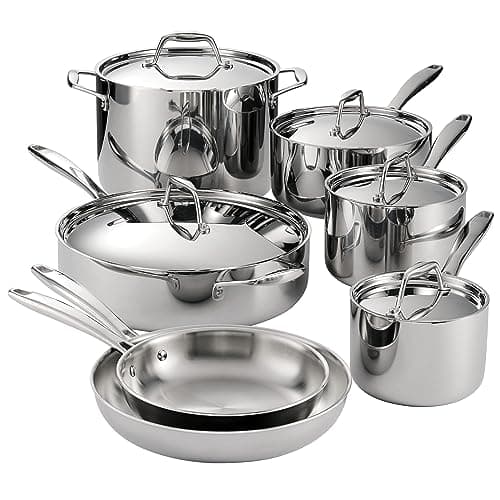
Twelve pieces means seven pans and five lids - the set that proves lids are the storage problem rather than pans.
Prices last checked October 24, 2026. Prices move constantly — the number on Amazon when you click is the real one.
What we can tell you here
Our audited ledger is cookware, so no organizer appears as a product card — we only put a spec table on something whose published specifications we have read. The method is here. This page explains what each organizer solves and points at tagged category searches, with the audited pans above as the items each solution serves.
This is the product-side companion to how to store pots and pans, which covers the habits. Habits are free and fix most of this; buy from this page only after they have not.
Lids are the problem
A twelve-piece cookware set contains seven pans and five lids. The pans nest into one stack. The lids do not nest at all, and a lid sitting on its pan prevents the pans from nesting either — so one lid costs you the whole benefit.
Take the lids out and file them on edge and a set that filled a cupboard becomes one stack of pans plus a lid file. That single change solves more storage problems than any other item on this page, and it is why we put it first.
Solution
What it holds
Where it goes
Adjustable lid rack
Four to eight lids on edge
Base cabinet or a deep drawer
Over-door rack
Lids and small flat items
Inside a cupboard door - free space
Tension rod across a drawer
Lids on edge, cheaply
A deep drawer; costs almost nothing
Wall-mounted lid rail
Lids at hand height
Wall near the hob
All four do the same job. The tension rod is the one that costs nothing, and it works.
Everything else on this page is about convenience. This one prevents permanent damage and costs less than a takeaway.
The base of a pan is metal with a rim. Set that rim on a coated surface, add the weight of the pan above, and slide it half an inch pulling it out of the cupboard — that is a scratch no careful cooking will undo. Every coated pan that dies early has some of this in its history, and since no maker publishes a coating lifespan it is one of very few variables you control — how long nonstick lasts.
Felt or fabric discs between stacked coated pans. The standard answer.
A paper towel or folded cloth does the same job for nothing, if you keep doing it.
The most useful rack format. Sheet pans, cutting boards, cooling racks and lids all stack badly and file perfectly, and a divider turns a dead cupboard into usable storage. If you own two half sheets — which cookware for batch cooking argues you should — this is the rack to buy.
Tiered pull-out shelves
Turn a deep base cabinet into something you can reach the back of. Genuinely good, and they reduce total capacity slightly because the mechanism takes space.
Stacking shelf inserts
A shelf-within-a-shelf. Cheap and effective for small pans, and they wobble under anything heavy.
Pot rails and hanging racks
The highest density per cubic foot and the only storage that protects a coated surface perfectly, because nothing touches it.
One caution on hanging, worth repeating: check what the rail is anchored into. A cast iron skillet and a full enameled Dutch oven together are a serious load, and plasterboard anchors are not the answer.
What each material needs
Material
Storage need
Solution
Clad stainless
None - it nests freely
Just remove the lids
Coated nonstick
Protection from other pans
Felt protectors, a rack, or hang it
Enameled cast iron
Protection from impact; low shelf
Store alone or with cloth, lid ajar
Bare cast iron
Dryness, not protection
Paper towel between pans, lid ajar
Sheet pans and boards
Vertical filing
A divider rack
Lids
Anything but stacking flat
A lid rack or a tension rod
Only two rows describe protection. The rest is filing, and filing is cheap.
In a small kitchen, buy less first
The order of operations matters. Organizers make a given amount of cookware fit better; they do not make an oversized set the right purchase. A seven-useful-piece set stores easily and a fourteen-piece set does not, and no rack closes that gap — cookware for small kitchens and what piece count you need both make that case.
If you are storing pans you have not used in a year, the honest fix is on the disposal side rather than the shelving side — what to do with old cookware.
What to buy, in order
A lid solution. Rack, over-door organizer or a tension rod. Do this first.
Felt protectors, if you own any coated or enameled cookware.
A vertical divider, if you own sheet pans and boards.
A pull-out or a hanging rail, only if the first three have not solved it.
The cookware that defines the storage problem
Organizers are recommended here as categories, via tagged searches, because we have not audited specific models. These are the audited pans each solution is for.
Each write-up below gives the published specs, what the pan is genuinely good at, what it costs you, and who should skip it. The trade-off line is there on the top pick too — a recommendation with no downside is an advertisement.
Top pick · Best cookware organizer test caseSpecs read September 3, 2026
Tramontina Signature Tri-Ply Clad 12-Piece Set
Twelve pieces means seven pans and five lids - the set that proves lids are the storage problem rather than pans.
Best for: A first kitchen that should not need replacing
Published specifications for the Tramontina Signature Tri-Ply Clad 12-Piece Set
Construction
Tri-ply: 18/10 stainless, aluminum core, magnetic stainless exterior
Pieces
8 in and 10 in fry pans; 1.5, 2 and 3 qt covered saucepans; 5 qt covered deep saute; 8 qt covered stockpot
Oven maximum
500F on the 80116-249DS listing; other SKUs in the line are listed at 350F
Induction
Yes - magnetic stainless exterior
Dishwasher
Listed dishwasher safe
Handles
Precision cast, riveted
Certification
NSF-certified on the 80116-249DS line
Country of origin
Not asserted - retail listings disagree across SKUs (Brazil and China both appear)
Good
Fully clad, not disc-bottom: the aluminum runs up the sidewalls, so sauces do not scorch in a ring at the base
NSF certification on the flagship SKU is a real, checkable third-party mark rather than a marketing badge
Induction-ready without paying an induction premium
Not good
Retail listings disagree on the oven maximum across SKUs in the same line, which is a documentation problem, not a cooking one
Handles run hot on gas
The 12-piece count includes lids; the useful-item count is seven
The trade-off. Handles are the weak point. They are riveted and sturdy, but they get hot on a gas ring in a way the more expensive clad brands' do not.
Skip this if. You want a set you can leave in the oven above 500F, or you cook mostly eggs and pancakes and would rather spend the money on one good nonstick pan.
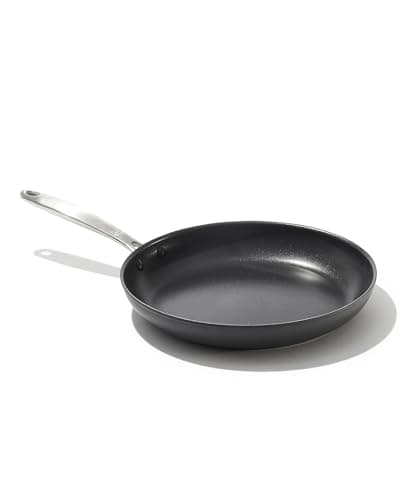
Published specifications for the OXO Good Grips Pro Hard-Anodized Nonstick Fry Pan, 10 in
Body
Hard-anodized aluminum
Coating
Three-layer PTFE nonstick, published PFOA-free
Oven maximum
430F published for the line
Induction
No on the standard hard-anodized line
Dishwasher
Dishwasher safe
Edge
Rolled, for pouring without dripping down the side
Coating lifespan
Not published
Good
The rolled pour edge is a small thing you notice every single time you use it
The hard-anodized body resists the denting that ruins cheap aluminum pans
Handle stays cool and does not rotate the way riveted plastic ones eventually do
Not good
Not induction compatible
Oven ceiling capped by the handle, not the pan
Still a coating, still a consumable, still no published lifespan
The trade-off. The handle that makes it comfortable is a stainless-and-silicone assembly, and that is what caps the oven rating below the body's own limit.
Skip this if. You need induction. The standard hard-anodized body is not ferrous.
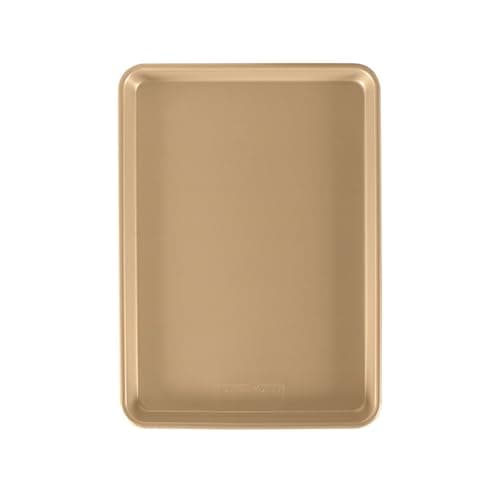
Published specifications for the Nordic Ware Naturals Half Sheet, 18 x 13 in
Exterior dimensions
17.9 x 12.9 x 1 in
Material
Aluminum
Rim
Encapsulated steel rim
Gauge
Not published by Nordic Ware
Warranty
Lifetime
Dishwasher
Hand wash recommended. Automatic dishwasher use is not advised
Made in
America of domestic and imported materials
Good
Aluminum conducts at 237 W/m-K, which is why it browns evenly and a steel pan does not
The encapsulated steel rim is the reason it does not warp in a hot oven
Lifetime warranty on a pan this cheap
Not good
Nordic Ware does not publish a gauge figure, so thickness cannot be compared like for like
Bare aluminum stains and reacts with acid
Not dishwasher safe by the maker's own advice
The trade-off. Bare aluminum discolors and reacts with acid. It will look used within a month and Nordic Ware advises against the dishwasher.
Skip this if. You want a pan that stays looking new, or you will not hand wash. Buy an aluminized-steel coated pan instead and accept the coating as a wear item.
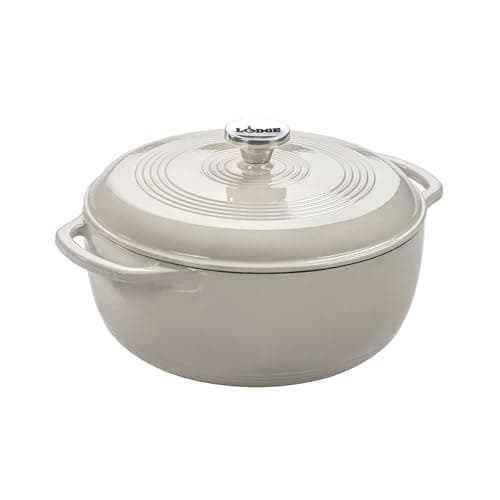
Published specifications for the Lodge Enameled Cast Iron Dutch Oven, 6 qt
Material
Cast iron with porcelain enamel, inside and out
Capacity
6 qt
Induction
Yes - the iron under the enamel is ferrous
Seasoning
None required - enamel is not a seasoning surface
Acid
Safe for tomato and wine, unlike bare iron
Oven maximum
Set by the knob material - check the specific SKU; Lodge publishes a lower ceiling than for bare iron
Good
Non-reactive, so it handles the acidic cooking bare iron cannot
No seasoning to maintain
Considerably cheaper than the French enameled pots it copies
Not good
Chipped enamel is not repairable, unlike bare iron's seasoning
Oven ceiling is lower than bare cast iron because of the knob
Heavy, and the enamel makes it heavier than bare iron of the same capacity
The trade-off. The enamel is a glass layer. Chip it and the pot is not restorable the way bare iron is, and Lodge's enamel chips more readily than the premium brands'.
Skip this if. You already own a large stainless stockpot and rarely braise. This duplicates it for most weeknight cooking.
Store the lids separately on edge, in a rack or on a tension rod. A lid sitting on its pan is what stops a set nesting, so removing them usually turns a full cupboard into one stack of pans plus a lid file.
›Do you need pan protectors?
For anything coated or enameled, yes. A stacked pan's metal rim scratches a coating permanently and chips enamel, and felt discs cost very little. Bare cast iron does not need them - iron does not scratch iron.
›What kind of rack is most useful?
A vertical divider. Sheet pans, cutting boards, cooling racks and lids all stack badly and file perfectly, so a divider turns a dead cupboard into usable storage. It is the format that solves the most problems at once.
›Is hanging pots and pans a good idea?
It is the highest density per cubic foot and the only storage that protects a coated surface perfectly, since nothing touches it. Check what the rail is anchored into first - cast iron and enameled cast iron are a serious load.
›Will organizers fix a small kitchen?
Only partly. Organizers make a given amount of cookware fit better; they do not make an oversized set the right purchase. If you are storing pans you have not used in a year, the fix is disposal rather than shelving.
Sources
Every figure on this page came from one of these. Follow them and check our arithmetic — that is the point.