Heads up: some links on this page earn us a commission at no extra cost to you. It does not change what we recommend or the order. How we are funded.
The short answer
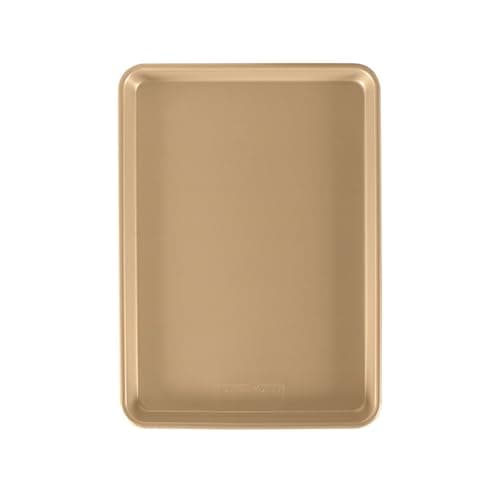
Two half-sheet pans. The single most useful batch cooking purchase. Roasting is limited by surface area, so two pans genuinely double the output.
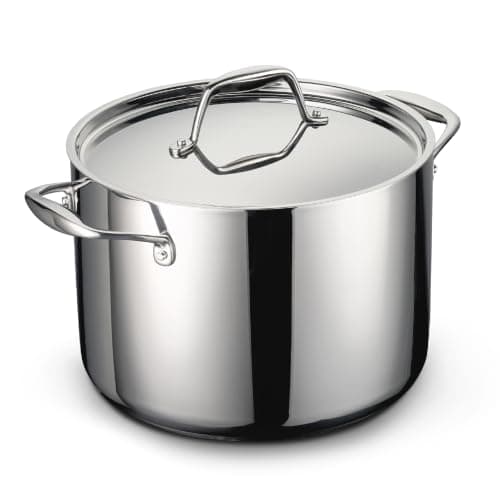
An 8 qt clad stockpot, for anything wet - chili, soup, stock, sauce.
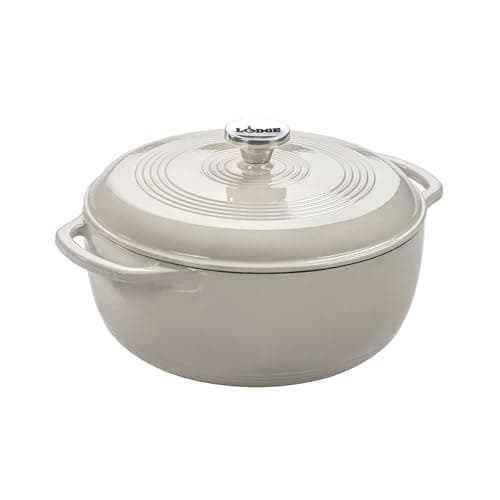
A 6 qt enameled Dutch oven if you braise, because a stockpot browns badly and a Dutch oven does both jobs.
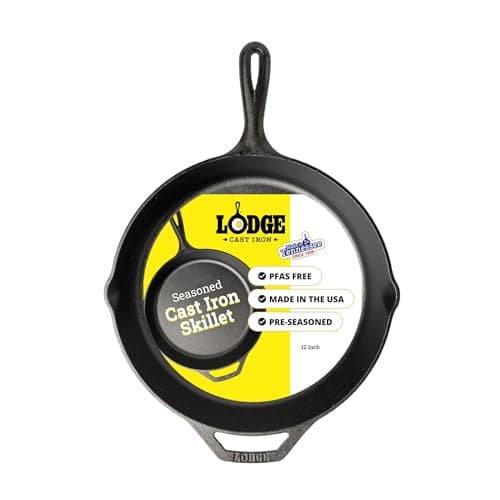
A 12-inch skillet, because a 10-inch one forces you into three batches where twelve inches needs two.
Surface area is the constraint, not volume
The intuitive mistake is to buy a bigger pot. But most of the things that go wrong in batch cooking are browning problems, and browning is limited by how much food touches hot metal - not by how much the vessel holds.
Put four portions of vegetables on one sheet pan and they overlap, release moisture, and steam into something pale and soft. Put them on two sheet pans in a single layer and they roast. The pot got no bigger; the surface area doubled. This is why the cheapest item on this page is also the most important one.
Job
Limited by
What scaling actually needs
Roasting vegetables
Surface area
A second sheet pan, not a deeper tray
Browning meat before a braise
Surface area
A wider pan, or accept two batches
Simmering chili or soup
Volume
A bigger pot genuinely helps
Making stock
Volume
8 qt or more, and a tall narrow shape
Cooking rice or grains
Volume
A 3 to 4 qt saucepan covers a lot of portions
Sheet pan dinners
Surface area
Two pans, rotated halfway
Only two rows in this table are solved by buying something bigger. The rest are solved by buying something wider, or a second one.
Two sheet pans, and why bare aluminum
A half sheet is the standard 18 by 13 inch pan, and two of them fit most domestic ovens on two racks. That is the core of batch cooking: roast two trays at once, swapping racks halfway, and you have most of a week's vegetables and protein.
Buy bare aluminum with an encapsulated steel rim. Aluminum conducts at roughly 237 watts per meter-kelvin, which is what browns bases properly, and the steel rim is what stops a loaded pan buckling in a hot oven - the reasoning is in sheet pan materials. Coated pans are a wear item you do not need here, since parchment does the release work.
Tall, relatively narrow, light for its capacity. Ideal for stock, soup, pasta and anything that never needs browning. Buy clad rather than disc-bottom if you make thick things in it, because a disc bottom scorches chili in a ring at the edge of the aluminum slug - disc bottom versus fully clad explains why.
Dutch oven
Wide, heavy, enameled. It browns a batch of meat properly and then braises it in the same pot, which is the sequence most batch recipes actually follow. It holds less than a stockpot of the same footprint and it is much heavier when full. Sizing is in what size Dutch oven.
If you can only own one, own the Dutch oven if you braise and the stockpot if you make soup and pasta. The stockpot is also the safer choice for anyone who will be lifting a full pot from a low shelf.
Why the 12-inch skillet earns its place
Cooking surface goes up with the square of the diameter, so the step from 10 inches to 12 inches is roughly forty percent more usable area - not twenty. In batch terms that is often the difference between two batches and three, repeated every week.
Remember that rim diameter is not cooking surface on a sloped pan; the arithmetic is in what size cast iron skillet.
What not to buy for this
A deep roasting tin as a substitute for sheet pans. High sides trap steam against the food, which is precisely the problem you are trying to solve - covered in best roasting pans.
A 12 qt stockpot unless you cook for eight. It heats slowly on a domestic ring and lives in a garage the rest of the year.
Coated bakeware for repeated high-volume roasting. It is a wear item doing a job parchment does for less.
A second set of pans. Two sheet pans and one bigger skillet is a far better use of money than duplicating a set.
Cooling and storage, briefly
Batch cooking creates a large volume of hot food that has to cool quickly. Two habits matter: divide it into shallow containers rather than cooling one deep pot, and do not put a hot pan straight onto a cold or wet surface - thermal shock is a real breakage risk for glass and a warping risk for thin metal.
Do not store food in the pan it was cooked in. On bare cast iron and carbon steel it strips seasoning, and on stainless it is the main cause of pitting.
The four-piece batch cooking kit
Buy two of the first one. It is the cheapest item here and the one that changes the most about how a week's cooking goes.
Nordic Ware Naturals Half Sheet, 18 x 13 in
Roasting vegetables, sheet-pan dinners, cookies - the pan you use most weeks
These are the products this page's reasoning actually points at. Same rules as everywhere else on the site: published specs, a stated trade-off, and a live price only where one exists.
Top pick · The batch cooking workhorseSpecs read September 3, 2026
Nordic Ware Naturals Half Sheet, 18 x 13 in
Bare aluminum with a steel rim so it does not warp under a full load, and cheap enough to own two or three.
Best for: Roasting vegetables, sheet-pan dinners, cookies - the pan you use most weeks
Published specifications for the Nordic Ware Naturals Half Sheet, 18 x 13 in
Exterior dimensions
17.9 x 12.9 x 1 in
Material
Aluminum
Rim
Encapsulated steel rim
Gauge
Not published by Nordic Ware
Warranty
Lifetime
Dishwasher
Hand wash recommended. Automatic dishwasher use is not advised
Made in
America of domestic and imported materials
Good
Aluminum conducts at 237 W/m-K, which is why it browns evenly and a steel pan does not
The encapsulated steel rim is the reason it does not warp in a hot oven
Lifetime warranty on a pan this cheap
Not good
Nordic Ware does not publish a gauge figure, so thickness cannot be compared like for like
Bare aluminum stains and reacts with acid
Not dishwasher safe by the maker's own advice
The trade-off. Bare aluminum discolors and reacts with acid. It will look used within a month and Nordic Ware advises against the dishwasher.
Skip this if. You want a pan that stays looking new, or you will not hand wash. Buy an aluminized-steel coated pan instead and accept the coating as a wear item.
Published specifications for the Lodge Enameled Cast Iron Dutch Oven, 6 qt
Material
Cast iron with porcelain enamel, inside and out
Capacity
6 qt
Induction
Yes - the iron under the enamel is ferrous
Seasoning
None required - enamel is not a seasoning surface
Acid
Safe for tomato and wine, unlike bare iron
Oven maximum
Set by the knob material - check the specific SKU; Lodge publishes a lower ceiling than for bare iron
Good
Non-reactive, so it handles the acidic cooking bare iron cannot
No seasoning to maintain
Considerably cheaper than the French enameled pots it copies
Not good
Chipped enamel is not repairable, unlike bare iron's seasoning
Oven ceiling is lower than bare cast iron because of the knob
Heavy, and the enamel makes it heavier than bare iron of the same capacity
The trade-off. The enamel is a glass layer. Chip it and the pot is not restorable the way bare iron is, and Lodge's enamel chips more readily than the premium brands'.
Skip this if. You already own a large stainless stockpot and rarely braise. This duplicates it for most weeknight cooking.
Two half-sheet pans, an 8 qt clad stockpot, a 6 qt enameled Dutch oven if you braise, and a 12-inch skillet. Roasting is limited by surface area rather than volume, which is why a second sheet pan matters more than a bigger pot.
›Why do my roasted vegetables go soggy when I cook a big batch?
They are overlapping. Crowded food releases moisture faster than it can evaporate, so it steams. Spread it across two sheet pans in a single layer and rotate the racks halfway through.
›Is a stockpot or a Dutch oven better for meal prep?
A stockpot for soup, stock and pasta; a Dutch oven if you sear meat before braising it, because a stockpot browns badly. The Dutch oven does both jobs in one pot but holds less and is much heavier when full.
›How much bigger is a 12-inch skillet than a 10-inch?
About forty percent more cooking surface, because area rises with the square of the diameter. In batch terms that is often the difference between two batches and three, every week.
›Should you store cooked food in the pan?
No. On bare cast iron and carbon steel it strips seasoning, and on stainless, salty or acidic food left standing is the main cause of pitting. Divide it into shallow containers, which also cools it faster.
Sources
Every figure on this page came from one of these. Follow them and check our arithmetic — that is the point.