Heads up: some links on this page earn us a commission at no extra cost to you. It does not change what we recommend or the order. How we are funded.
The short answer
For most roasting, use a half-sheet pan: low sides let steam escape, which is what browning requires, and bare aluminum browns bases better than heavy enamelware. Buy a true roasting pan only if you regularly cook a large bird or joint that needs a rack and produces a lot of fat - high walls exist to contain that, not to improve roasting. An enameled Dutch oven covers most of the remaining cases and does far more the rest of the year.
Quick picks
The whole answer, on one screen. Tap a row to jump to the full write-up. Every pick below carries a stated trade-off further down — including the one at the top.
#
Product
Best for
Price
1
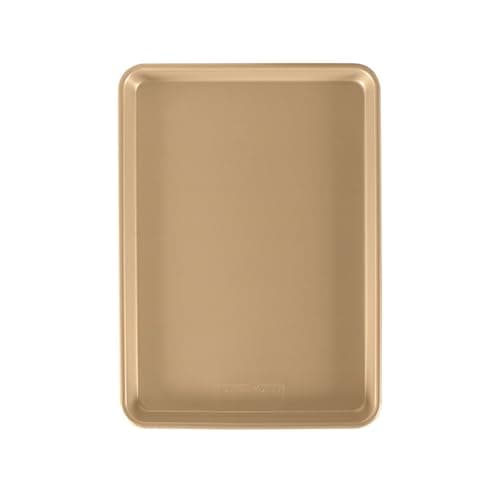
Nordic Ware Naturals Half Sheet, 18 x 13 in
Bare aluminum conducting at 237 W/m-K with an encapsulated steel rim, low sides for steam to escape, and a lifetime warranty.
Prices last checked October 22, 2026. Prices move constantly — the number on Amazon when you click is the real one.
Why high sides work against you
Roasting is dry-heat browning. Food releases moisture, that moisture has to leave, and anything that keeps it near the food converts roasting into steaming.
A roasting pan with three-inch walls does exactly that. Steam pools inside the walls, the vegetables at the edges go soft rather than caramelized, and the underside of whatever you are cooking sits in liquid. A half-sheet pan with a one-inch rim lets the steam off and browns everything.
This is the same surface-area-and-steam argument made in cookware for batch cooking, where two sheet pans beat one deep tray for exactly this reason.
Job
Sheet pan
Roasting pan
Dutch oven
Vegetables
Best - nothing else browns as well
Poor - they steam at the edges
Poor
Chicken thighs, sausages, chops
Best
Workable
Good if you sear first
A whole chicken
Very good
Good, with a rack
Good, covered or uncovered
A large turkey or joint
Not enough capacity
This is what it is for
Usually too small
Anything producing a lot of fat
It can overflow a 1 in rim
Good - the walls contain it
Good
Wet or acidic braises in the oven
No
Only if non-reactive
Best
Pan gravy on the stovetop afterward
No - it will warp on a burner
Yes, if it is stovetop safe
Yes
Only two rows favor a dedicated roasting pan, and both involve size or fat volume rather than roasting quality.
When you genuinely need one
A large bird. A turkey does not fit on a half sheet and produces enough fat to overflow a shallow rim.
A big joint on a rack, where you want air underneath and fat below.
Anything where you will make gravy in the pan afterward, which needs a vessel that can go on a burner - a sheet pan cannot.
Very fatty cuts, where a 1-inch rim is not enough containment.
Note how seasonal that list is. For a lot of households a roasting pan is used twice a year and stored for the other 363 days, which is a real cost in a small kitchen - cookware for small kitchens.
Materials, honestly assessed
Bare aluminum sheet pan
The default recommendation. Aluminum conducts at roughly 237 watts per meter-kelvin, which is why it browns bases properly, and an encapsulated steel rim stops it buckling under a full load. Nothing on it wears out. It is also the cheapest item on this page by a wide margin - the detail is in best sheet pans.
Glass
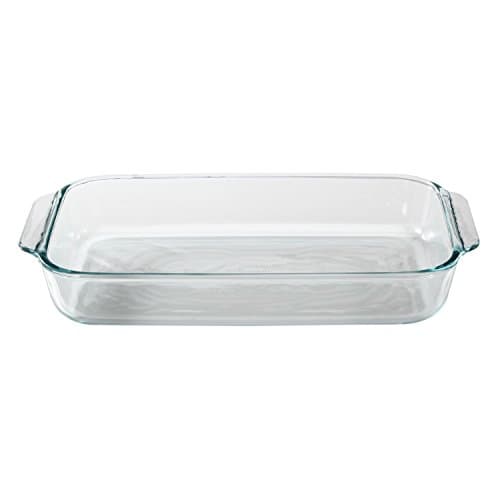
Non-reactive, so it is the right choice for anything with wine, tomato or citrus in the pan. It conducts poorly, so bases brown slowly and pale, and it is not broiler safe. Pyrex publishes a thermal-shock warning that is a genuine breakage mechanism rather than a disclaimer - glass versus metal bakeware.
Enameled cast iron
Excellent at everything except being a roasting pan cheaply. It browns on the stove, roasts in the oven, holds heat superbly and is non-reactive. It is heavy, and a large one is expensive. If you already own a Dutch oven you own most of a roasting pan - what size Dutch oven.
Stainless roasting pans
Sold widely, often disc-bottom or single-ply, and the good ones are clad and expensive. The advantage over glass is stovetop use for gravy; the disadvantage over a sheet pan is the steam trap. We have not audited a specific stainless roasting pan and will not recommend a model we cannot cite specifications for.
Thin, cheap roasting tins are the worst option on this page. They warp under a heavy load, they buckle when fat hits a hot spot, and the handles are usually too small for an oven mitt on a full pan. If you buy a roasting pan, buy a heavy one.
Racks, and whether you need one
A rack lifts food out of its own fat and lets air reach the underside, so skin crisps all round. It matters for a large bird or joint, and it matters much less on a sheet pan where the food is already sitting in a thin layer with steam escaping.
For sheet pan cooking, a flat cooling rack that fits inside the pan does the same job and costs very little. Half-sheet wire racks are the version worth owning, because they double as cooling racks.
The specification nobody checks
Handles. A full roasting pan with a bird in it is heavy, hot and awkward, and the handles are what you have. Look for upright handles large enough for a hand in an oven mitt, not the shallow indentations pressed into cheap tins.
It is the same specification that separates enameled Dutch ovens in practice, and it is almost never published - you judge it from the product photograph, as noted in what size Dutch oven.
Each write-up below gives the published specs, what the pan is genuinely good at, what it costs you, and who should skip it. The trade-off line is there on the top pick too — a recommendation with no downside is an advertisement.
Top pick · Best roasting panSpecs read September 3, 2026
Nordic Ware Naturals Half Sheet, 18 x 13 in
Bare aluminum conducting at 237 W/m-K with an encapsulated steel rim, low sides for steam to escape, and a lifetime warranty.
Best for: Roasting vegetables, sheet-pan dinners, cookies - the pan you use most weeks
Published specifications for the Nordic Ware Naturals Half Sheet, 18 x 13 in
Exterior dimensions
17.9 x 12.9 x 1 in
Material
Aluminum
Rim
Encapsulated steel rim
Gauge
Not published by Nordic Ware
Warranty
Lifetime
Dishwasher
Hand wash recommended. Automatic dishwasher use is not advised
Made in
America of domestic and imported materials
Good
Aluminum conducts at 237 W/m-K, which is why it browns evenly and a steel pan does not
The encapsulated steel rim is the reason it does not warp in a hot oven
Lifetime warranty on a pan this cheap
Not good
Nordic Ware does not publish a gauge figure, so thickness cannot be compared like for like
Bare aluminum stains and reacts with acid
Not dishwasher safe by the maker's own advice
The trade-off. Bare aluminum discolors and reacts with acid. It will look used within a month and Nordic Ware advises against the dishwasher.
Skip this if. You want a pan that stays looking new, or you will not hand wash. Buy an aluminized-steel coated pan instead and accept the coating as a wear item.
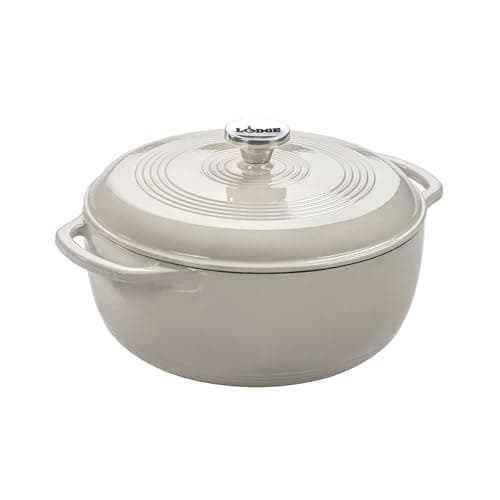
Published specifications for the Lodge Enameled Cast Iron Dutch Oven, 6 qt
Material
Cast iron with porcelain enamel, inside and out
Capacity
6 qt
Induction
Yes - the iron under the enamel is ferrous
Seasoning
None required - enamel is not a seasoning surface
Acid
Safe for tomato and wine, unlike bare iron
Oven maximum
Set by the knob material - check the specific SKU; Lodge publishes a lower ceiling than for bare iron
Good
Non-reactive, so it handles the acidic cooking bare iron cannot
No seasoning to maintain
Considerably cheaper than the French enameled pots it copies
Not good
Chipped enamel is not repairable, unlike bare iron's seasoning
Oven ceiling is lower than bare cast iron because of the knob
Heavy, and the enamel makes it heavier than bare iron of the same capacity
The trade-off. The enamel is a glass layer. Chip it and the pot is not restorable the way bare iron is, and Lodge's enamel chips more readily than the premium brands'.
Skip this if. You already own a large stainless stockpot and rarely braise. This duplicates it for most weeknight cooking.
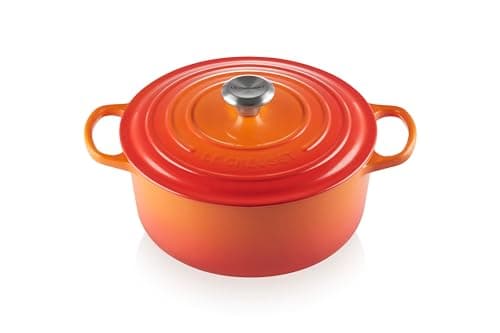
Published specifications for the Le Creuset Signature Round Dutch Oven, 5.5 qt
Material
Cast iron with porcelain enamel inside and out
Capacity
5.5 qt
Interior enamel
Sand-colored, so browning and fond stay visible
Knob
Stainless steel, rated to 500F
Induction
Yes - the iron under the enamel is ferrous
Dishwasher
Dishwasher safe; Le Creuset recommends hand washing
Warranty
Limited lifetime
Made in
France
Good
The pale interior is a genuine cooking advantage: you can see whether the fond is browning or burning
Wide, low-profile handles that a hand in an oven mitt actually fits
The one enameled pot with a real secondhand market, which changes the true cost of ownership
Not good
Costs several times a Lodge enameled pot of the same capacity
The pale interior stains permanently, and Le Creuset says so
Chipped enamel is not repairable on any enameled pot, this one included
The trade-off. You are paying a large multiple of what a Lodge enameled pot costs for a difference in enamel quality, finish and resale value rather than in cooking.
Skip this if. You braise a few times a year. The cooking difference over a Lodge enameled pot is small; the price difference is not.
Only for large birds and joints, or anything producing enough fat to overflow a shallow rim. For everything else a half-sheet pan roasts better, because low sides let steam escape and high sides trap it against the food.
›Is a sheet pan better than a roasting pan?
For vegetables, chicken pieces, sausages and anything that fits, yes. Browning needs moisture to leave, and a 1-inch rim lets it go where 3-inch walls hold it in. A roasting pan wins on capacity and fat containment, not on roasting quality.
›Can you use a glass dish as a roasting pan?
For wet or acidic dishes, yes - glass is non-reactive and goes oven to table. It conducts poorly, so bases brown slowly and pale, and it is not broiler safe. Pyrex also publishes a thermal-shock warning that is a real breakage risk.
›Do you need a rack in a roasting pan?
For a large bird or joint, yes - it lifts food out of its fat so the underside crisps. On a sheet pan it matters much less, since the food already sits in a thin layer with steam escaping. A flat wire rack that fits the pan does both jobs.
›Can a Dutch oven replace a roasting pan?
For most of the year, yes. It browns on the stove, roasts covered or uncovered, holds heat superbly and is non-reactive. It is usually too small for a turkey and it is much heavier when full.
Sources
Every figure on this page came from one of these. Follow them and check our arithmetic — that is the point.