A pressure cooker raises the boiling point so food cooks faster. A Dutch oven lets water leave so flavor concentrates. Those are opposite mechanisms, and they make different food.
Heads up: some links on this page earn us a commission at no extra cost to you. It does not change what we recommend or the order. How we are funded.
The short answer
Buy the Dutch oven first. It browns properly, reduces sauces as it cooks, bakes bread, goes in the oven and onto the table, and has nothing on it that can fail. A pressure cooker is a specialist that compresses time - it turns dried beans, tough cuts and stock from an afternoon into under an hour - by sealing steam above atmospheric pressure so water boils hotter than 212F. It cannot brown while sealed and it cannot reduce, so pressure-cooked braises need finishing. Most people who cook a lot eventually own both.
What we can tell you here
Our audited ledger contains Dutch ovens rather than a separately audited pressure cooker, so this page recommends the audited pots and points at a tagged category search for pressure cookers themselves. Every specification quoted below for a Dutch oven comes from the maker; the pressure figures are the physics of saturated steam rather than any particular product's claim. The method is here.
Two opposite mechanisms
The pressure cooker raises the boiling point
Water boils at 212F at sea level and cannot get hotter while it stays liquid - extra heat just turns more of it into steam. Seal the vessel and that steam has nowhere to go, so pressure rises, and under pressure water boils at a higher temperature. At the roughly 15 psi most cookers are built around, the contents sit near 250F.
That extra 35 or 40 degrees is the whole product. Reaction rates climb steeply with temperature, so collagen in tough cuts converts to gelatin in a fraction of the usual time, and dried beans hydrate and soften without an overnight soak.
The Dutch oven lets water leave
An open or loosely lidded pot does the opposite. Liquid evaporates, which concentrates everything dissolved in it, and the exposed surface lets food brown. Thick cast iron walls hold a steady temperature so a braise sits at a gentle simmer for hours without scorching - is a Dutch oven worth it covers the material case.
This is the same distinction as Dutch oven versus slow cooker, pushed to the other extreme. A slow cooker is sealed and cool; a pressure cooker is sealed and hot. Both trap moisture, so both produce thinner sauces than an open pot.
Same ingredients, different food
Put identical beef, stock, wine and vegetables in each and you get two different dishes.
Dutch oven
Pressure cooker
Time for a beef braise
2.5 to 3 hours
Around 35 to 45 minutes at pressure
Browning
Excellent - mass plus an open surface
None while sealed; sear before or after
Sauce consistency
Reduces and thickens as it cooks
No evaporation - thin, needs reducing after
Flavor development
Long, layered, Maillard-driven
Clean and direct; less depth
Texture of tough cuts
Yielding, still sliceable
Very soft, can go stringy if overrun
Vegetables added at the start
Hold shape reasonably
Usually collapse
Control mid-cook
Taste and adjust any time
Sealed - you cannot look or taste
Energy and kitchen heat
Hours of oven or burner
Much less, and a cooler kitchen
Neither column is better. They are answers to different questions about the same evening.
What the pressure cooker genuinely wins
Dried beans and pulses, from dry. No overnight soak and no three-hour simmer. This is the single strongest case and it is not close.
Stock. A rich chicken stock in about an hour rather than four to six, and it stays clearer because it never reaches a rolling boil in open air.
Tough cuts on a weeknight. Shanks, cheeks, shoulder and oxtail become a Tuesday option rather than a Sunday project.
Grains and pulses in bulk, which makes it a genuinely useful batch cooking tool - cookware for batch cooking.
Summer cooking. Twenty minutes sealed beats three hours of a 325F oven heating the house.
Energy. Less total input for the same result, which matters if you braise often.
What the Dutch oven wins
Bread. There is no pressure cooker equivalent, at all. The lid traps the loaf's own steam while the preheated mass drives oven spring - baking bread in a Dutch oven.
Browning. Thermal mass means a cold piece of meat barely drops the surface temperature, so a crust forms instead of the meat stewing. Most pressure cooker recipes open by telling you to brown first, which is a tacit admission.
Reduction. Sauces concentrate while the dish cooks rather than needing a separate step afterward.
Deep frying. Thermal mass keeps oil temperature stable when cold food goes in - cookware for deep frying.
Serving. It goes to the table and keeps food hot through a meal.
Nothing to fail. No gasket, no valve, no electronics. An enameled pot outlives the person who bought it - buy-it-for-life cookware.
The clearest dividing line on this page. A pressure cooker cannot approach this, and no accessory changes that.
Stovetop pressure cooker or electric multicooker?
Worth separating, because they are different products that get discussed as one.
Stovetop pressure cooker
Electric multicooker
Working pressure
Higher - typically around 15 psi
Usually lower, around 10 to 12 psi
Time to pressure
Faster
Slower - the element is modest
Browning before pressure
Good - a real burner underneath
Weak; many people brown in a separate pan
Set and forget
No - you regulate the heat
Yes, with timers and keep-warm
Lifespan
Decades; gaskets are consumables
Limited by electronics
Also does
Nothing else
Slow cooking, rice, yogurt, sometimes air frying
Cleaning
Simple pot
Inner pot plus lid assembly and seal
If you want the pressure cooker for speed and results, stovetop does it better and lasts far longer. If you want one countertop appliance that replaces several, the electric version is the reasonable choice and the browning compromise is the price.
Safety, and one thing people get wrong
Modern pressure cookers are safe. The folklore comes from mid-century designs; current ones carry lid interlocks that prevent opening under pressure, plus primary and backup release valves. The real maintenance is unglamorous: keep the vent clear, inspect and replace the rubber gasket periodically, and do not fill past the marked maximum.
A pressure cooker is not a pressure canner. Home canning of low-acid foods requires a tested pressure canner that can hold a verified pressure with a gauge, and USDA-backed guidance is explicit that ordinary pressure cookers should not be substituted. If you want to can, buy a canner - the two are not interchangeable.
A 5 to 6 quart Dutch oven and a 6 quart pressure cooker cover a household of four with room for batch cooking. Do not buy both large - a big Dutch oven is heavy and a big pressure cooker takes longer to come to pressure, which erodes the reason you bought it.
The Dutch oven, for almost everyone. It does more distinct kinds of cooking, several of which have no substitute, and it is the piece a kitchen keeps for decades. A pressure cooker is the better second purchase than a third skillet.
Buy the pressure cooker first only if your binding constraint is weeknight time and you already own a large heavy pot to brown in. If you cook dried beans weekly, it pays for itself in patience alone.
Budget is tight and a pressure cooker is also on the list:a 5 qt enameled pot, then add the cooker.
Owning both, which is where most cooks end up
They divide cleanly. The pressure cooker takes beans, stock and any weeknight where a tough cut has to be dinner in an hour. The Dutch oven takes weekends, bread, anything going to the table, and anything where the sauce is the point.
A useful hybrid: brown in the Dutch oven, transfer to the pressure cooker for the long part, then reduce the sauce back in the Dutch oven. It uses two pots and it produces better food than either alone. Best enameled Dutch ovens covers choosing the pot, and Dutch oven versus braiser covers the other shape decision in this corner of the kitchen.
The audited pots behind this page
Pressure cookers themselves are recommended as a category via a tagged search, because our ledger has no separately audited example. Check the knob rating on any pot you intend to bake bread in.
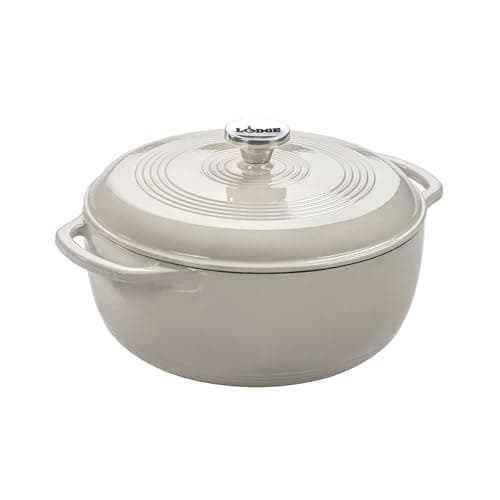
Lodge Enameled Cast Iron Dutch Oven, 6 qt
Braises, stews, tomato sauce, bread - anything long and wet
These are the products this page's reasoning actually points at. Same rules as everywhere else on the site: published specs, a stated trade-off, and a live price only where one exists.
Top pick · Best value Dutch ovenSpecs read September 3, 2026
Lodge Enameled Cast Iron Dutch Oven, 6 qt
Six quarts of enameled cast iron at a price that makes owning both vessels realistic rather than theoretical.
Best for: Braises, stews, tomato sauce, bread - anything long and wet
Published specifications for the Lodge Enameled Cast Iron Dutch Oven, 6 qt
Material
Cast iron with porcelain enamel, inside and out
Capacity
6 qt
Induction
Yes - the iron under the enamel is ferrous
Seasoning
None required - enamel is not a seasoning surface
Acid
Safe for tomato and wine, unlike bare iron
Oven maximum
Set by the knob material - check the specific SKU; Lodge publishes a lower ceiling than for bare iron
Good
Non-reactive, so it handles the acidic cooking bare iron cannot
No seasoning to maintain
Considerably cheaper than the French enameled pots it copies
Not good
Chipped enamel is not repairable, unlike bare iron's seasoning
Oven ceiling is lower than bare cast iron because of the knob
Heavy, and the enamel makes it heavier than bare iron of the same capacity
The trade-off. The enamel is a glass layer. Chip it and the pot is not restorable the way bare iron is, and Lodge's enamel chips more readily than the premium brands'.
Skip this if. You already own a large stainless stockpot and rarely braise. This duplicates it for most weeknight cooking.
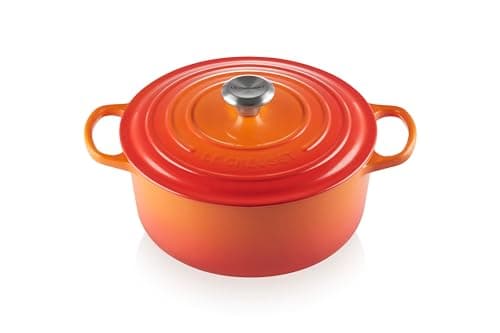
Published specifications for the Le Creuset Signature Round Dutch Oven, 5.5 qt
Material
Cast iron with porcelain enamel inside and out
Capacity
5.5 qt
Interior enamel
Sand-colored, so browning and fond stay visible
Knob
Stainless steel, rated to 500F
Induction
Yes - the iron under the enamel is ferrous
Dishwasher
Dishwasher safe; Le Creuset recommends hand washing
Warranty
Limited lifetime
Made in
France
Good
The pale interior is a genuine cooking advantage: you can see whether the fond is browning or burning
Wide, low-profile handles that a hand in an oven mitt actually fits
The one enameled pot with a real secondhand market, which changes the true cost of ownership
Not good
Costs several times a Lodge enameled pot of the same capacity
The pale interior stains permanently, and Le Creuset says so
Chipped enamel is not repairable on any enameled pot, this one included
The trade-off. You are paying a large multiple of what a Lodge enameled pot costs for a difference in enamel quality, finish and resale value rather than in cooking.
Skip this if. You braise a few times a year. The cooking difference over a Lodge enameled pot is small; the price difference is not.
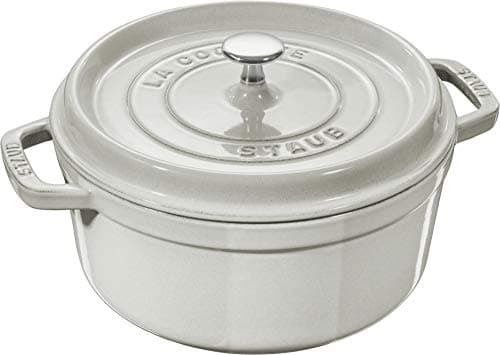
Published specifications for the Staub Round Cocotte, 5.5 qt
Material
Cast iron with enamel inside and out
Capacity
5.5 qt
Interior enamel
Black matte and textured - does not show staining
Lid
Self-basting spikes on the underside
Knob
Metal; the oven rating is set by the knob, so check the specific SKU
Induction
Yes
Warranty
Limited lifetime
Made in
France
Good
Black matte interior is the practical answer to the staining complaint about pale enamel
Heavier lid than most, which matters more than the spikes do on a long braise
Textured interior takes a hard sear better than a glossy enamel does
Not good
You cannot see the fond, which is a real loss on anything you are building a sauce from
Heavy even by enameled cast iron standards
Priced with Le Creuset, so the same skip-if applies
The trade-off. The black matte interior hides fond as well as it hides stains, so you judge browning by smell and by lifting the food rather than by looking.
Skip this if. You want to watch the fond develop. Buy the sand-colored interior instead and accept that it will discolor.
They do different things. A Dutch oven browns, reduces sauces, bakes bread and goes to the table; a pressure cooker compresses hours into under an hour by sealing steam so water boils near 250F. For a first purchase the Dutch oven does more, and several of its jobs have no substitute.
›Can you use a Dutch oven instead of a pressure cooker?
For the same dishes, yes, with far more time - a braise that takes 35 to 45 minutes under pressure takes two and a half to three hours in a Dutch oven. What you cannot do is replicate the speed, and dried beans from dry are the clearest example.
›Why does pressure cooker stew taste flat?
Usually because the meat was not browned first and because nothing evaporated. A sealed cooker develops no Maillard flavor while it is under pressure and loses no liquid, so the sauce stays thin. Brown properly before sealing, and reduce the sauce uncovered afterward.
›Can you bake bread in a pressure cooker?
No. Bread needs dry radiant heat and a preheated mass to drive oven spring, and a trapped-steam environment that then vents. A pressure cooker provides none of that, which is the one job on this page where the Dutch oven has no competition at all.
›Is a stovetop pressure cooker better than an electric one?
For results and lifespan, yes - stovetop models typically run near 15 psi against roughly 10 to 12 for electric, reach pressure faster, and brown better because a real burner sits underneath. An electric multicooker wins on set-and-forget convenience and on replacing several appliances at once.
›Can you use a pressure cooker for canning?
Not for low-acid foods. Home canning requires a tested pressure canner able to hold a verified pressure, and USDA-backed guidance is explicit that ordinary pressure cookers are not a substitute. The two are different pieces of equipment despite the similar name.
Sources
Every figure on this page came from one of these. Follow them and check our arithmetic — that is the point.