Heads up: some links on this page earn us a commission at no extra cost to you. It does not change what we recommend or the order. How we are funded.
The short answer
Buy by weight first. An empty pan is half the problem; food is the other half.
Insist on a helper handle on anything over ten inches or four quarts.
Go one size down. A ten-inch skillet does most of what a twelve does, at two-thirds the loaded weight.
Choose thick, soft, oval grips over thin round stainless.
Avoid cast iron for daily pans, and keep it for things that live in the oven.
The weight problem, with real numbers
Cookware is usually sold on how it cooks. If your hands hurt, it is sold on what it weighs, and the published weights are rarely the whole story because they describe an empty pan. Food, oil and liquid frequently double it.
Pan
Roughly empty
Roughly loaded
Grip verdict
8 inch coated aluminum skillet
Around 1.5 lb
Around 2.5 lb
Comfortable one-handed for most
10 inch coated aluminum skillet
Around 2 lb
Around 3.5 lb
The practical daily maximum
10 inch clad stainless skillet
Around 3 lb
Around 4.5 lb
Manageable, two hands to move
12 inch clad stainless skillet
Around 4 lb
Around 7 lb
Two hands, and a helper handle required
10 inch cast iron skillet
Around 5.5 lb
Around 8 lb
Hard one-handed, and it stays hot
12 inch cast iron skillet
Around 8 lb
Around 12 lb
Not a daily pan for painful hands
5 to 6 qt enameled Dutch oven
Around 11 lb
Around 18 lb
Two hands, two loop handles, short carries only
Weights are approximate and vary by line. The pattern does not: material and diameter dominate everything else.
The single most effective change is dropping one size. A ten-inch skillet cooks for two comfortably and weighs roughly two-thirds of a twelve. Most people own the twelve because a set came with it, not because they need the area - what size skillet makes the case in full.
Leverage matters as much as mass
A pan on a stove is a lever, and your wrist is the pivot. The weight acts at the pan, six to ten inches out from your hand, so a long handle multiplies the strain even though it keeps your hand cooler. That is the trade nobody mentions in the accessibility context: the stay-cool handle design that protects your skin makes the load on your wrist worse.
A helper handle changes the geometry entirely. Two points of support turn a lever into a carry, and it is the single most useful feature on this page. Demand it above ten inches or four quarts - cookware handles explained.
Two loop handles are better still, which is why Dutch ovens are usable at weights no long-handled pan could manage.
Slide, do not lift. A smooth glass or ceramic cooktop lets you move a heavy pan without taking its weight at all.
Never carry a full pan to the sink. Ladle the contents out first. This is where most kitchen burns and drops happen.
What a good handle feels like
Grip strength problems are made worse by handles that are thin, round, hard and slippery. They are helped by handles that are thick, oval, slightly soft and textured, because a larger contact area needs less pinch force to hold securely. This is the principle OXO built a company on, and it transfers directly to cookware.
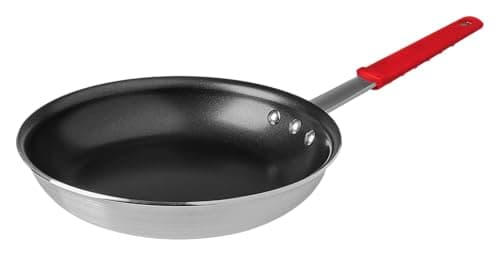
Silicone sleeves are the cheapest upgrade available. A commercial pan with a removable silicone grip gives you a thick, warm, non-slip surface, and the sleeve comes off when the pan goes in the oven. Where a pan you already own has a thin stainless handle, a slip-on silicone handle cover costs very little and fixes most of the problem without replacing anything.
If you can only change one thing, change the handle covering rather than the pan. It is cheaper, it is immediate, and grip security prevents drops better than weight reduction does.
Material, ranked for hands rather than for cooking
Coated aluminum: the clear winner
Light, and it needs no scrubbing. Both halves matter, because washing a pan is a grip task too and scouring a stuck-on stainless base is harder on hands than lifting it was. The cost is the coating's replacement cycle - how long nonstick lasts.
Clad stainless: good up to a size
Heavier than aluminum but far lighter than iron, and it lasts indefinitely. Keep to eight and ten inch skillets and two to three quart saucepans, and it is entirely workable. A twelve-inch clad skillet full of food is genuinely heavy.
Cast iron: keep it, but change its job
There is no light cast iron, and the material is not the point here - it is that a cast iron pan is heavy while empty, stays dangerously hot long after the stove is off, and has a handle that is exactly as hot as the pan. The workaround is to stop treating it as a stovetop pan. Cornbread, roasted vegetables and anything that goes in cold and comes out on a trivet works fine. An eight-inch skillet is the version most people can still use daily - is cast iron worth it is the honest assessment.
Enameled cast iron: the heaviest thing in the kitchen
A loaded five-quart Dutch oven can reach around eighteen pounds. If you want one, buy smaller than the advice usually suggests - a three to four quart pot does most weeknight cooking and is a fundamentally different object to carry.
Thin, round and hard is the worst combination for a painful grip. Thick, oval and slightly soft needs less pinch force for the same security.
The things that are not pans
Several of the hardest moments in cooking are not lifting the pan at all.
Draining pasta. Lifting a full stockpot to a colander is the single heaviest thing most home cooks do. A pasta insert lets you lift the food out and leave the water behind, or use a spider to scoop - pasta pots and steamer inserts.
Stiff lids. Glass lids with small knobs are hard to grip. A lid with a wide loop or a large flat knob is better, and silicone-topped knobs are better again.
Opening jars and packets. Not cookware, but it determines whether you cook at all. Kitchen shears do more of this than people expect - best kitchen shears.
Scrubbing. Choose surfaces that release food, and deglaze stainless while it is still warm so you never need pressure - cleaning burnt stainless.
Getting pans out of a low cupboard. Move daily pans to waist height. This is free and it removes a bend and a lift from every meal - how to store pots and pans.
A workable set
Four pieces cover almost everything, chosen for weight rather than for prestige:
A rimmed half sheet pan, which carries with two hands on the rim and moves most cooking into the oven where nothing needs holding.
Sheet-pan cooking deserves the emphasis. It removes lifting, stirring and pan-watching from a meal almost entirely - best sheet pans, and cookware for batch cooking for cooking once and eating several times, which is its own kind of relief.
Light pans with grippable handles
Chosen for weight and handle design rather than for cooking performance, which is the correct order for this page.
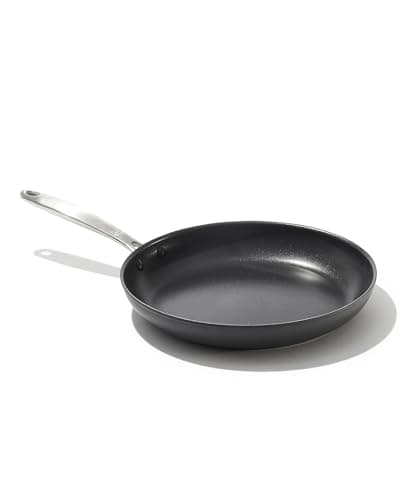
OXO Good Grips Pro Hard-Anodized Nonstick Fry Pan, 10 in
Someone who cooks daily and cares how a pan feels in the hand
These are the products this page's reasoning actually points at. Same rules as everywhere else on the site: published specs, a stated trade-off, and a live price only where one exists.
Top pick · Best grip designSpecs read September 3, 2026
OXO Good Grips Pro Hard-Anodized Nonstick Fry Pan, 10 in
OXO built its business on handles for hands that hurt, and the cookware carries the same thinking - a thick, soft, non-slip grip on a light aluminum pan.
Best for: Someone who cooks daily and cares how a pan feels in the hand
Published specifications for the OXO Good Grips Pro Hard-Anodized Nonstick Fry Pan, 10 in
Body
Hard-anodized aluminum
Coating
Three-layer PTFE nonstick, published PFOA-free
Oven maximum
430F published for the line
Induction
No on the standard hard-anodized line
Dishwasher
Dishwasher safe
Edge
Rolled, for pouring without dripping down the side
Coating lifespan
Not published
Good
The rolled pour edge is a small thing you notice every single time you use it
The hard-anodized body resists the denting that ruins cheap aluminum pans
Handle stays cool and does not rotate the way riveted plastic ones eventually do
Not good
Not induction compatible
Oven ceiling capped by the handle, not the pan
Still a coating, still a consumable, still no published lifespan
The trade-off. The handle that makes it comfortable is a stainless-and-silicone assembly, and that is what caps the oven rating below the body's own limit.
Skip this if. You need induction. The standard hard-anodized body is not ferrous.
Published specifications for the Tramontina Professional Restaurant Fry Pan, 10 in
Body
Heavy-gauge aluminum
Coating
PTFE nonstick
Induction
No - aluminum body is not ferrous
Coating lifespan
Not published, by this or any nonstick maker
Good
Cheap enough that replacing it every couple of years is a real plan rather than a failure
Heavy gauge for a nonstick pan, so it does not warp on the first hot burner
Silicone handle sleeve that actually stays cool
Not good
Not induction compatible
PTFE, which some buyers will rule out on principle
No published coating lifespan, so the value case is unverifiable by design
The trade-off. It is PTFE. That is fine at normal cooking temperatures, and it is not a pan to preheat empty on high.
Skip this if. You want to avoid PTFE entirely. Buy ceramic instead and accept the shorter release life rather than pretending either one lasts forever.
Light coated aluminum pans in eight and ten inch sizes, with thick, soft, non-slip handles and a helper handle on anything larger. Weight and grip security matter more than cooking performance, and dropping one pan size does more than any other single change.
›Is cast iron bad for arthritis?
As a daily stovetop pan, it is a poor choice - a twelve inch skillet weighs around eight pounds empty and the handle gets as hot as the pan. It still works well for oven cooking where it goes in cold and comes out onto a trivet, and an eight inch skillet remains usable for many people.
›What is the lightest cookware you can buy?
Coated aluminum, by a wide margin. A ten inch coated aluminum skillet is around two pounds against roughly three for clad stainless and five and a half for cast iron. Commercial aluminum lines with silicone handle sleeves combine the low weight with a grippable handle.
›How do you lift a heavy pot with weak hands?
Avoid lifting it at all. Slide it across a smooth cooktop, ladle the contents out before moving the pot, and use a pasta insert so you lift the food rather than the water. Where you must carry, use both hands on two loop handles rather than one long handle.
›Do silicone handle covers help?
Considerably, and they are the cheapest improvement available. A thicker, softer, textured surface needs less pinch force to hold securely, which reduces both strain and the chance of a drop. They also work on pans you already own.
Sources
Every figure on this page came from one of these. Follow them and check our arithmetic — that is the point.