Heads up: some links on this page earn us a commission at no extra cost to you. It does not change what we recommend or the order. How we are funded.
The short answer
Household or job
Size
Note
One or two people, minimum
6 qt
Enough for a pound of pasta, and little headroom
Most households, one pot
8 qt
The default. Pasta, stock, soup, blanching, corn
Family of four or more
10 to 12 qt
Batch cooking and whole chickens fit
Stock from a carcass
12 qt and up
Bones plus water plus vegetables needs volume
Canning, brewing, crab boils
16 to 20 qt
Check it fits your burner and under your hood
Soup for two, most nights
4 to 5 qt saucepan
You do not want a stockpot for this
Why people buy the wrong size
A stockpot gets bought for its name and used for something else. People size it by imagining making stock two or three times a year, then discover the pot's actual job is boiling pasta every week, blanching vegetables, cooking corn, making chili in quantity and occasionally holding a large soup.
Pasta is the deciding use for most households, and pasta needs more water than people expect - a pound of dried pasta wants roughly four quarts of water at a rolling boil, plus headroom so it does not foam over. That alone rules out anything under six quarts and makes eight the comfortable answer.
The cost of buying too big is storage and a slightly longer boil. The cost of buying too small is a pot that boils over, cannot hold a chicken, and gets replaced. Err large.
Sizing by what you actually do
Pasta and blanching — 8 qt
Four quarts of water for a pound of pasta, plus room for the boil. Eight quarts gives that with headroom and is the single most common real use of a stockpot - pasta pots and steamer inserts covers the insert that turns a stockpot into a pasta pot.
Soup and chili — 6 to 8 qt
A pot of soup for four to six people is around six quarts of finished volume, which needs eight quarts of pot. If your soup habit is two portions on a weeknight, a 3 to 4 quart saucepan is the better vessel and a stockpot is overkill - what size saucepan.
Stock — 12 qt and up
Real stock from a carcass or from bones needs the bones covered by several inches of water plus aromatics, and the yield after reduction is much less than the volume you started with. Twelve quarts is a sensible minimum if this is a regular activity. Eight will do a single chicken carcass at a push.
Large-format cooking — 16 qt and up
Canning, brewing, seafood boils and cooking for a crowd. Two practical checks before buying: whether the base fits your largest burner, and whether the filled pot is liftable. A 20 quart pot of water weighs more than most people want to move - cookware for arthritis and limited grip.
Shape matters as much as volume
Two pots of the same capacity can behave very differently depending on proportions.
Proportion
Good for
Poor for
Tall and narrow
Stock - less surface area, so less evaporation over hours
Reducing, and anything you need to stir
Wide and low
Soup, chili, reducing, browning first
Long stock simmers
Very wide base
Fits the burner properly, browns better
Storage, and evaporates faster
Narrow base, tall walls
Storage, boils fast
Scorches if the base is thin
For a single general-purpose pot, moderately wide is the better bet, because you can brown onions in the bottom before adding liquid and you can actually stir it. A dedicated stock pot is the one case for tall and narrow - Dutch oven versus stock pot.
How much construction does a stockpot need?
Less than any other pot, which is why this is the piece to save money on.
Most of what a stockpot does happens in liquid, and nothing sticks in liquid. You are boiling and simmering rather than searing, so the even heat distribution you pay for in a skillet earns much less here. A disc-bottom stockpot is genuinely fine, and this is the one shape where that is true - disc bottom versus fully clad.
What does matter:
A thick base, so thick soups and chili do not scorch on the bottom.
Two loop handles, because a full stockpot is a two-handed object and no long handle could carry it - cookware handles explained.
A lid that fits properly, which speeds every boil and matters more here than on any other pot.
Volume markings inside, a small feature that is genuinely useful.
Save the money here and spend it on the skillet, where cladding changes the result - are expensive pans worth it.
The pot people buy for stock ends up boiling pasta every week. Size it for the weekly job, not the annual one.
Do you already own one?
Before buying, check what the pieces you have cover, because the overlap is real.
A 5 to 7 qt Dutch oven does much of what a small stockpot does, and braises and bakes bread as well - what size Dutch oven. It is heavy and it is usually enameled, so it is not ideal for a long stock simmer, but it is not nothing.
A 4 qt saucepan covers most weeknight soup and grain cooking.
A cookware set probably already includes a stockpot, often 8 qt - count the pieces before buying a duplicate - what piece count you need.
If you own a Dutch oven and a 3 quart saucepan, the gap a stockpot fills is specifically large volumes of boiling water. That is a real gap, and 8 quarts fills it.
Inserts, which change what a pot can do
A stockpot plus the right insert replaces several specialist pieces. A pasta insert lets you lift food out and leave the water, which removes the heaviest and most hazardous moment in home cooking. A steamer basket turns it into a vegetable steamer, and a tall version handles corn and crab.
These are the products this page's reasoning actually points at. Same rules as everywhere else on the site: published specs, a stated trade-off, and a live price only where one exists.
Top pick · The right default sizeSpecs read September 3, 2026
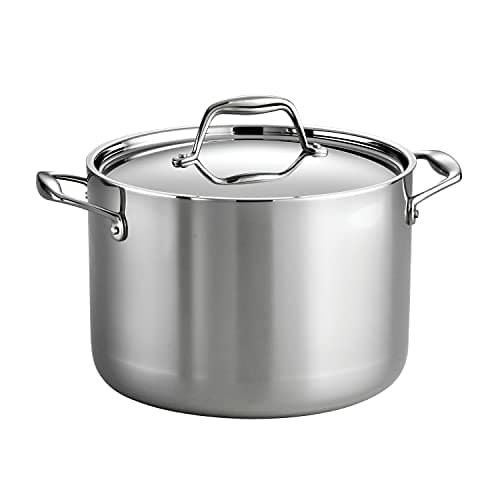
Tramontina Tri-Ply Clad Covered Stock Pot, 8 qt
Eight quarts of fully clad stainless - the capacity that covers pasta, stock and soup without becoming awkward to lift or store.
Best for: Stock, chili, pasta for a family, and batch cooking on a Sunday
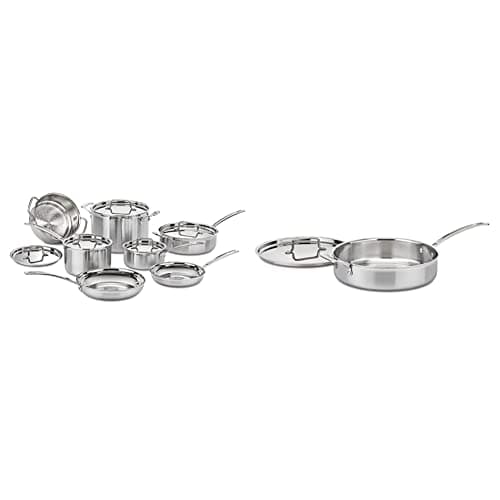
Published specifications for the Cuisinart MultiClad Pro MCP-12N 12-Piece Set
Construction
Tri-ply: 18/10 stainless interior, pure aluminum core, brushed stainless exterior
Pieces
1.5 and 3 qt covered saucepans; 8 in and 10 in skillets; 3.5 qt covered saute; 8 qt covered stockpot; steamer insert
Oven maximum
500F per the Cuisinart use-and-care manual. Amazon listings say 550F; Cuisinart has confirmed the manual figure
Induction
Yes
Dishwasher
Dishwasher safe
Handles
Riveted solid stainless, cool-grip profile
Warranty
Lifetime
Good
Heat runs up the sidewalls, not just across the base
Genuinely dishwasher safe, which the pricier clad brands often are not
Lifetime warranty on a set at this price
Not good
Published oven maximum contradicts the retail listing for the same product
Handle spine is divisive
No 12-inch skillet in the box, which is the pan most people reach for second
The trade-off. The cool-grip handles have a sharp spine that some people find uncomfortable on a full 8-quart stockpot.
Skip this if. You want the higher oven ceiling that the Amazon listing advertises. The manual says 500F and Cuisinart has confirmed the manual is correct.
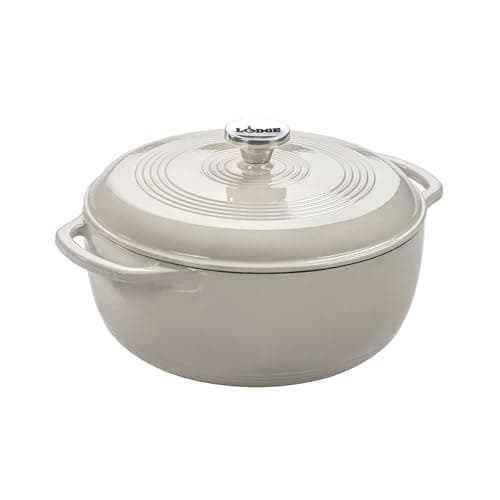
Published specifications for the Lodge Enameled Cast Iron Dutch Oven, 6 qt
Material
Cast iron with porcelain enamel, inside and out
Capacity
6 qt
Induction
Yes - the iron under the enamel is ferrous
Seasoning
None required - enamel is not a seasoning surface
Acid
Safe for tomato and wine, unlike bare iron
Oven maximum
Set by the knob material - check the specific SKU; Lodge publishes a lower ceiling than for bare iron
Good
Non-reactive, so it handles the acidic cooking bare iron cannot
No seasoning to maintain
Considerably cheaper than the French enameled pots it copies
Not good
Chipped enamel is not repairable, unlike bare iron's seasoning
Oven ceiling is lower than bare cast iron because of the knob
Heavy, and the enamel makes it heavier than bare iron of the same capacity
The trade-off. The enamel is a glass layer. Chip it and the pot is not restorable the way bare iron is, and Lodge's enamel chips more readily than the premium brands'.
Skip this if. You already own a large stainless stockpot and rarely braise. This duplicates it for most weeknight cooking.
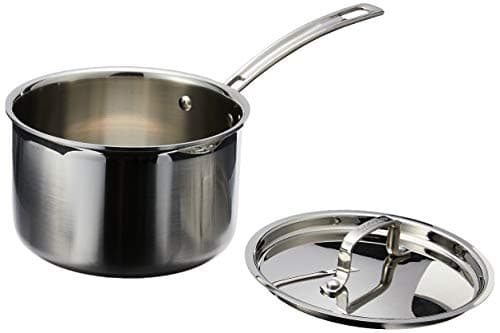
Published specifications for the Cuisinart MultiClad Pro Saucepan, 3 qt
Construction
Tri-ply: 18/10 stainless interior, pure aluminum core, brushed stainless exterior
Capacity
3 qt with lid
Oven maximum
500F per the Cuisinart use-and-care manual; retail listings say 550F
Induction
Yes
Dishwasher
Dishwasher safe
Handle
Riveted solid stainless, cool-grip profile
Warranty
Lifetime
Good
Genuinely dishwasher-safe clad stainless, which the premium brands are not
Fully clad rather than disc-bottom at an open-stock price
Lifetime warranty
Not good
Published oven maximum contradicts the retail listing for the same pan
The handle spine is divisive on larger pieces
No published country of manufacture
The trade-off. The oven ceiling is 500F per Cuisinart's manual, not the 550F some retail listings advertise. That is a documentation problem the buyer inherits.
Skip this if. You want the higher oven ceiling or the published US factory. That is All-Clad, and you pay for it.
Eight quarts for most households. That is driven by pasta rather than stock - a pound of dried pasta wants roughly four quarts of water plus headroom, which rules out anything under six quarts. Go to 10 or 12 quarts for a family of four or more, or if you make stock from carcasses regularly.
›Is an 8 quart stockpot big enough?
For pasta, soup, blanching and chili for a household of two to four, yes - it is the size that covers the most common jobs without becoming awkward to lift or store. It is on the small side for making stock from a whole carcass, where 12 quarts is more comfortable.
›Do you need a stockpot if you have a Dutch oven?
Only for large volumes of boiling water. A 5 to 7 quart Dutch oven covers much of what a small stockpot does and braises far better. The specific gap a stockpot fills is boiling pasta and blanching in quantity, which a Dutch oven is too small and too heavy to do well.
›Does a stockpot need to be fully clad?
No, and this is the one shape where a disc bottom is genuinely fine. Almost everything a stockpot does happens in liquid, and nothing sticks in liquid, so the even heat distribution you pay for in a skillet earns much less here. A thick base matters; full cladding does not.
›What is the difference between a stockpot and a Dutch oven?
A stockpot is tall, relatively thin-walled and built for boiling large volumes. A Dutch oven is squat, heavy and built to store heat for braising and baking. The stockpot boils better and the Dutch oven browns and braises better, and neither substitutes well for the other.
Sources
Every figure on this page came from one of these. Follow them and check our arithmetic — that is the point.