Heads up: some links on this page earn us a commission at no extra cost to you. It does not change what we recommend or the order. How we are funded.
The short answer
Skip egg and omelette pans, grill pans, double boilers, pasta pots, milk pans, square skillets, griddle plates, and almost every single-purpose gadget pan. In nearly every case a 10-inch skillet, a 2 to 3 quart saucepan, a stockpot and a half sheet pan already do the job, and the specialist version buys convenience you will not use often enough to justify the storage. Buy specialists only after you have hit the limitation yourself.
Why this list exists
Cookware is sold by adding pieces. Sets grow, brands extend lines, and every cooking task gets a dedicated vessel. The result is kitchens with fourteen pans where five get used, and a cupboard that is hard to store, hard to search and where coated surfaces get scratched by being stacked - how to store pots and pans.
This is the inverse of what you actually need. That page makes the case for five pieces. This one goes through what people buy instead, and what to reach for in place of each.
The list
1. An egg or omelette pan
A small coated skillet with sloped sides. Genuinely good at eggs - and so is an 8-inch coated skillet, which also does one chop, a grilled sandwich, toasted nuts and a single portion of anything. Buy the 8-inch skillet - best nonstick pans for eggs.
2. A grill pan
The ridges produce stripes, not grilling. Flavor comes from browning, and ridges reduce contact area by roughly half, so you get less browning than a flat pan plus a pan that is genuinely unpleasant to clean. A flat cast iron skillet sears better - grill pan versus griddle.
3. A dedicated double boiler
Two nesting pieces that do one job. A heatproof bowl over a saucepan does the same thing, stores better, and the bowl earns its space elsewhere - best double boilers.
4. A pasta pot with a strainer lid
The lid clogs, it drains slowly, and it rarely seals as promised. A stockpot plus a colander is more reliable, and a pasta insert is better than a strainer lid if lifting a full pot is the problem - pasta pots and steamer inserts.
5. A milk pan
A 1 quart saucepan under another name. Buy a 2 quart and heat milk in that.
6. A square skillet or square griddle
Sold on fitting more bacon. Corners heat unevenly, spatulas do not reach into them, and the shape suits no burner. A round 12-inch pan or a sheet pan in the oven does more bacon, better - best sheet pans.
7. A stovetop griddle plate that spans two burners
They warp, they are awkward to store and wash, and they heat in two hot stripes with a cold middle. A large skillet in two batches is faster than people expect.
8. A wok, if you have an ordinary hob
A wok needs the enormous, wrap-around heat of a wok burner. On a domestic hob it makes a hot ring and cool walls, and a large skillet stir-fries better - wok versus skillet and stir-frying without a wok.
9. A coated saucepan, as your main saucepan
Nothing sticks in liquid, so a coating in a saucepan is a wear surface doing very little work - best nonstick saucepans.
10. A second Dutch oven
One is transformative; two is storage. If you want a different capacity, sell the first - what size Dutch oven.
What replaces what
The specialist
What you already own
What you actually give up
Egg or omelette pan
8 inch coated skillet
Nothing
Grill pan
Cast iron skillet
Stripes
Double boiler
Bowl over a saucepan
Slight stability when whisking hard
Pasta pot with strainer lid
Stockpot and colander
One trip to the sink
Milk pan
2 qt saucepan
Nothing
Square skillet
12 inch round skillet
Nothing - corners are a downgrade
Two-burner griddle
Large skillet, two batches
A few minutes
Wok, on a domestic hob
12 inch skillet
Nothing, without a wok burner
Crepe pan
10 inch coated skillet
A very thin edge on presentation
Roasting pan, if you rarely roast whole birds
Half sheet pan with a rack
Deep drippings for gravy
The specialists that are actually worth it
This is not an argument against specialist cookware in general. Some earn their space immediately, and the test is whether you have already hit the limitation.
A Dutch oven. No general-purpose pan does a covered braise or a loaf of bread - is a Dutch oven worth it.
A half sheet pan, or two. The highest-use piece in most kitchens.
These are the products this page's reasoning actually points at. Same rules as everywhere else on the site: published specs, a stated trade-off, and a live price only where one exists.
Top pick · What replaces most of itSpecs read September 3, 2026
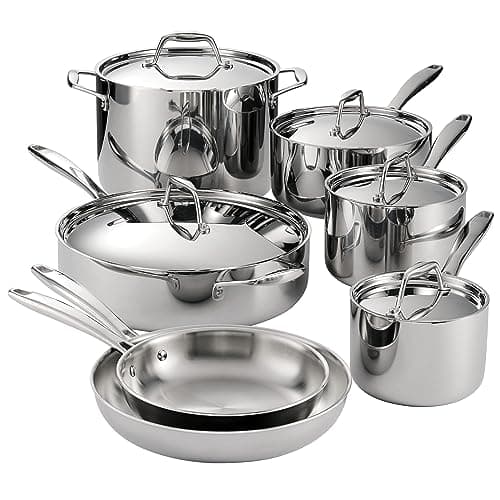
Tramontina Signature Tri-Ply Clad 12-Piece Set
A clad stainless set covers the skillet, saucepan and stockpot jobs that the specialists on this page are versions of.
Best for: A first kitchen that should not need replacing
Published specifications for the Tramontina Signature Tri-Ply Clad 12-Piece Set
Construction
Tri-ply: 18/10 stainless, aluminum core, magnetic stainless exterior
Pieces
8 in and 10 in fry pans; 1.5, 2 and 3 qt covered saucepans; 5 qt covered deep saute; 8 qt covered stockpot
Oven maximum
500F on the 80116-249DS listing; other SKUs in the line are listed at 350F
Induction
Yes - magnetic stainless exterior
Dishwasher
Listed dishwasher safe
Handles
Precision cast, riveted
Certification
NSF-certified on the 80116-249DS line
Country of origin
Not asserted - retail listings disagree across SKUs (Brazil and China both appear)
Good
Fully clad, not disc-bottom: the aluminum runs up the sidewalls, so sauces do not scorch in a ring at the base
NSF certification on the flagship SKU is a real, checkable third-party mark rather than a marketing badge
Induction-ready without paying an induction premium
Not good
Retail listings disagree on the oven maximum across SKUs in the same line, which is a documentation problem, not a cooking one
Handles run hot on gas
The 12-piece count includes lids; the useful-item count is seven
The trade-off. Handles are the weak point. They are riveted and sturdy, but they get hot on a gas ring in a way the more expensive clad brands' do not.
Skip this if. You want a set you can leave in the oven above 500F, or you cook mostly eggs and pancakes and would rather spend the money on one good nonstick pan.
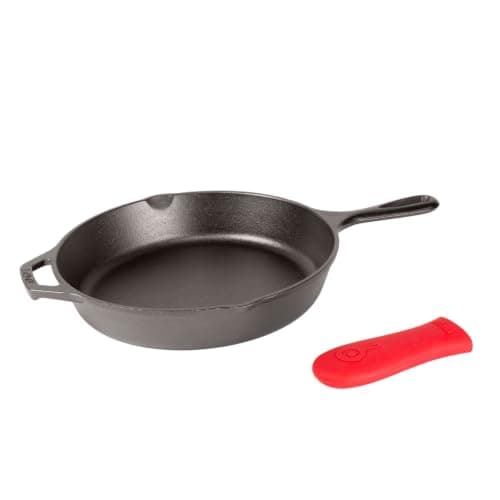
Published specifications for the Lodge Seasoned Cast Iron Skillet, 10.25 in (L8SK3)
Diameter
10.25 in
Weight
5.66 lb
Oven maximum
550F
Induction
Yes - bare iron is ferrous
Seasoning
Pre-seasoned with soy-based vegetable oil, no synthetic chemicals
Warranty
Lifetime
Made in
USA
Care
Hand wash. Lodge's own instructions permit warm soapy water
Good
Effectively unbreakable and fully restorable - a rusted one can be stripped and re-seasoned
Holds heat better than anything else at the price, which is what a sear needs
Lodge publishes its seasoning method openly, so the maintenance is not a mystery
Not good
Heavy
Heats unevenly on a small burner: cast iron conducts at roughly 50 W/m-K, so it is slow to spread and slow to react
Bare iron is reactive; long tomato braises will taste of it
The trade-off. It weighs 5.66 lb empty. You will feel that every time you move it full, and it is the single most common reason a cast iron skillet ends up in a cupboard.
Skip this if. You have wrist or shoulder trouble, or you cook mostly acidic braises. Carbon steel does most of the same jobs at roughly half the weight.
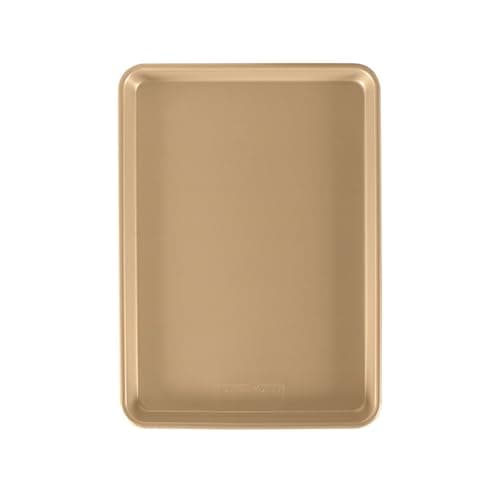
Published specifications for the Nordic Ware Naturals Half Sheet, 18 x 13 in
Exterior dimensions
17.9 x 12.9 x 1 in
Material
Aluminum
Rim
Encapsulated steel rim
Gauge
Not published by Nordic Ware
Warranty
Lifetime
Dishwasher
Hand wash recommended. Automatic dishwasher use is not advised
Made in
America of domestic and imported materials
Good
Aluminum conducts at 237 W/m-K, which is why it browns evenly and a steel pan does not
The encapsulated steel rim is the reason it does not warp in a hot oven
Lifetime warranty on a pan this cheap
Not good
Nordic Ware does not publish a gauge figure, so thickness cannot be compared like for like
Bare aluminum stains and reacts with acid
Not dishwasher safe by the maker's own advice
The trade-off. Bare aluminum discolors and reacts with acid. It will look used within a month and Nordic Ware advises against the dishwasher.
Skip this if. You want a pan that stays looking new, or you will not hand wash. Buy an aluminized-steel coated pan instead and accept the coating as a wear item.
Egg and omelette pans, grill pans, dedicated double boilers, pasta pots with strainer lids, milk pans, square skillets, two-burner griddle plates, and a wok if you do not have a wok burner. In each case a general-purpose skillet, saucepan, stockpot or sheet pan already does the job.
›Is a grill pan worth buying?
Rarely. The ridges create stripes rather than grilling, and they cut contact with the food by roughly half, so you get less browning than a flat pan plus a pan that is genuinely difficult to clean. A flat cast iron skillet sears better.
›Do I need a pasta pot?
No. A stockpot and a colander drain faster and more reliably than a pot with a strainer lid, which tends to clog and rarely seals as advertised. If lifting a full pot is the difficulty, a pasta insert solves that better than a strainer lid does.
›How many pots and pans does one kitchen need?
Five pieces cover the great majority of home cooking: a 10 inch skillet, a 2 to 3 quart saucepan with a lid, a stockpot, one cheap coated pan for eggs, and a half sheet pan. Everything beyond that should answer a limitation you have actually run into.
›Which specialist pans are actually worth it?
A Dutch oven, because nothing general-purpose does a covered braise or bakes bread as well; a second sheet pan; a saucier if you make custards or risotto often; a stockpot larger than you think you need; and a wok only if you have a wok burner or outdoor ring.
Sources
Every figure on this page came from one of these. Follow them and check our arithmetic — that is the point.